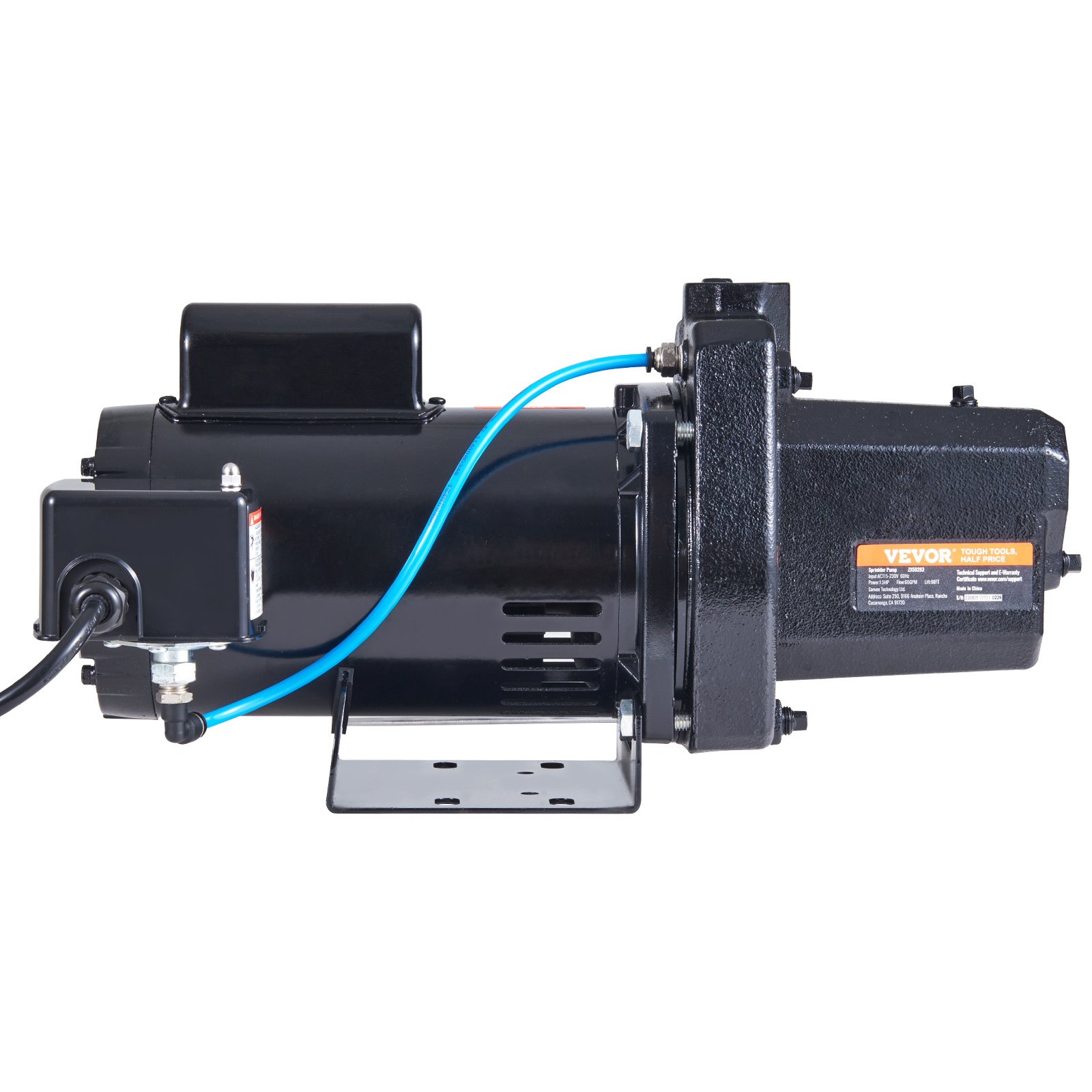

Photos from current listings. Actual item, color, and included accessories may vary.
Sprinkler Pump Buying Guide
A sprinkler pump only pays off when its GPM, pressure head, and suction type actually match your water source and zone count. Most buyers oversize horsepower while ignoring shallow-well vs. convertible jet architecture, then fight cycling, poor coverage, or burned motors. Sizing starts with your worst-case lift height, total sprinkler flow demand, and whether the source is a lake, cistern, or driven well point.
Key takeaways
- Shallow-well jet pumps handle suction lifts up to about 25 ft; deeper lifts demand a convertible jet with a venturi ejector or a submersible pump instead.
- A 1.5 HP, 3450 RPM cast-iron jet pump typically delivers around 60-70 GPM at low head but drops sharply past 40-50 PSI, so zone flow matters more than tank size.
- Dual-voltage 115/230 V motors ship wired for one voltage; switching to 230 V requires rewiring the motor leads and a matching double-pole breaker.
At a glance
- Category
- Watering & Irrigation
- Last updated
- Nov 28, 2026
Current offers
Highlights
- Shallow-well jet pumps handle suction lifts up to about 25 ft; deeper lifts demand a convertible jet with a venturi ejector or a submersible pump instead.
- A 1.5 HP, 3450 RPM cast-iron jet pump typically delivers around 60-70 GPM at low head but drops sharply past 40-50 PSI, so zone flow matters more than tank size.
- Dual-voltage 115/230 V motors ship wired for one voltage; switching to 230 V requires rewiring the motor leads and a matching double-pole breaker.
- Cast-iron volute and impeller bodies resist abrasion and heat better than thermoplastic heads, but they still need a strainer to keep sand and debris out of the jet.
Best use cases
- Best fit: lake or pond irrigation feeding 4-8 rotor zones through a 1 in. outlet, provided vertical lift stays under 25 ft and total flow stays below the pump curve's mid-range.
- Best fit: boosting pressure from a buried cistern or holding tank where a 1-1/4 in. suction line can be kept short, level, and fully primed.
- Wrong fit: pulling from a deep drilled well past 25 ft suction lift — choose a submersible well pump or deep-well jet instead.
- Wrong fit: running many micro-drip or low-flow zones where a high-GPM jet pump short-cycles; a smaller booster or pressure-tank setup suits better.
Buying tips
- Check total dynamic head first: add vertical lift, friction loss in suction and discharge pipe, and target sprinkler pressure before comparing horsepower ratings.
- Prioritize a pump whose published curve hits your required GPM at your required PSI, not one that only lists a free-flow maximum.
- Avoid necking down the suction line; a 1-1/4 in. inlet needs at least that diameter for the full run to prevent cavitation.
- Choose cast iron over thermoplastic for continuous duty and sandy water, and add a suction strainer plus a check valve on every install.
Specs
| Pump Type | Shallow-well jet vs convertible jet |
|---|---|
| Max Suction Lift | ≤25 ft shallow / deep-well ejector |
| Motor Voltage | 115/230 V dual-voltage, 3450 RPM |
| Port Sizing | 1 in. discharge / 1-1/4 in. suction NPT |
What to check before buying
- Measure vertical lift from water surface to pump inlet at the lowest water level, not just the typical level.
- Confirm the suction line can be run short and uphill-free; long horizontal suction runs demand a larger pipe diameter.
- Verify your electrical service: 115 V needs a dedicated 20 A circuit, while 230 V needs a double-pole breaker and correct motor lead wiring.
- Size the pressure tank and check valve to the pump's flow so the motor cycles no more than a few times per irrigation cycle.
FAQ
Data sources: eBay / Amazon listings and product attribute feeds. Updated Nov 28, 2026.
Some links on this page are affiliate links. If you buy after clicking one, we may earn a commission at no extra cost to you. This does not change which products appear here or their order. Affiliate disclosure.