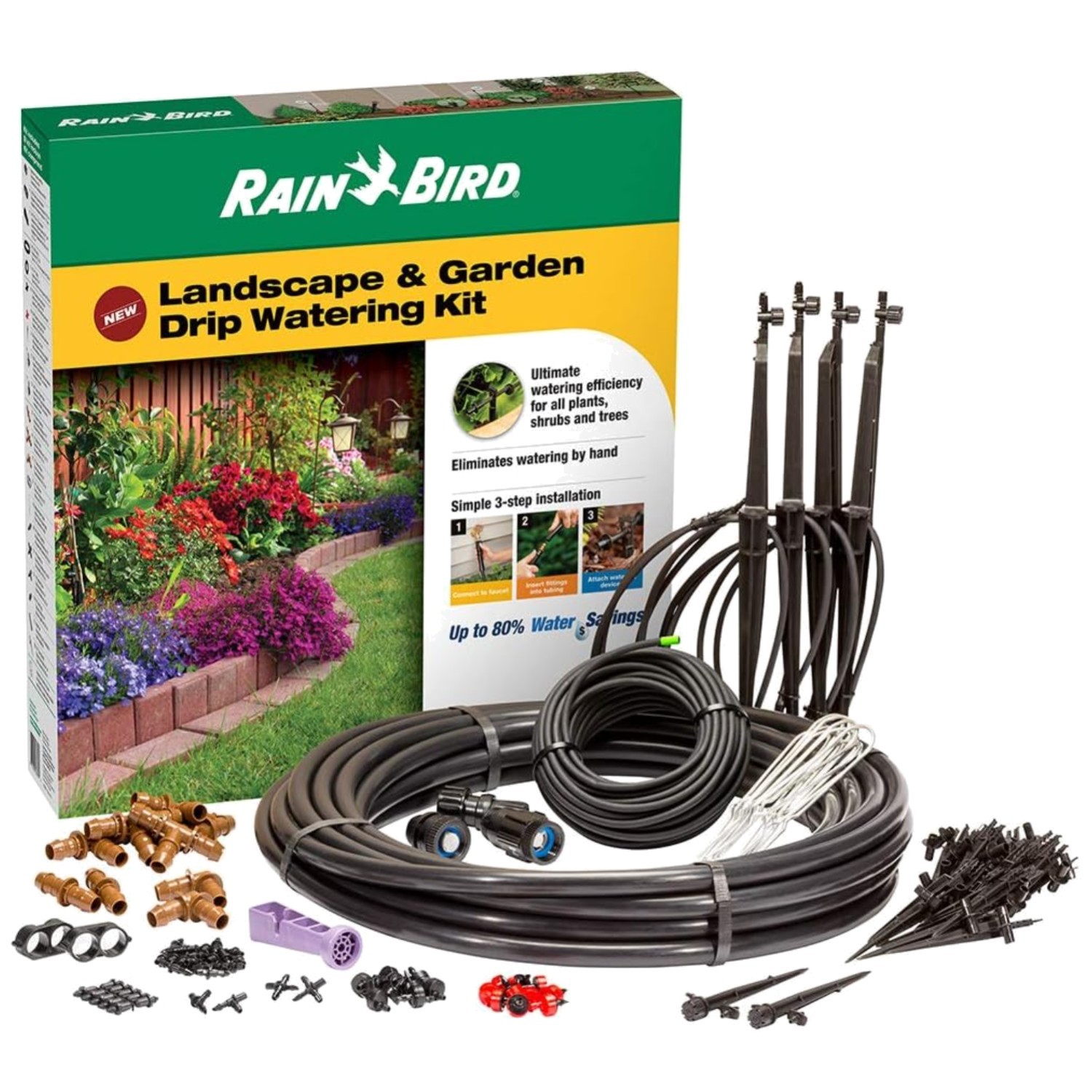

Photos from current listings. Actual item, color, and included accessories may vary.
Rainbird Drip Irrigation Buying Guide
Rain Bird drip irrigation is a modular 1/4-inch and 1/2-inch tubing system built around pressure-compensating or turbulent-flow emitters, and the core trade-off is emitter uniformity versus cost: pressure-compensating (PC) emitters hold flow rate across long runs and elevation changes, while non-PC turbulent emitters rely on short, level runs. The decision rule: buy PC emitters and a pressure regulator whenever your lateral exceeds roughly 30 feet or climbs more than a few feet; use basic non-PC kits only for small, level beds fed from a single faucet.
Key takeaways
- Pressure-compensating emitters regulate to a fixed flow (commonly 0.5, 1, or 2 GPH) across roughly 10-50 PSI, so long runs and slopes stay uniform.
- Non-PC turbulent emitters are cheaper but flow varies with pressure; keep laterals under about 30 feet and level for acceptable uniformity.
- Rain Bird 1/4-inch distribution tubing feeds individual plants; 1/2-inch blank tubing is the mainline that carries water from the faucet or valve.
At a glance
- Category
- Watering & Irrigation
- Last updated
- Nov 28, 2026
Current offers
Highlights
- Pressure-compensating emitters regulate to a fixed flow (commonly 0.5, 1, or 2 GPH) across roughly 10-50 PSI, so long runs and slopes stay uniform.
- Non-PC turbulent emitters are cheaper but flow varies with pressure; keep laterals under about 30 feet and level for acceptable uniformity.
- Rain Bird 1/4-inch distribution tubing feeds individual plants; 1/2-inch blank tubing is the mainline that carries water from the faucet or valve.
- A 25-PSI pressure regulator is required on most faucet-fed drip systems; without it, emitters pop off and tubing joints leak.
Best use cases
- Best fit: garden beds and containers within 30 feet of a faucet — a 1/4-inch kit with 0.5-1 GPH PC emitters and a 25-PSI regulator gives even watering with minimal parts.
- Best fit: long rows or sloped yards — specify 1/2-inch mainline plus 1/4-inch laterals and pressure-compensating emitters; non-PC emitters will starve the far end.
- Wrong fit: burying 1/4-inch tubing directly in soil without stakes or mulch — it kinks and shifts; use 1/2-inch buried mainline and stake 1/4-inch lines.
- Wrong fit: connecting drip directly to a hose bib without a regulator and filter — debris clogs emitters and full house pressure blows fittings; add both.
Buying tips
- Size the kit by emitter count, not piece count: one 0.5-1 GPH emitter per container or per 12-18 inches of row is the working rule.
- Match tubing diameter to role: 1/2-inch for mainline runs over 10 feet, 1/4-inch only for final runs to individual plants.
- Choose pressure-compensating emitters for runs over 30 feet or elevation changes over 3 feet; non-PC only for short, level beds.
- Barbed fittings match tubing OD: 1/4-inch fittings fit 1/4-inch tubing, 1/2-inch fittings fit 1/2-inch tubing — do not mix without adapters.
Specs
| Emitter Type | Pressure-compensating vs turbulent non-PC |
|---|---|
| Tubing Sizes | 1/2 in mainline / 1/4 in lateral |
| Operating Pressure | 10-50 PSI; 25 PSI regulator typical |
| Emitter Flow Rates | 0.5 / 1 / 2 GPH |
Related searches
What to check before buying
- Measure the longest run from faucet to farthest plant; over 30 feet or any slope means PC emitters and 1/2-inch mainline.
- Confirm your faucet thread (3/4-inch hose thread in the US) and add a backflow preventer plus 25-PSI regulator at the connection.
- Count plants and row length to calculate emitter quantity: roughly one emitter per container or per 12-18 inches of row.
- Check water pressure at the faucet; above 50 PSI requires a regulator, and hard water benefits from an inline filter to prevent clogging.
FAQ
Data sources: eBay / Amazon listings and product attribute feeds. Updated Nov 28, 2026.
Some links on this page are affiliate links. If you buy after clicking one, we may earn a commission at no extra cost to you. This does not change which products appear here or their order. Affiliate disclosure.