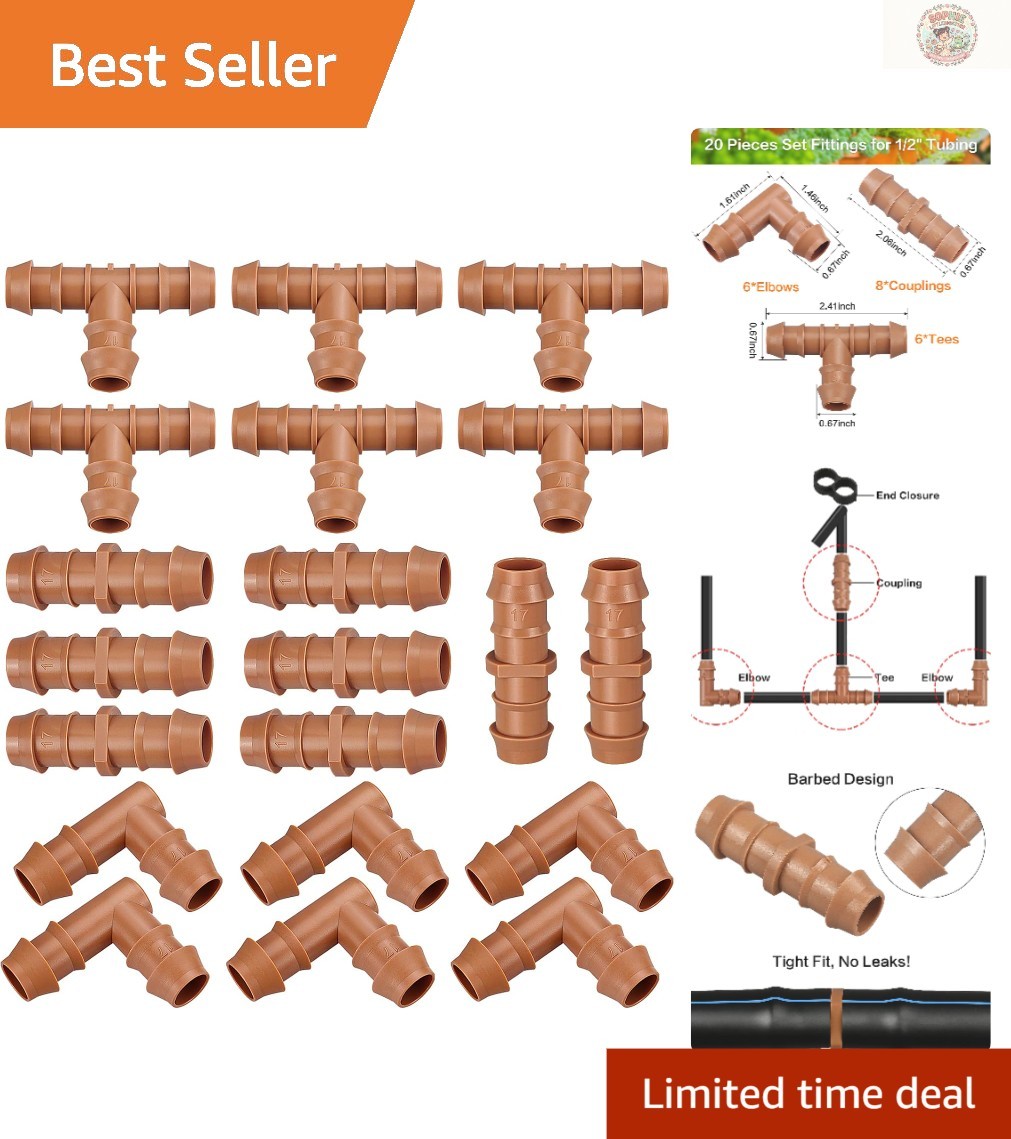

Photos from current listings. Actual item, color, and included accessories may vary.
Drip Lock Buying Guide
Drip lock fittings secure 1/4-inch and 1/2-inch drip irrigation tubing with barbed or compression connections, so matching the fitting style and tubing hardness to your system is what prevents blowouts and leaks. Buyers often ruin a run by mixing threadless barbed tees with rigid poly tubing or by forcing a 1/2-inch lock ring onto 1/4-inch line. Confirm tube outer diameter, wall thickness, and whether your system uses barbed inserts, compression rings, or push-to-connect locks before you buy a bag of connectors.
Key takeaways
- Barbed drip-lock connectors rely on friction and tube elasticity; they work best on flexible vinyl or polyethylene tubing with a wall thickness of 0.020–0.060 inch.
- Compression lock fittings use a threaded collar and internal ferrule to clamp the tube—choose these for rigid 1/2-inch poly mainline where barbed fittings would weep.
- Standard drip tubing sizes are 1/4-inch (0.170–0.250 inch OD) and 1/2-inch (0.600–0.710 inch OD); fittings are sized by OD, not by nominal inside diameter.
At a glance
- Category
- Watering & Irrigation
- Last updated
- Nov 28, 2026
Current offers
Highlights
- Barbed drip-lock connectors rely on friction and tube elasticity; they work best on flexible vinyl or polyethylene tubing with a wall thickness of 0.020–0.060 inch.
- Compression lock fittings use a threaded collar and internal ferrule to clamp the tube—choose these for rigid 1/2-inch poly mainline where barbed fittings would weep.
- Standard drip tubing sizes are 1/4-inch (0.170–0.250 inch OD) and 1/2-inch (0.600–0.710 inch OD); fittings are sized by OD, not by nominal inside diameter.
- UV-stabilized polypropylene and nylon bodies resist sunlight and calcium scale better than cheap acetal or PVC fittings, which become brittle after one or two seasons outdoors.
Best use cases
- Best fit: raised beds or container pots fed by a 1/4-inch micro-tubing run—use barbed drip-lock tees and elbows in UV-stabilized nylon, and skip compression rings entirely.
- Best fit: buried or long 1/2-inch mainline runs from a hose bib to garden zones—choose compression lock fittings with threaded collars so joints stay serviceable and leak-free under constant pressure.
- Wrong fit: connecting 1/4-inch drip line directly to a 1/2-inch main without a reducing tee or adapter—the barb will not seal, and the joint will blow off at full water pressure. Use a 1/2-inch x 1/4-inch reducing tee instead.
Buying tips
- Measure tube outer diameter with calipers before ordering: 1/4-inch fittings accept roughly 0.170–0.250 inch OD, while 1/2-inch fittings accept 0.600–0.710 inch OD, and no lock ring bridges the gap.
- Prioritize UV-stabilized nylon or polypropylene bodies for any fitting left above ground; acetal and cheap PVC become brittle and crack after one or two seasons of sun exposure.
- Choose compression lock fittings over barbed inserts whenever your mainline runs above 30 PSI or uses rigid 1/2-inch poly—barbed joints can weep or blow off under sustained pressure.
- Avoid mixing fitting brands on the same run: barb diameters and lock-ring threads vary by a few thousandths of an inch, and cross-brand joints are the most common source of drip leaks.
Specs
| Fitting Style | Barbed vs Compression Lock |
|---|---|
| Tube Size (OD) | 1/4 in (0.170–0.250) / 1/2 in (0.600–0.710) |
| Body Material | UV Nylon / PP vs Acetal / PVC |
| Pressure Rating | Barbed <30 PSI / Compression 30–60 PSI |
Related searches
What to check before buying
- Confirm your tubing's exact outer diameter and wall thickness—use calipers, not the nominal 1/4-inch or 1/2-inch label on the box.
- Check your system pressure at the hose bib or regulator: barbed drip-lock fittings are rated for low-pressure micro-irrigation, typically under 30 PSI.
- Verify whether your existing fittings are barbed, compression-ring, or push-to-connect—lock rings and collars are not interchangeable between styles.
- Plan for a pressure regulator and filter upstream of any drip-lock fitting, since debris and water hammer are the top causes of joint failure.
FAQ
Data sources: eBay / Amazon listings and product attribute feeds. Updated Nov 28, 2026.
Some links on this page are affiliate links. If you buy after clicking one, we may earn a commission at no extra cost to you. This does not change which products appear here or their order. Affiliate disclosure.