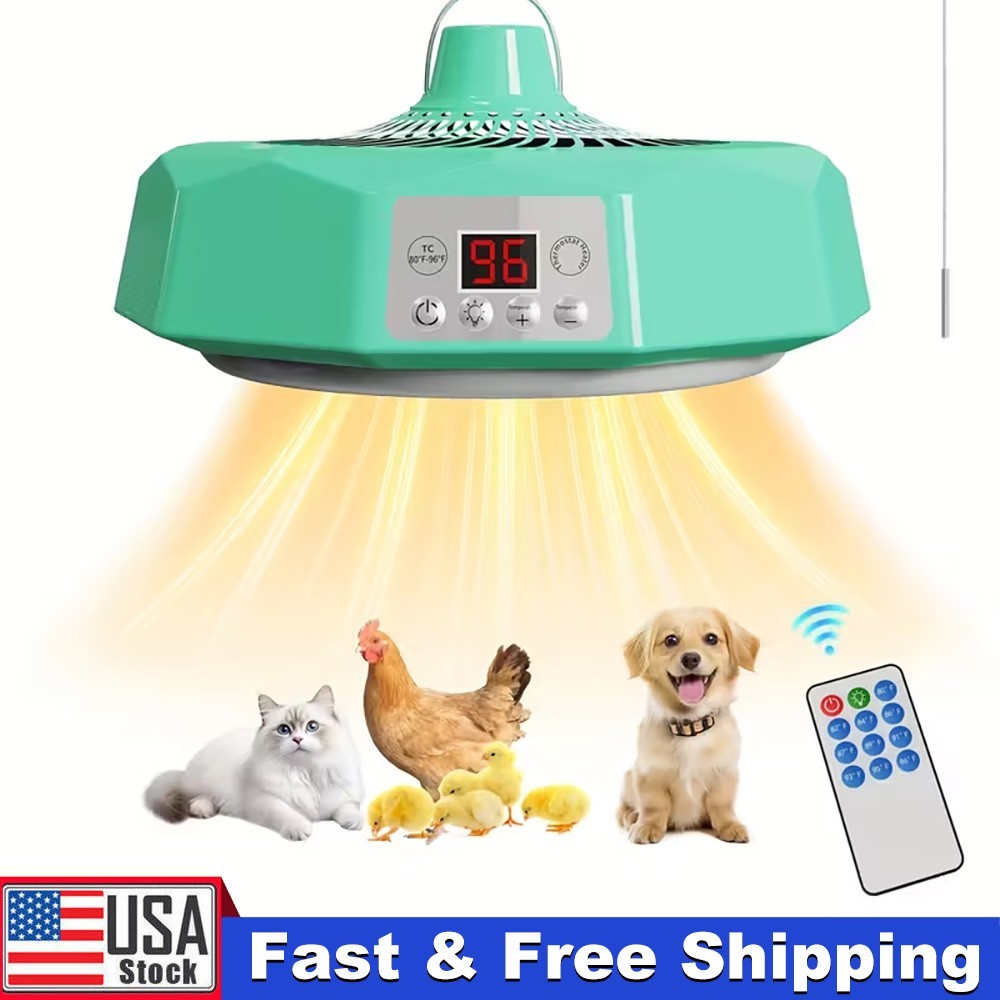

Photos from current listings. Actual item, color, and included accessories may vary.
Chicken Coop Heater Buying Guide
A chicken coop heater is a winter-life-support appliance that must raise ambient temperature without fire risk in a dusty, unheated outbuilding. The core trade-off is radiant spot heat (lamps, plates) versus convection area heat (panel/fan heaters), and the decision rule is simple: buy only heaters with a listed wattage, a thermostat or thermal cutoff, and a metal or sealed-element housing rated for outbuildings; skip bare-bulb kits and unlisted wattage imports.
Key takeaways
- Radiant heat lamps concentrate 150-250W into a small spot and require a ceramic socket plus a wire guard; they warm birds, not the coop air.
- Flat panel heaters typically run 150-400W, mount vertically, and heat by direct contact/radiation, so they must be placed within inches of perches to matter.
- Thermostatically controlled units cycle on below roughly 35-40°F and cut off above it, which prevents overheating and wasted power in small coops.
At a glance
- Category
- Chicken Brooders & Heat
- Last updated
- Nov 24, 2026
Current offers
Highlights
- Radiant heat lamps concentrate 150-250W into a small spot and require a ceramic socket plus a wire guard; they warm birds, not the coop air.
- Flat panel heaters typically run 150-400W, mount vertically, and heat by direct contact/radiation, so they must be placed within inches of perches to matter.
- Thermostatically controlled units cycle on below roughly 35-40°F and cut off above it, which prevents overheating and wasted power in small coops.
- Ceramic heat emitters (CHE) screw into standard E26/27 porcelain fixtures and produce no light, avoiding the 24-hour light stress of white/red bulbs.
Best use cases
- Best fit: a small 4x6 ft coop with 4-6 hens in a 20-35°F climate — pick a 200W thermostatic panel or a 150W ceramic emitter with guard, mounted 12-18 in above the roost.
- Best fit: a brooder box for chicks — use a 10x10 in radiant brooder plate at 1-3 in height, raising it weekly, rather than a heat lamp that cannot be dimmed safely.
- Wrong fit: uninsulated large coops or open runs below 10°F — a single 200W panel cannot hold air temperature; insulate and reduce cubic feet first or use multiple units.
- Skip: bare clamp lamps with no guard, no thermostat, and plastic sockets — they are the leading cause of coop fires and cracked sockets in damp air.
Buying tips
- Size wattage to coop volume: roughly 5-10W per cubic foot of coop for a 30-40°F lift; a 4x4x6 ft coop (96 cu ft) needs about 500-900W total, or targeted radiant heat instead.
- Demand a listed thermostat range or thermal cutoff; a heater without an automatic cutoff can cook hens when daytime temps rise above 40°F.
- Match the fixture: ceramic heat emitters need porcelain/ceramic E26/E27 sockets rated for the wattage; standard plastic lamp sockets deform above 100W.
- For cords and plugs, choose a grounded 3-prong plug and a cord long enough to reach an outdoor GFCI receptacle; never daisy-chain extension cords into a coop.
Specs
| Heater Type | Radiant panel / lamp / ceramic emitter |
|---|---|
| Wattage Range | 150-400W typical; 500W+ for large coops |
| Thermostat Control | Adjustable 35-95°F / thermal cutoff |
| Housing & Safety | Metal guard / IP44 sealed / 3-prong plug |
Related searches
What to check before buying
- Measure coop interior length x width x height to get cubic feet — wattage and heater count follow from this number, not from chicken count alone.
- Confirm the roost height and wall space: panels need 12-24 in of clear vertical mounting within 18 in of where birds sleep.
- Check your outlet: a GFCI-protected outdoor receptacle within cord reach; if absent, budget for an outdoor-rated extension and GFCI adapter.
- Verify the heater's ingress rating and housing — metal or sealed polycarbonate, at least IP44 for damp coops; open-element designs are not suitable.
FAQ
Data sources: eBay / Amazon listings and product attribute feeds. Updated Nov 24, 2026.
Some links on this page are affiliate links. If you buy after clicking one, we may earn a commission at no extra cost to you. This does not change which products appear here or their order. Affiliate disclosure.