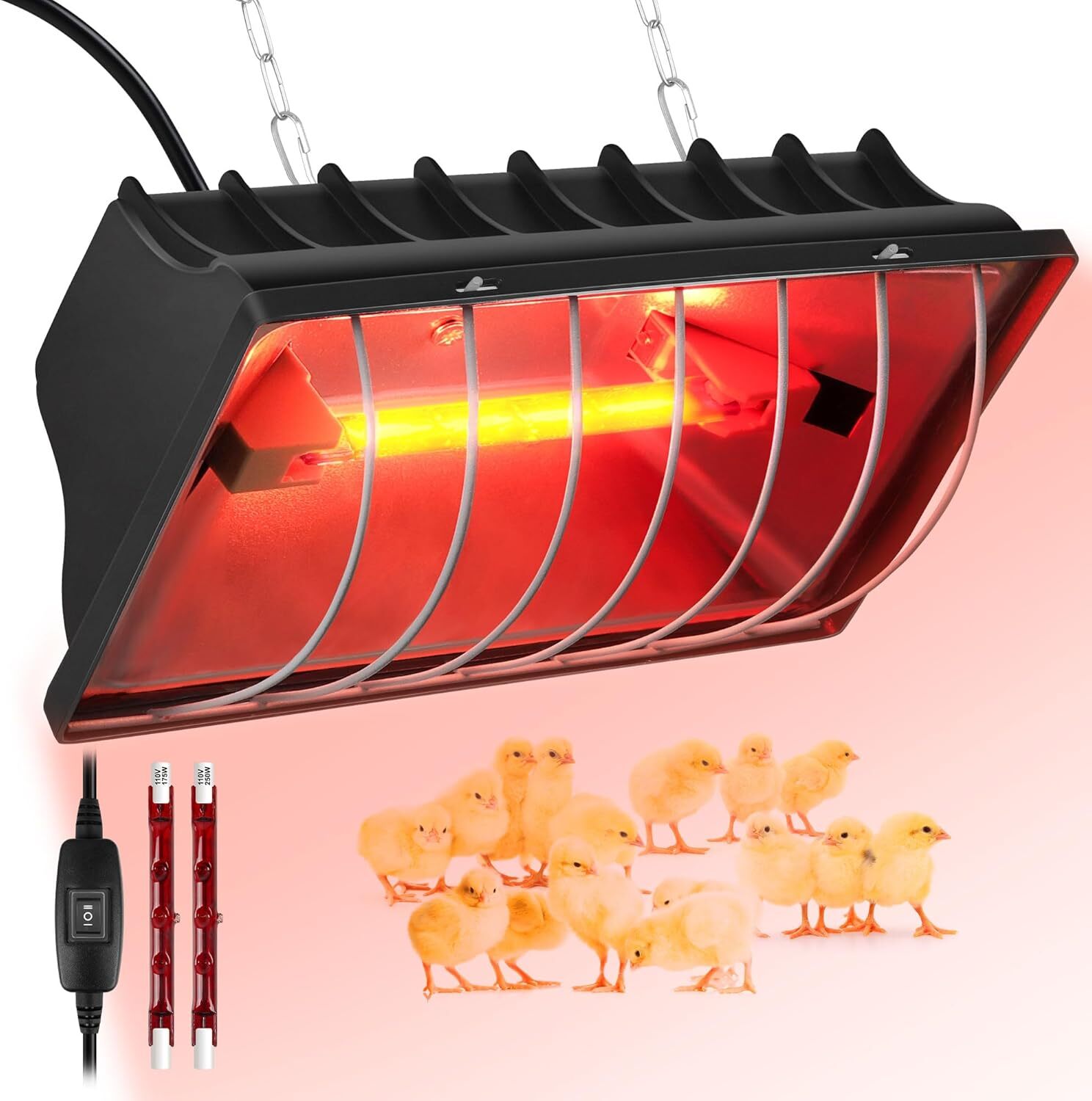

Photos from current listings. Actual item, color, and included accessories may vary.
Chick Heat Lamp Buying Guide
A chick heat lamp is a radiant brooder fixture that supplies focused warmth for young poultry without heating the entire coop. The core trade-off is between a high-wattage incandescent bulb that delivers intense spot heat but risks fire and burns, versus a ceramic heat emitter or low-wattage radiant panel that provides safer, more even warmth at higher upfront cost. Choose a ceramic emitter or panel with a ceramic socket and thermostat control for durable, fire-resistant brooding; skip bare 250W incandescent bulbs in unguarded plastic fixtures.
Key takeaways
- Incandescent 250W bulbs produce intense spot heat but reach surface temperatures above 400°F and shatter on contact with water or chicks.
- Ceramic heat emitters (CHE) emit infrared heat without light, screw into standard E26/E27 sockets, and are rated 60W–250W with 10,000+ hour lifespans.
- Radiant heat panels operate at 50W–200W, stay touch-safe below 150°F, and distribute warmth evenly across a 12–24 inch footprint.
At a glance
- Category
- Chicken Brooders & Heat
- Last updated
- Nov 24, 2026
Current offers
Highlights
- Incandescent 250W bulbs produce intense spot heat but reach surface temperatures above 400°F and shatter on contact with water or chicks.
- Ceramic heat emitters (CHE) emit infrared heat without light, screw into standard E26/E27 sockets, and are rated 60W–250W with 10,000+ hour lifespans.
- Radiant heat panels operate at 50W–200W, stay touch-safe below 150°F, and distribute warmth evenly across a 12–24 inch footprint.
- A ceramic or porcelain socket rated for 660W/250V is mandatory for any bulb above 150W; plastic sockets deform and arc under sustained brooder loads.
Best use cases
- Best fit: A 250W ceramic heat emitter in a ceramic socket with a dimmer or thermostat for a 3×4 ft brooder in an unheated garage—skip bare incandescent bulbs that burn out and shatter.
- Best fit: A 100W–150W radiant heat panel clamped to a brooder wall for 10–15 chicks in a climate-controlled room—skip 250W bulbs that overheat small enclosures.
- Wrong fit: Using a 250W bulb in a plastic clamp lamp without a wire guard—this is a fire hazard and not a valid brooder configuration; choose a ceramic socket with a metal cage guard instead.
Buying tips
- Match wattage to brooder volume: 250W covers roughly 4×4 ft in a cold space; 100W–150W suits 2×3 ft in a warm room; dimmers let one fixture span both.
- Demand a ceramic E26/E27 socket rated 250V/660W and a metal wire guard—plastic sockets and unguarded bulbs are the leading cause of brooder fires.
- Choose a ceramic heat emitter over a red incandescent bulb when you need 24-hour heat without disrupting chick sleep cycles or risking bulb shatter.
- Hang the fixture 18–24 inches above the brooder floor and adjust height or use a dimmer to hit 95°F in week one, dropping 5°F weekly.
Specs
| Heat Source Type | Incandescent / Ceramic emitter / Panel |
|---|---|
| Wattage Range | 100W–250W (dimmable) |
| Socket Grade | Ceramic E26/E27, 660W/250V |
| Safety Guard | Metal wire cage required |
Related searches
What to check before buying
- Measure your brooder floor area and ceiling height—a 250W bulb needs at least 18 inches of clearance and a 4×4 ft footprint to avoid overheating chicks.
- Confirm your outlet voltage and plug type (120V NEMA 1-15 or 5-15 for North America) and that the cord reaches from the fixture to a GFCI-protected outlet.
- Check that your brooder has a wire-mesh or hardwire guard and a non-combustible mounting point—clamp lamps alone are not secure for high-wattage bulbs.
- Verify you have a thermometer at chick level and a spare bulb or emitter, since a failed heat source can chill a brood within hours.
FAQ
Data sources: eBay / Amazon listings and product attribute feeds. Updated Nov 24, 2026.
Some links on this page are affiliate links. If you buy after clicking one, we may earn a commission at no extra cost to you. This does not change which products appear here or their order. Affiliate disclosure.