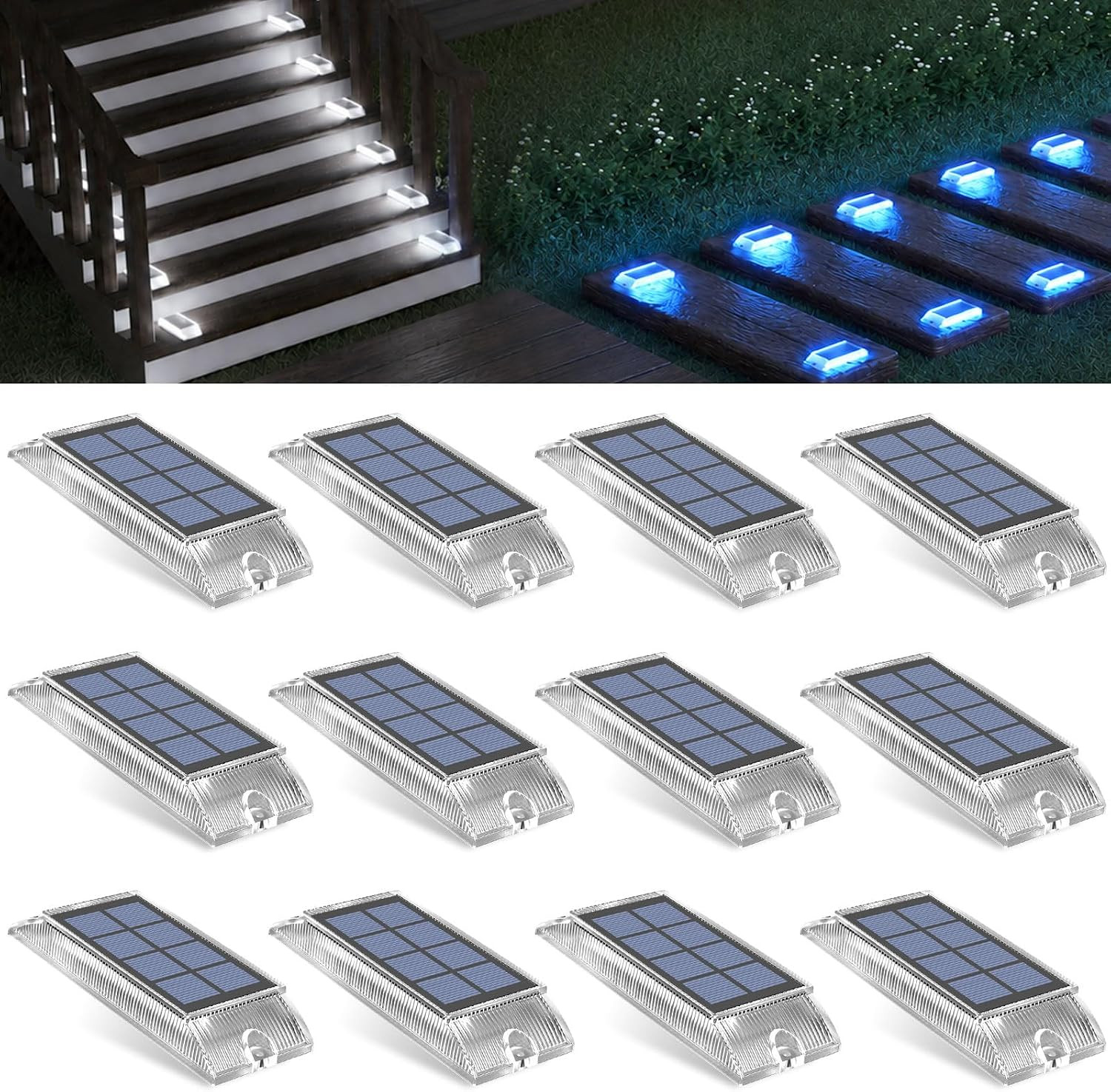

Photos from current listings. Actual item, color, and included accessories may vary.
Outdoor Walkway Light Buying Guide
Outdoor walkway lights are low-level fixtures—path stakes, bollards, step lights, and decorative string/pole units—that mark routes and add accent lighting after dark. The core trade-off is between integrated solar (zero wiring, but at the mercy of panel efficiency, battery chemistry, and winter sun) and low-voltage wired (reliable output, but requires a transformer and cable runs). The decision rule: choose solar only for unobstructed, sun-facing placements with removable/replaceable LiFePO4 or NiMH cells; choose wired for shaded paths or year-round consistent brightness.
Key takeaways
- Solar path lights split into two architectures: integrated panel-on-fixture (cheap, but panel angle fixed and often undersized) vs. separate panel with 3–5 ft cable (allows optimal sun placement); the latter is the only reliable choice for shaded walkways.
- Battery chemistry determines winter survival: LiFePO4 cells tolerate -4°F to 140°F and 2000+ cycles, while sealed NiMH loses 30–50% capacity below freezing; replaceable AAA/AA cells beat sealed integrated packs for longevity.
- IP ratings matter more than lumens on walkway fixtures: IP65 (dust-tight, water-jet resistant) is the minimum for year-round exposure; IP44 (splash-resistant) is only safe under eaves or in covered porches.
At a glance
- Category
- Outdoor Lighting & Decor
- Last updated
- Nov 28, 2026
Current offers
Highlights
- Solar path lights split into two architectures: integrated panel-on-fixture (cheap, but panel angle fixed and often undersized) vs. separate panel with 3–5 ft cable (allows optimal sun placement); the latter is the only reliable choice for shaded walkways.
- Battery chemistry determines winter survival: LiFePO4 cells tolerate -4°F to 140°F and 2000+ cycles, while sealed NiMH loses 30–50% capacity below freezing; replaceable AAA/AA cells beat sealed integrated packs for longevity.
- IP ratings matter more than lumens on walkway fixtures: IP65 (dust-tight, water-jet resistant) is the minimum for year-round exposure; IP44 (splash-resistant) is only safe under eaves or in covered porches.
- Housing material separates durable from disposable: die-cast aluminum or stainless-steel bodies with polycarbonate lenses resist UV yellowing and impact; thin ABS plastic cracks at stake threads within 1–2 seasons.
Best use cases
- Best fit for a dark, shaded front path: low-voltage wired bollards or step lights on a 12V/15V transformer—skip solar entirely, because even separate-panel units need 4+ hours of direct sun to charge.
- Best fit for a sunny suburban walkway with no outlet nearby: separate-panel solar path stakes with replaceable LiFePO4 AA cells and IP65 rating; skip integrated all-in-one plastic stakes, which fail at the first freeze.
- Best fit for seasonal holiday marking (Christmas walkway lights): color-changing or warm-white solar stake sets with 8 lighting modes and candy-cane or fireworks form factors—pack these away after the season rather than expecting year-round durability.
- Wrong fit for any walkway: decorative watering-can or lantern-style accent pieces marketed as 'pathway' lights—these are tabletop/ambient decor with small panels and low lumens, not route-marking fixtures.
Buying tips
- Size spacing from beam spread, not fixture count: path lights with 120° spread and 8–12 in. head height need 4–6 ft spacing; bollards with 360° output need 6–8 ft; step lights need one per 3–4 treads.
- Match panel wattage to battery capacity: a 1.5W panel paired with a 600mAh cell gives roughly 6–8 hours of run time; below 1W panel with 300mAh cells, expect 3–4 hours and dimming by midnight.
- For wired systems, stay under 80% of transformer capacity (e.g., 12V 100W transformer for ≤80W of LED load) and use 12/2 or 14/2 direct-burial cable; voltage drop over 100 ft requires 10/2.
- Verify replaceable batteries: any sealed integrated solar fixture is a disposable product—choose units that open with screws and accept standard AA/AAA NiMH or LiFePO4 cells for multi-season service.
Specs
| Power Source | Solar integrated / solar separate panel / 12V wired |
|---|---|
| Battery Chemistry | LiFePO4 / NiMH / sealed (non-replaceable) |
| Ingress Protection | IP44 splash / IP65 jet-resistant |
| Housing Material | Die-cast aluminum / stainless / ABS plastic |
Related searches
What to check before buying
- Measure path width and stake offset: fixtures should sit 12–18 in. from the walk edge and be spaced per beam spread; narrow paths (under 3 ft) suit single-sided staking, wide paths need both sides.
- Check sun exposure before committing to solar: the chosen spot needs 5–6 hours of direct sun; if shaded by eaves, trees, or a north-facing wall, plan for separate-panel units or low-voltage wired fixtures.
- Confirm mounting substrate: stake fixtures need soft soil or mulch (not packed gravel or rock); step lights need flat tread or riser surfaces; post lights need a concrete base or existing post anchor.
- For wired systems, verify transformer location and outdoor GFCI outlet within cable reach; low-voltage cable runs should not exceed 100 ft per 12/2 run without upsizing wire.
FAQ
Data sources: eBay / Amazon listings and product attribute feeds. Updated Nov 28, 2026.
Some links on this page are affiliate links. If you buy after clicking one, we may earn a commission at no extra cost to you. This does not change which products appear here or their order. Affiliate disclosure.