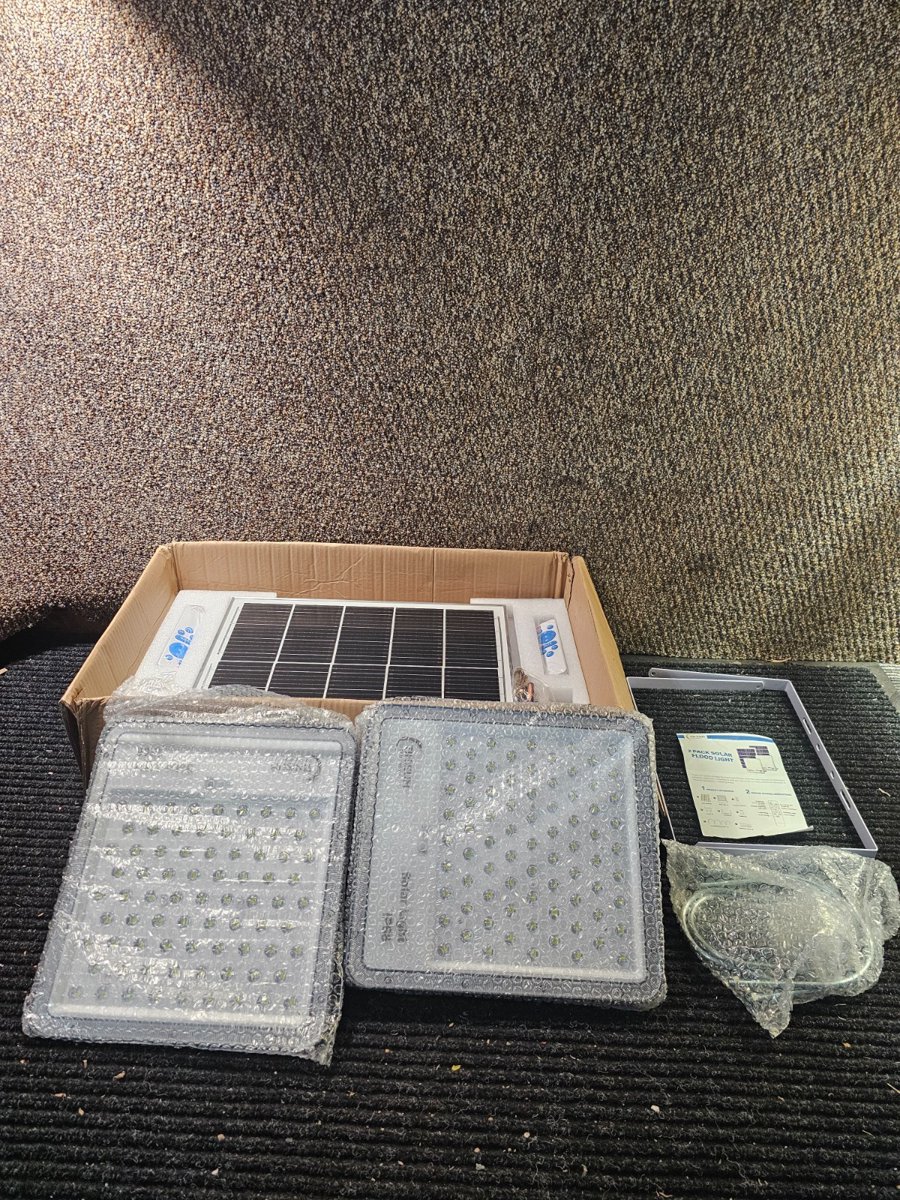

Photos from current listings. Actual item, color, and included accessories may vary.
Outdoor LED Flood Light Buying Guide
Outdoor LED flood lights are high-output, weather-sealed fixtures used for security, yard illumination, and architectural accenting. The core trade-off is lumen output and beam control versus thermal mass and housing grade: cheap units overdrive LEDs in thin plastic or stamped aluminum shells, while durable fixtures use die-cast aluminum heat sinks and constant-current drivers. The decision rule is simple: buy by IP rating, die-cast housing mass, and driver architecture (integrated vs. remote), not by advertised wattage alone.
Key takeaways
- IP65 is the minimum for exposed rain; IP66 adds powerful jet resistance for washdown or coastal exposure, while IP44 is only splash-safe under eaves.
- Die-cast aluminum housings with finned heat sinks sustain 50,000+ hour LED life; thin stamped steel or plastic shells cook drivers and cause premature failure.
- Integrated constant-current drivers are compact but heat-sensitive; remote or separate drivers last longer but require a weatherproof junction box and low-voltage wiring.
At a glance
- Category
- Outdoor Lighting & Decor
- Last updated
- Nov 28, 2026
Current offers
Highlights
- IP65 is the minimum for exposed rain; IP66 adds powerful jet resistance for washdown or coastal exposure, while IP44 is only splash-safe under eaves.
- Die-cast aluminum housings with finned heat sinks sustain 50,000+ hour LED life; thin stamped steel or plastic shells cook drivers and cause premature failure.
- Integrated constant-current drivers are compact but heat-sensitive; remote or separate drivers last longer but require a weatherproof junction box and low-voltage wiring.
- Beam angle and throw determine usable coverage: 120° wide floods wash walls and yards, 60° spot floods punch 30-50 ft for security, and 90° is the general-purpose middle ground.
Best use cases
- Best fit: mount a 120° IP65 die-cast flood on a 4x4 post or eave to light a 20-30 ft driveway or yard; skip 180° flat-panel units that glare and waste lumens upward.
- Best fit: use a 60° spot or 90° narrow flood on a 10-12 ft wall for motion-triggered security coverage of a 30-40 ft run; skip wide 120° heads at that height unless you want broad ambient wash.
- Best fit: coastal or washdown areas call for IP66 die-cast fixtures with stainless hardware and sealed cable glands; skip IP44 plastic-body fixtures and any unit with exposed screw terminals.
- Best fit: decorative or accent lighting uses 3000K-4000K CRI 80+ fixtures on a dimmer-compatible driver; skip high-output 5000K+ cool-white floods near seating areas due to glare and color shift.
Buying tips
- Match lumens to throw, not wattage: a 30W LED at 100 lm/W delivers 3,000 lm; at 10 ft mounting height a 60° beam covers roughly a 12 ft circle, so scale fixture count from your measured coverage area.
- Choose 3000K-4000K for living and accent areas, 5000K only for task/security zones; CRI 80+ is the minimum for facade color fidelity, and 90+ for architectural detailing.
- Verify die-cast aluminum housing and finned heat sink, not just 'aluminum' in the title; a 1.5-2 lb housing at 30-50W signals real thermal mass, while sub-1 lb units at 100W+ are overdriven.
- For retrofit and solar models, confirm the fixture includes a compatible driver or panel voltage (12V/24V DC vs 120-277V AC); mixing a 12V fixture onto a 120V circuit destroys the driver instantly.
Specs
| IP Rating | IP65 min; IP66 coastal/washdown |
|---|---|
| Housing Grade | Die-cast aluminum w/ finned heat sink |
| Beam Angle | 60° spot / 90° mid / 120° wide |
| Color Temp / CRI | 3000-4000K living; 80+ CRI |
Related searches
What to check before buying
- Measure mounting height and target spread: at 10 ft, a 60° beam covers ~12 ft diameter; at 20 ft, ~23 ft; at 30 ft, ~35 ft — buy beam angle from this math, not guesswork.
- Confirm circuit capacity: a 50W LED draws ~0.42A at 120V; a 100W draws ~0.83A, so a 15A circuit supports multiple floods but check total load including other fixtures.
- Check mounting surface and hardware: die-cast yoke brackets need solid wood, masonry anchors, or a 4x4 post; plastic knuckles strip and sag under wind load on exposed eaves.
- For coastal or high-humidity installs, require IP66, stainless steel fasteners, and sealed cable glands; inland sheltered eaves tolerate IP65 with standard glands.
FAQ
Data sources: eBay / Amazon listings and product attribute feeds. Updated Nov 28, 2026.
Some links on this page are affiliate links. If you buy after clicking one, we may earn a commission at no extra cost to you. This does not change which products appear here or their order. Affiliate disclosure.