
Photos from current listings. Actual item, color, and included accessories may vary.
Shade Umbrella With Stand Buying Guide
A shade umbrella with stand pairs a canopy (market, cantilever, or specialty) with a weighted base to deliver freestanding UV protection without a table. The core trade-off is canopy span versus stability: larger spans and cantilever designs need heavier bases and stronger frames, while smaller market umbrellas are easier to secure. Decide by base weight and frame material first—if the stand can't hold the canopy in wind, the umbrella is a seasonal compromise.
Key takeaways
- Market umbrellas use a center pole through a table or freestanding base; cantilever umbrellas hang the canopy from an offset arm, requiring a cross base or weighted plates for stability.
- Rib material determines wind resilience: fiberglass ribs flex and resist snapping, aluminum ribs balance weight and corrosion resistance, and steel ribs are strong but prone to rust if powder coating chips.
- Canopy fabric grade separates durable from disposable: solution-dyed or acrylic fabrics resist fading and mildew far better than thin polyester, which degrades within a season or two under strong UV.
At a glance
- Category
- Outdoor Structures, Shade & Awnings
- Last updated
- Nov 28, 2026
Current offers
Highlights
- Market umbrellas use a center pole through a table or freestanding base; cantilever umbrellas hang the canopy from an offset arm, requiring a cross base or weighted plates for stability.
- Rib material determines wind resilience: fiberglass ribs flex and resist snapping, aluminum ribs balance weight and corrosion resistance, and steel ribs are strong but prone to rust if powder coating chips.
- Canopy fabric grade separates durable from disposable: solution-dyed or acrylic fabrics resist fading and mildew far better than thin polyester, which degrades within a season or two under strong UV.
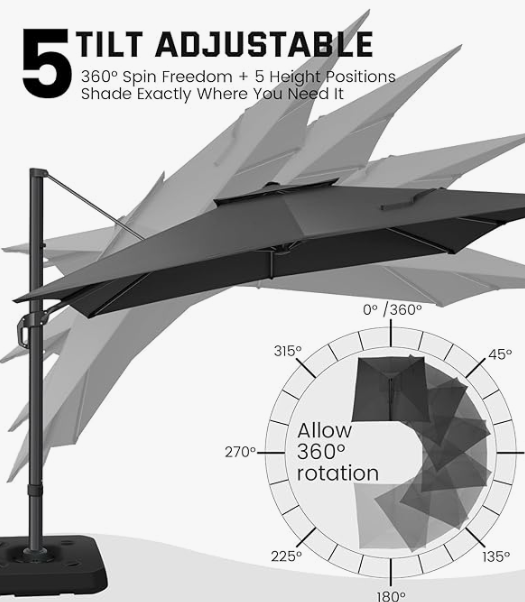
- Cantilever bases need substantially more weight than market bases—often 100 lb or more of sand or water—and 360-degree rotation models add mechanical joints that must be checked for wobble.
Best use cases
- Best fit: a 10 ft market umbrella with fiberglass ribs and crank lift for patio tables and deck dining—choose this if you have a table with a 1.5–2 in umbrella hole and want simple, stable shade.
- Best fit: a cantilever umbrella with cross base and weighted plates for poolside or lounge seating where a center pole would obstruct—pick this only if you can supply 100+ lb of base weight and have clearance for the offset arm.
- Wrong fit: a large cantilever umbrella on a windy rooftop or open lawn without anchoring—skip cantilever designs in exposed sites and choose a smaller market umbrella with a heavy freestanding base instead.
- Best fit: a double-sided or tiki-style umbrella for wide entertainment areas—select this for coverage across two seating zones, but only if the frame's 12-rib construction is specified and the base footprint matches your space.
Buying tips
- Match canopy span to base weight: a 9–10 ft market umbrella needs a base of at least 50 lb, while a 10 ft cantilever needs 100 lb or more of sand or water to stay upright in gusty conditions.
- Choose fiberglass or aluminum ribs over steel for coastal or humid climates; steel ribs rust at joints and hinge points even with powder coating, shortening the umbrella's service life.
- Verify pole diameter compatibility before buying a separate stand: market umbrella poles are commonly 1.5 in, and a stand bored for 1.5 in will wobble with a 1.375 in pole unless a reducer sleeve is included.
- For cantilever models, confirm the base type—cross base with pavers, fixed plate base, or water-filled base—because each requires different anchoring and some cross bases ship without weights.
Specs
| Umbrella Type | Market center-pole / Cantilever offset |
|---|---|
| Rib Material | Fiberglass / Aluminum / Steel |
| Canopy Fabric | Solution-dyed acrylic / Polyester |
| Base Fill Weight | 50 lb market / 100+ lb cantilever |
Related searches
What to check before buying
- Measure your table's umbrella hole diameter (typically 1.5–2 in) and confirm the umbrella pole fits without a reducer, or that the stand is freestanding.
- Clear a footprint for the base: cantilever cross bases span roughly 3 x 3 ft, and the offset arm swings the canopy beyond the base—ensure no walls or railings block rotation.
- Check wind exposure: open decks, waterfront, and rooftops demand a heavier base and a vented canopy to reduce uplift; calm courtyards can use lighter market bases.
- Confirm the stand's fill requirement—sand, water, or pavers—and that you can source the weight locally; an unfilled cantilever base is unstable in any breeze.
FAQ
Data sources: eBay / Amazon listings and product attribute feeds. Updated Nov 28, 2026.
Some links on this page are affiliate links. If you buy after clicking one, we may earn a commission at no extra cost to you. This does not change which products appear here or their order. Affiliate disclosure.