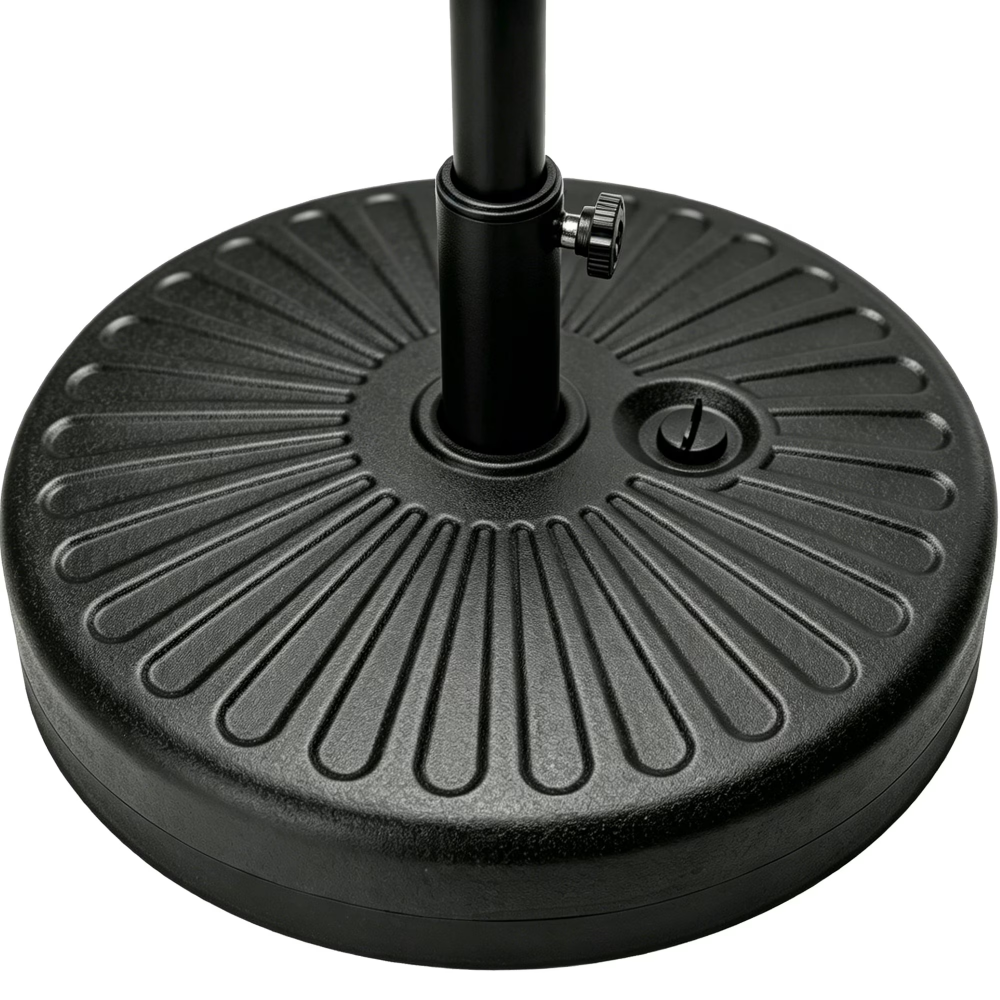

Photos from current listings. Actual item, color, and included accessories may vary.
Heavy Duty Umbrella Stand Buying Guide
A heavy-duty umbrella stand is a weighted base engineered to keep a patio or offset umbrella upright under wind load, with stability determined by total ballasted mass, the base-to-pole interface, and the fill material. The core trade-off is between sand/water-fillable HDPE bases (movable, high mass per volume) and solid cast-concrete or steel-plate bases (permanent, dense, low-profile). Choose a fillable HDPE base with locking casters for seasonal repositioning of a 6–10 ft umbrella; choose cast concrete or steel for a permanent offset cantilever in an exposed, windy site.
Key takeaways
- Ballast capacity is the stability metric: fillable bases reach roughly 150–180 lb with dry sand versus about 90–110 lb with water, so sand-filled bases outperform water-filled bases of equal volume.
- Offset (cantilever) umbrellas need a base plate or cross-base that spans at least 3–4 ft and carries 150–200 lb, because the canopy load acts on a lever arm rather than straight down the pole.
- Fillable HDPE bases are rotational-molded or blow-molded polyethylene with UV stabilizers; wall thickness of 3–5 mm resists cracking, and molded-in fill ports and drain plugs are the durability differentiators.
At a glance
- Category
- Outdoor Structures, Shade & Awnings
- Last updated
- Nov 28, 2026
Current offers
Highlights
- Ballast capacity is the stability metric: fillable bases reach roughly 150–180 lb with dry sand versus about 90–110 lb with water, so sand-filled bases outperform water-filled bases of equal volume.
- Offset (cantilever) umbrellas need a base plate or cross-base that spans at least 3–4 ft and carries 150–200 lb, because the canopy load acts on a lever arm rather than straight down the pole.
- Fillable HDPE bases are rotational-molded or blow-molded polyethylene with UV stabilizers; wall thickness of 3–5 mm resists cracking, and molded-in fill ports and drain plugs are the durability differentiators.
- Locking swivel casters (typically 2–3 in wheels) let a fully ballasted base roll on hardscape but must be locked in service; caster plates and axle bolts are the first failure point on wheeled bases.
Best use cases
- Best fit: fillable HDPE base with 4 locking casters for a 6–10 ft market umbrella on a patio or deck you reconfigure seasonally — roll it empty, fill with sand on site, lock the wheels.
- Best fit: cast-concrete or steel-plate base for a permanent cantilever offset umbrella at a poolside or windy coastal site, where the base stays put and maximum mass per footprint matters.
- Wrong fit: a plastic water-filled base under a large offset cantilever in an exposed yard — water ballast is too light and the lever arm will tip it; step up to a 4-plate weight set or concrete.
- Wrong fit: a wheeled base left unlocked on a sloped deck or in gusty conditions — lock casters and add ballast plates, or switch to a fixed cross-base.
Buying tips
- Match ballast to canopy: a 6–7 ft umbrella needs about 50–75 lb, an 8–9 ft needs 75–100 lb, and a 10 ft or offset cantilever needs 150 lb or more of sand-filled ballast.
- Prefer sand over water fill: dry sand is roughly 100 lb per cubic foot versus about 62 lb for water, giving 40–60% more mass in the same base volume.
- Check the pole collar and stem diameter: most market umbrellas use a 1.5 in (38 mm) pole, and offset umbrellas use a cross-base or plate mount — the base must match the umbrella's mount type, not just its weight rating.
- For wheeled bases, confirm the casters are lockable and at least 2 in in diameter; small hard-plastic casters sink into pavers and fail at the axle under full ballast.
Specs
| Ballast Type | Sand vs water fill (sand 40-60% heavier) |
|---|---|
| Ballast Capacity | 50-200 lb by canopy size |
| Base Material | HDPE, cast concrete, or steel |
| Mobility | Locking casters vs fixed plate |
Related searches
What to check before buying
- Measure the umbrella pole diameter (commonly 1.5 in) and note whether the umbrella is center-pole or offset cantilever — the base mount must match.
- Confirm the deck or patio surface: locking casters work on smooth hardscape, while gravel, grass, or sloped decks need a fixed plate or cross-base.
- Verify ballast volume and the fill medium you will actually use, and plan a fill location near the base since a full base weighs 100–180 lb and is not easily moved.
- Check the footprint diameter against table and chair clearance so the base does not become a trip hazard, and confirm the base's UV-rated polyethylene suits your sun exposure.
FAQ
Data sources: eBay / Amazon listings and product attribute feeds. Updated Nov 28, 2026.
Some links on this page are affiliate links. If you buy after clicking one, we may earn a commission at no extra cost to you. This does not change which products appear here or their order. Affiliate disclosure.