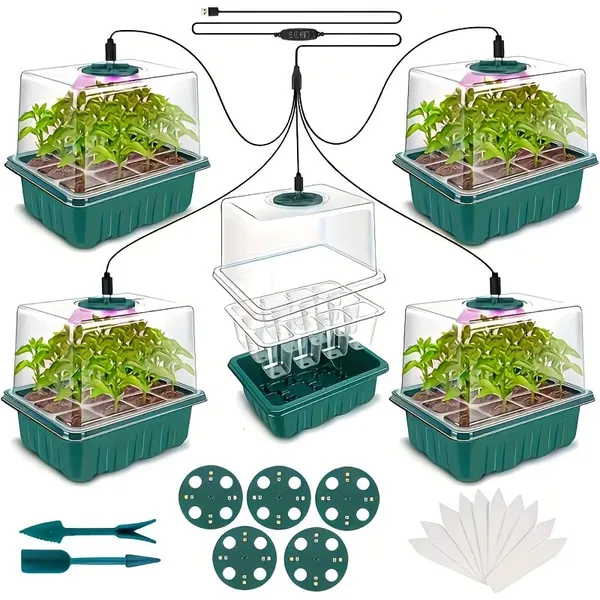

Photos from current listings. Actual item, color, and included accessories may vary.
Starting Seed Indoor With Grow Light Buying Guide
Indoor seed-starting with grow lights is a controlled-environment system combining a propagation tray or mini-greenhouse with a full-spectrum LED fixture to germinate and raise seedlings before transplant. The primary trade-off is coverage versus intensity: low-wattage strip or dome-integrated LEDs suit germination and early cotyledon stages, while higher-wattage panel or tiered fixtures are required to sustain stocky growth without stretching. The decision rule is simple: match fixture wattage and PPF to canopy area and seedling stage, and choose rigid, UV-stabilized trays with humidity domes over thin disposable cells for multi-season durability.
Key takeaways
- Full-spectrum white LEDs (3500-5000K with 660nm red) support both vegetative growth and root development; blurple-only arrays are older and harder for pest and deficiency inspection.
- Seedling-stage PPFD of 150-250 µmol/m²/s over 14-18 hours daily is the working target; 40W-class domed units cover roughly 1-2 sq ft, while 45W 4-tier shelves spread light across multiple shallow trays.
- PROPAGATION HUMIDITY DOMES: adjustable vented domes hold 70-90% RH for germination, then vents open to harden seedlings and reduce damping-off; rigid PET or PP trays outlast thin PVC inserts.
At a glance
- Category
- Greenhouse & Hydroponics
- Last updated
- Nov 28, 2026
Current offers
Highlights
- Full-spectrum white LEDs (3500-5000K with 660nm red) support both vegetative growth and root development; blurple-only arrays are older and harder for pest and deficiency inspection.
- Seedling-stage PPFD of 150-250 µmol/m²/s over 14-18 hours daily is the working target; 40W-class domed units cover roughly 1-2 sq ft, while 45W 4-tier shelves spread light across multiple shallow trays.
- PROPAGATION HUMIDITY DOMES: adjustable vented domes hold 70-90% RH for germination, then vents open to harden seedlings and reduce damping-off; rigid PET or PP trays outlast thin PVC inserts.
- PPF EFFICIENCY: modern mid-power LED bars deliver 1.5-2.2 µmol/J; a 40W fixture yields roughly 60-90 µmol/s PPF, enough for one standard 10x20 tray of germinating seedlings.
Best use cases
- Best fit: a 40W LED mini-greenhouse with zippered PVC cover and vented humidity dome for germinating one to two 10x20 trays of tomatoes, peppers, or herbs on a shelf or windowsill.
- Best fit: a 4-tier metal plant stand with 45W full-spectrum bars, 3-mode timer, and wheels for starting successive seed batches and moving plants to brighter light as they grow.
- Wrong fit: buying a high-wattage panel (100W+) for a small domed propagator—excess intensity and heat can scorch emerging cotyledons; step up wattage only at true-leaf stage.
- Wrong fit: relying on a dome-integrated LED without a timer for full lifecycle growth—seedlings need 14-18 hours of consistent light; use an inline timer or smart plug from day one.
Buying tips
- Size the light to the tray: one 10x20 tray (approx. 1.4 sq ft) needs roughly 40W of LED; scale to 45W per shelf tier when stacking multiple trays vertically.
- Choose full-spectrum white plus 660nm red over blurple; white LEDs make it easier to spot pests, edema, and nutrient deficiency before transplant.
- Require adjustable vented humidity domes: closed for germination at 70-90% RH, opened gradually once 50% of seeds have cotyledons to prevent damping-off.
- For multi-season use, pick rigid PP/PET trays and powder-coated metal frames; thin PVC covers and wire shelves degrade under repeated watering and UV exposure.
Specs
| Fixture Wattage | 40-45W LED typical; 60-100W for panels |
|---|---|
| Spectrum | Full-spectrum white + 660nm red |
| Tray Footprint | 10x20 in standard propagation tray |
| Dome Humidity | Vented adjustable, 70-90% RH |
Related searches
What to check before buying
- Measure your shelf or stand footprint: a standard 10x20 tray needs about 21x11 in; 4-tier stands typically occupy roughly 2x1 ft of floor space.
- Confirm indoor ambient temperature stays 65-75°F; LED domes add little heat, so a heat mat is required for peppers and tomatoes in cool rooms.
- Check outlet and timer capacity: 40-45W LED fixtures run on standard 120V US plugs; use a grounded timer rated for the fixture wattage.
- Verify the kit includes trays, domes, and light mounting hardware—many mini-greenhouse listings ship cover and light only, requiring separate 10x20 trays and cells.
FAQ
Data sources: eBay / Amazon listings and product attribute feeds. Updated Nov 28, 2026.
Some links on this page are affiliate links. If you buy after clicking one, we may earn a commission at no extra cost to you. This does not change which products appear here or their order. Affiliate disclosure.