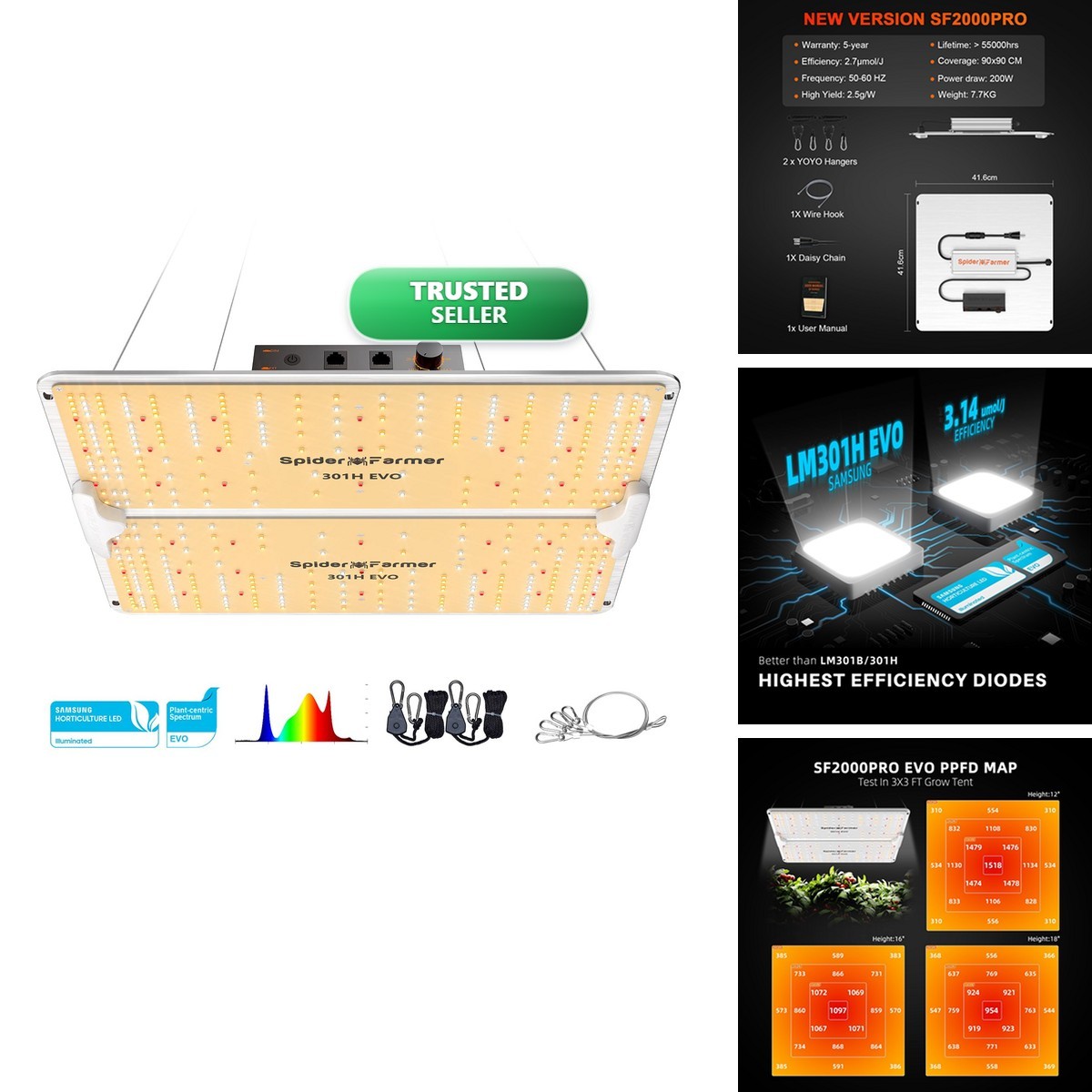

Photos from current listings. Actual item, color, and included accessories may vary.
Spider Farmer Grow Tent Kit Buying Guide
A Spider Farmer grow tent kit bundles a Spider Farmer LED grow light, a reflective fabric tent, and often an inline fan/filter into a single matched package. The core trade-off is whether the included light and ventilation are sized to the tent volume and plant stage, or merely bundled to hit a low price. Buy only kits where the light's true wattage and fan CFM are published and matched to the tent's cubic footage; skip bundles that hide specs behind vague 'complete kit' claims.
Key takeaways
- Spider Farmer LED bars use Samsung LM301 diodes with meanwell drivers in higher tiers; entry kits often use older or lower-bin diodes, cutting PPF efficiency per watt.
- Tent fabric is typically 1680D Oxford with a mylar interior; thinner 600D tents crease, leak light at seams, and tear at pole sleeves under fan load.
- Ventilation kits pair a 4-inch or 6-inch inline fan rated near 200-400 CFM; a 6-inch fan is required for tents of 4x4 ft and larger to cycle air every 1-2 minutes.
At a glance
- Category
- Greenhouse & Hydroponics
- Last updated
- Nov 28, 2026
Current offers
Highlights
- Spider Farmer LED bars use Samsung LM301 diodes with meanwell drivers in higher tiers; entry kits often use older or lower-bin diodes, cutting PPF efficiency per watt.
- Tent fabric is typically 1680D Oxford with a mylar interior; thinner 600D tents crease, leak light at seams, and tear at pole sleeves under fan load.
- Ventilation kits pair a 4-inch or 6-inch inline fan rated near 200-400 CFM; a 6-inch fan is required for tents of 4x4 ft and larger to cycle air every 1-2 minutes.
- Kits ship in 2x2, 3x3, 4x4, and 5x5 footprints; light wattage scales from roughly 100W to 450W, and undersized lights force stretching and lower yields in flower.
Best use cases
- Best fit: a first-time indoor grower with a 2x2 or 3x3 space who wants a matched light, tent, and fan without sourcing parts separately—pick the kit whose true LED wattage is at least 30W per square foot.
- Best fit: a hobbyist upgrading to a 4x4 flower room—choose the 6-inch fan and 450W-class bar light kit; a 4-inch fan and 200W light will not clear heat or canopy demand at that footprint.
- Wrong fit: a buyer wanting to mix brands or reuse an existing light—skip kits and buy the tent and fan separately, since bundled lights are rarely the best value when you already own a fixture.
- Wrong fit: a garage or unheated space grower—standard kits assume stable room temperature; add insulation and a heater, because tent fabric alone does not buffer cold-night temperature swings.
Buying tips
- Match light wattage to footprint: target 30-40W per square foot of true LED draw, so a 2x2 needs about 120-160W, a 3x3 about 270-360W, and a 4x4 about 480-640W.
- Size the fan to tent volume: multiply length x width x height in feet to get cubic feet, then pick a fan rated to exchange that volume in 1-3 minutes; a 4x4x6.5 ft tent is 104 cu ft and needs roughly 35-105 CFM before filter losses.
- Insist on a published diode and driver brand—Spider Farmer's higher tiers list Samsung LM301 diodes and Meanwell drivers; if the listing omits both, assume lower-bin components and reduced efficiency.
- Check tent fabric weight: 1680D Oxford with a reinforced floor tray and double-stitched seams outlasts 600D fabric, which is common in budget bundles and fails at zippers and pole corners.
Specs
| LED Diode Tier | Samsung LM301 vs generic diodes |
|---|---|
| Tent Fabric | 1680D vs 600D Oxford, mylar lined |
| Fan Size / CFM | 4-in ~200 CFM / 6-in ~350-400 CFM |
| Footprint / Wattage | 2x2~120W to 5x5~450W+ true draw |
Related searches
What to check before buying
- Measure ceiling height and door clearance: a 4x4 kit tent is typically 6.5-7 ft tall and needs several feet of overhead clearance for the light hanger and fan ducting.
- Confirm the room's electrical circuit: a 450W LED plus fan and accessories draws roughly 4-5A at 120V, so a dedicated 15A circuit is adequate but shared circuits with heaters may trip.
- Verify floor and drainage plan: tents need a level, water-resistant floor and a runoff strategy, since kits include a floor tray but not a drain or elevated rack.
- Plan ducting exit: an inline fan needs a window, vent, or carbon-filter recirculation path; a sealed room without exhaust will build heat and humidity regardless of kit quality.
FAQ
Data sources: eBay / Amazon listings and product attribute feeds. Updated Nov 28, 2026.
Some links on this page are affiliate links. If you buy after clicking one, we may earn a commission at no extra cost to you. This does not change which products appear here or their order. Affiliate disclosure.