
Photos from current listings. Actual item, color, and included accessories may vary.
Plant Light Bulb Buying Guide
Plant light bulbs are screw-in or pin-base lamps that deliver the specific spectrum and intensity plants need for photosynthesis, bridging the gap between ordinary room light and dedicated grow fixtures. The primary trade-off is between budget LED bulbs with unverified spectra and drivers versus horticultural-grade lamps with measured PPF, credible warranty, and stable output over thousands of hours. The decision rule: buy a bulb only when it publishes PPF (μmol/s) or PPFD at a stated distance, a Kelvin or spectrum claim backed by a PAR chart, and a base/driver rated for your fixture — skip anything that lists only wattage and "full spectrum" with no photometric data.
Median $490.09 · New listings
Key takeaways
- PPF (μmol/s) and PPFD at a given hang height are the only meaningful output metrics; wattage alone says nothing about usable PAR.
- LED efficiency for horticultural bulbs typically runs 1.5–2.7 μmol/J; cheap bulbs often fall below 1.2 μmol/J due to low-bin diodes and passive cooling limits.
- Base and driver compatibility matters: E26/E27 screw base fits standard lamps, while GU24, mogul E39, and pin-base (GX16d) bulbs require matching sockets or adapters.
At a glance
- Category
- Greenhouse & Hydroponics
- Last updated
- Nov 27, 2026
Current offers
 LED Grow Light Bulb For Indoor Plants Red And Blue Spectrum LED Plant Light XIRK$245.36New · Last checked Nov 20, 2026View on eBay
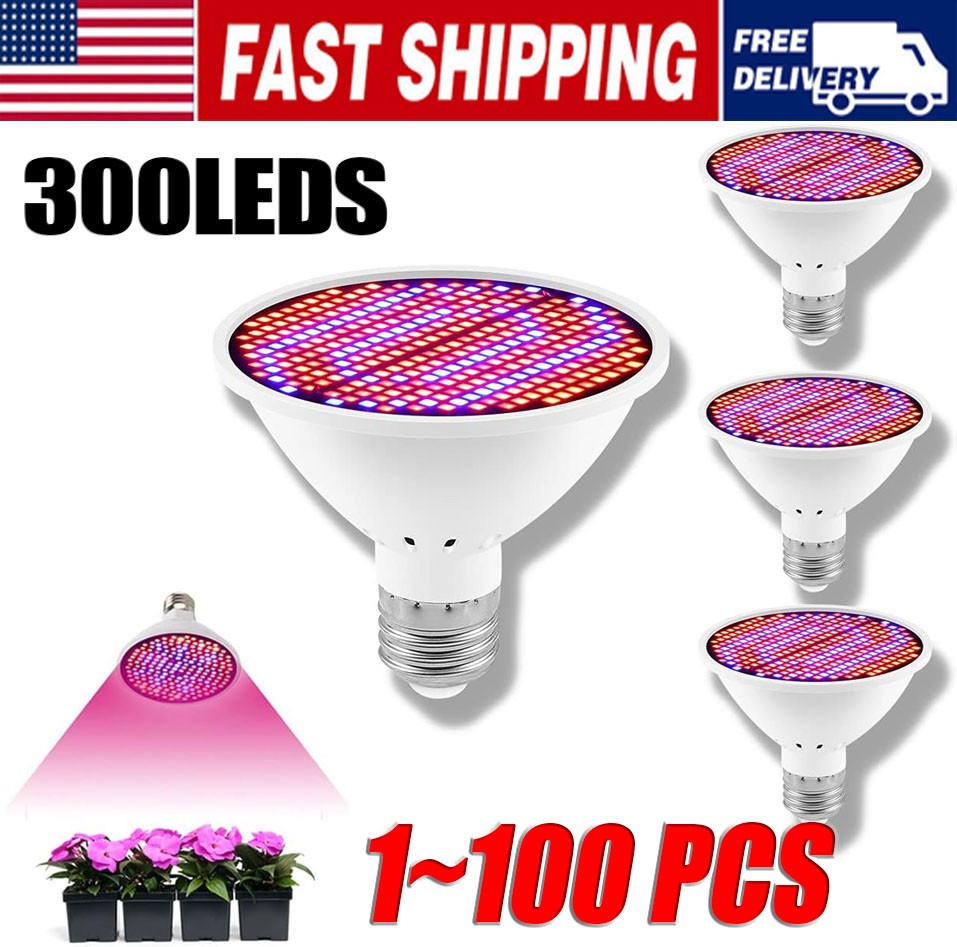 300LED Grow Light Bulb Full Spectrum Light for Indoor Plants Flowers Veg Growing$490.09New · Last checked Nov 20, 2026View on eBay
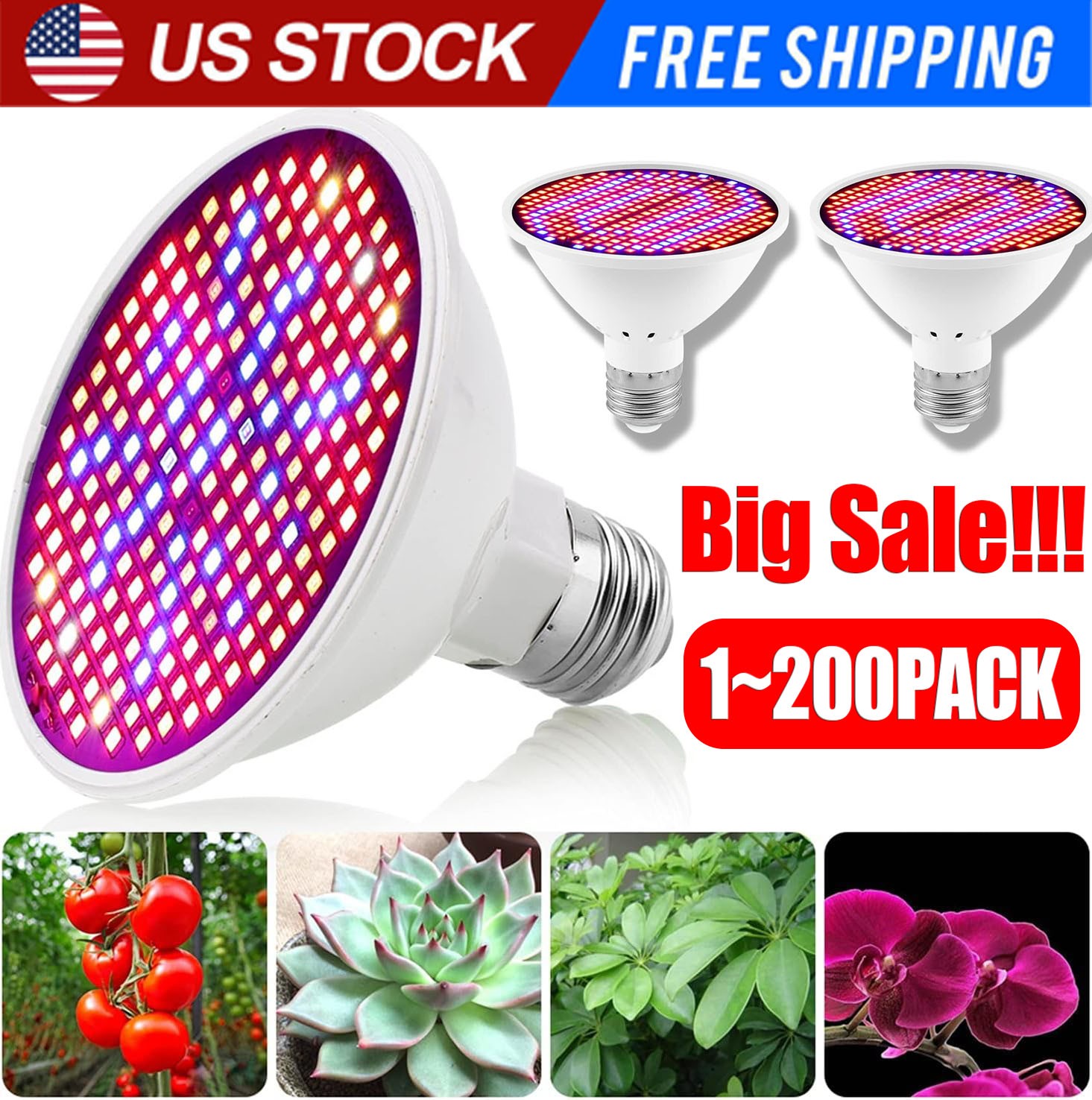 300LED Grow Light Bulb Full Spectrum Light for Indoor Plants Flowers Veg Growing$652.39New · Last checked Nov 20, 2026View on eBay
Highlights
- PPF (μmol/s) and PPFD at a given hang height are the only meaningful output metrics; wattage alone says nothing about usable PAR.
- LED efficiency for horticultural bulbs typically runs 1.5–2.7 μmol/J; cheap bulbs often fall below 1.2 μmol/J due to low-bin diodes and passive cooling limits.
- Base and driver compatibility matters: E26/E27 screw base fits standard lamps, while GU24, mogul E39, and pin-base (GX16d) bulbs require matching sockets or adapters.
- Spectrum tiers differ by use: 3000–4000K white plus deep red (660 nm) suits flowering, while 5000–6500K white or blue-heavy blends favor vegetative growth and stocky seedlings.
Best use cases
- Best fit: a single E26/E27 LED bulb of 15–30 W actual draw with a published PPF above 30 μmol/s for supplementing one shelf of herbs or a few houseplants — pick a 4000–5000K white spectrum for balanced growth.
- Best fit: a cluster of 2–4 bulbs on a daisy-chain or multi-socket fixture for a 2×2 ft seedling rack — choose 5000–6500K vegetative bulbs and keep 12–18 in above the canopy to avoid stretch.
- Wrong fit: replacing a dedicated bar or panel fixture in a 4×4 ft flowering tent with screw-in bulbs — the PPFD falloff and coverage are inadequate; use a bar-style LED with a PAR map instead.
- Wrong fit: buying high-wattage incandescent "plant bulbs" or blurple-only bulbs for a bright room — incandescent wastes most energy as heat, and blurple makes it hard to judge plant health; choose white-phosphor LED with red supplementation.
Buying tips
- Match the bulb's actual wattage to the socket and fixture rating: a 30 W LED bulb draws roughly 0.25 A at 120 V, but confirm the fixture's max wattage label since enclosed fixtures trap heat and shorten driver life.
- Use the inverse-square rule: PPFD drops to one-quarter when you double the distance, so a bulb rated 200 μmol/m²/s at 6 in delivers about 50 at 12 in — hang accordingly and measure with a PAR app or meter.
- Choose a dimmable bulb only if your fixture or smart plug supports dimming; many horticultural LEDs are non-dimmable, and pairing a dimmable bulb with a standard switch gives no benefit.
- Prefer bulbs with a listed lifetime of 25,000–50,000 hours (L70) and an IP rating of IP20 or better for humid rooms; in greenhouses with condensation, choose IP44+ or a sealed fixture.
Specs
| Base Type | E26/E27 / GU24 / E39 mogul |
|---|---|
| Actual Draw | 9–30 W LED (40–100 W equiv.) |
| Efficacy | 1.5–2.7 μmol/J horticultural |
| Spectrum | 3000–6500K white / red 660 nm |
Related searches
What to check before buying
- Measure your socket type and fixture max wattage before ordering — E26/E27 is standard in North America, but GU24 and mogul E39 appear in utility and high-bay fixtures.
- Confirm the bulb's physical length clears your shade or reflector; high-output horticultural bulbs often exceed 5 in and can block airflow in tight domes.
- Check your room's ambient temperature and humidity: LEDs tolerate 0–40°C, but drivers degrade above 35°C, so avoid enclosed glass domes in hot greenhouses without ventilation.
- Verify voltage: 120 V bulbs are standard in the US/Canada, 220–240 V in Europe and Asia; a 120 V bulb in a 240 V socket will fail immediately.
FAQ
Data sources: eBay / Amazon listings and product attribute feeds. Updated Nov 27, 2026.
Some links on this page are affiliate links. If you buy after clicking one, we may earn a commission at no extra cost to you. This does not change which products appear here or their order. Affiliate disclosure.