
Photos from current listings. Actual item, color, and included accessories may vary.
Plant Grow Light Bulb Buying Guide
Plant grow light bulbs are screw-in or plug-in lamps that replace ordinary bulbs to deliver the specific light spectrum and intensity plants need for photosynthesis indoors. The core trade-off is LED efficiency and targeted spectrum versus heat output, initial cost, and true PAR output at canopy distance — many low-cost bulbs are dim, narrow-band, or overrated. The decision rule: buy a bulb with published PPF/PPFD at a stated distance and a spectrum matched to your growth stage; skip any bulb that lists only wattage equivalence or 'full spectrum' with no radiometric data.
Median $490.09 · New listings
Key takeaways
- LED bulbs dominate new purchases: they deliver 2-3x the usable light per watt of incandescent or halogen and run cool enough for enclosed fixtures and close canopy spacing.
- Spectrum matters by stage: blue-heavy 4000-6500K supports vegetative growth and stocky seedlings, while red-heavy 2700-3000K or enhanced-red blends support flowering and fruiting.
- Form factor determines coverage: standard A19/E26 bulbs suit single plants and small shelves, while PAR30/PAR38 reflector floods and corn-cob style bulbs push light deeper and wider.
At a glance
- Category
- Greenhouse & Hydroponics
- Last updated
- Nov 27, 2026
Current offers
 LED Grow Light Bulb For Indoor Plants Red And Blue Spectrum LED Plant Light XIRK$245.36New · Last checked Nov 20, 2026View on eBay
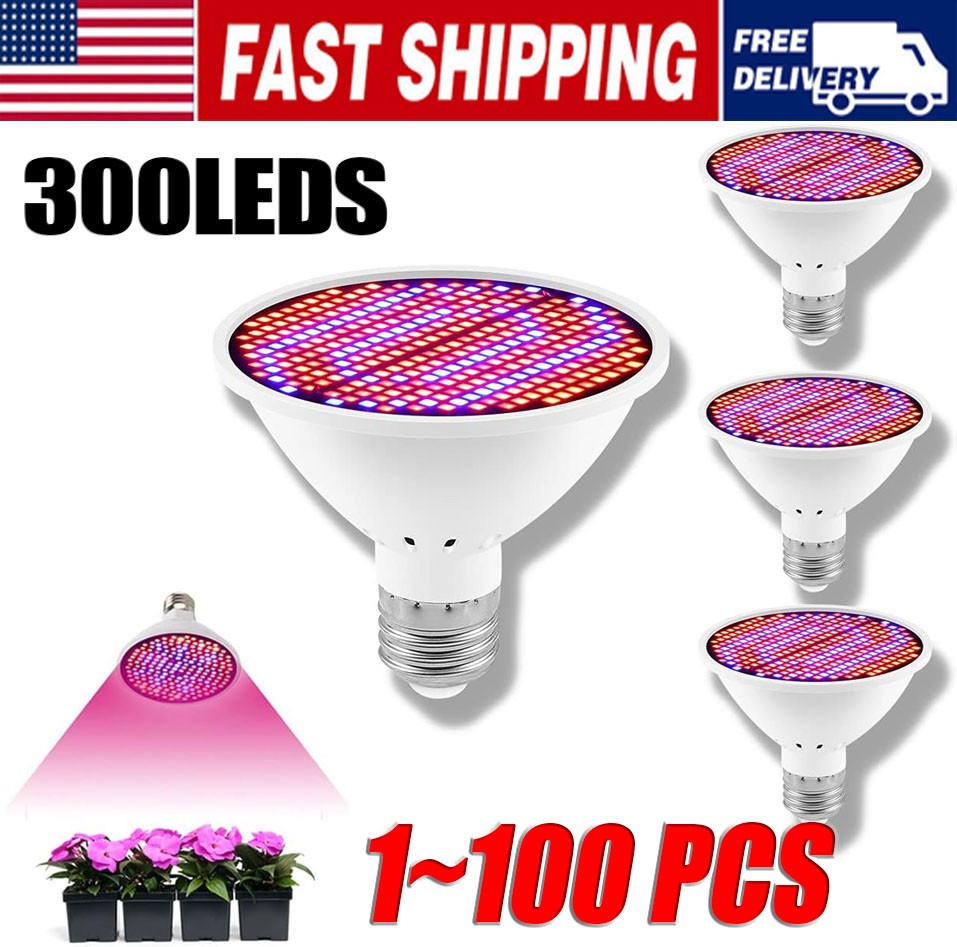 300LED Grow Light Bulb Full Spectrum Light for Indoor Plants Flowers Veg Growing$490.09New · Last checked Nov 20, 2026View on eBay
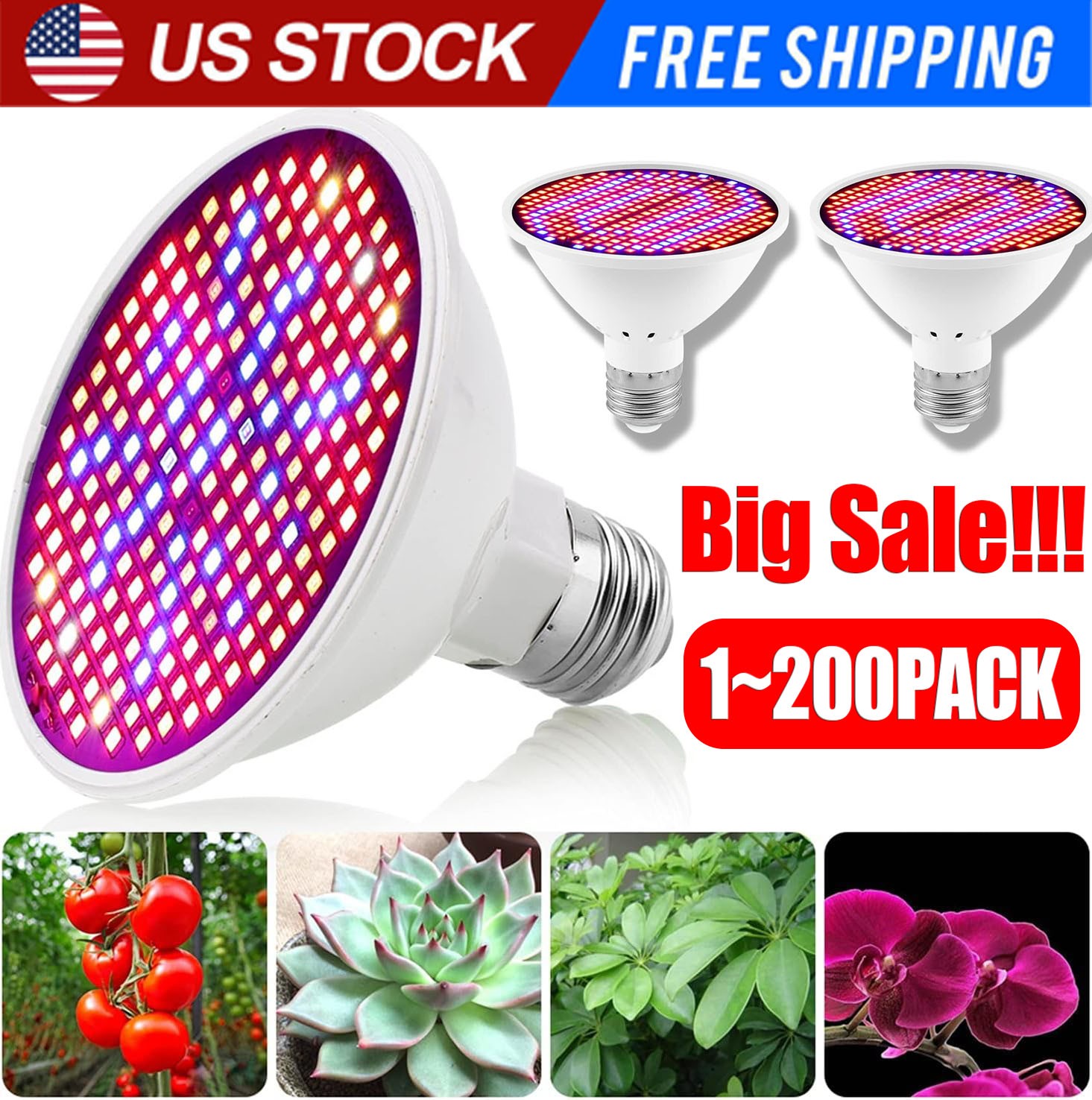 300LED Grow Light Bulb Full Spectrum Light for Indoor Plants Flowers Veg Growing$652.39New · Last checked Nov 20, 2026View on eBay
Highlights
- LED bulbs dominate new purchases: they deliver 2-3x the usable light per watt of incandescent or halogen and run cool enough for enclosed fixtures and close canopy spacing.
- Spectrum matters by stage: blue-heavy 4000-6500K supports vegetative growth and stocky seedlings, while red-heavy 2700-3000K or enhanced-red blends support flowering and fruiting.
- Form factor determines coverage: standard A19/E26 bulbs suit single plants and small shelves, while PAR30/PAR38 reflector floods and corn-cob style bulbs push light deeper and wider.
- Dimmability and timers are separate compatibility layers: bulb, fixture, and dimmer must all support the same protocol (triac, 0-10V, or app) or flicker and shortened life result.
Best use cases
- Seedling starting on a shelf: choose 4000-6500K LED bulbs at 10-20W actual draw per square foot, mounted 6-12 inches above trays; skip high-wattage red-blend bulbs that cause stretch.
- Vegetative growth in a small tent: pick dimmable full-spectrum LED bulbs or PAR-style floods delivering 300-600 PPFD at canopy; skip decorative 'plant bulbs' with no PPFD rating.
- Flowering/fruiting for compact plants: use enhanced-red or 2700-3000K bulbs plus a timer set to 12/12; skip single blue-heavy bulbs that bias vegetative growth.
- Supplemental light for houseplants in low-light rooms: choose low-wattage full-spectrum A19 LEDs on a 12-16 hour timer; skip high-output commercial floods that overlight and bleach foliage.
Buying tips
- Match bulb base to fixture: E26/E27 is the standard household screw base; GU10, GU24, and BA15d appear in track and specialty fixtures and will not fit an E26 socket without an adapter.
- Size by actual wattage, not equivalence: a '100W equivalent' LED grow bulb typically draws 10-20W; for serious growth target 30-50W actual per plant or 20-40W per square foot.
- Check PPF (µmol/s) and PPFD at distance where available: a bulb rated 30-60 PPF at 12 inches covers roughly a 1-2 square foot canopy; higher PPF allows greater mounting distance.
- Prioritize dimmable, timer-compatible bulbs with a known CRI and spectrum chart over claims of 'full spectrum' alone; verify heatsink size and warranty length as durability signals.
Specs
| Bulb Type | LED / Fluorescent / Incandescent |
|---|---|
| Base Type | E26/E27 / GU10 / GU24 |
| Spectrum | Full-spectrum / Blue / Red blend |
| Actual Wattage | 10-50W LED typical |
Related searches
What to check before buying
- Measure your fixture socket type (E26/E27, GU10, GU24) and maximum bulb wattage rating before ordering.
- Confirm canopy distance and coverage area: bulbs with narrow beam angles need closer mounting and cover less area.
- Verify your timer and dimmer compatibility (triac dimmers for screw-in LEDs; app or 0-10V for smart fixtures).
- Check ambient heat and ventilation: even LED bulbs emit heat at the driver; enclosed fixtures need bulbs rated for enclosed use.
FAQ
Data sources: eBay / Amazon listings and product attribute feeds. Updated Nov 27, 2026.
Some links on this page are affiliate links. If you buy after clicking one, we may earn a commission at no extra cost to you. This does not change which products appear here or their order. Affiliate disclosure.