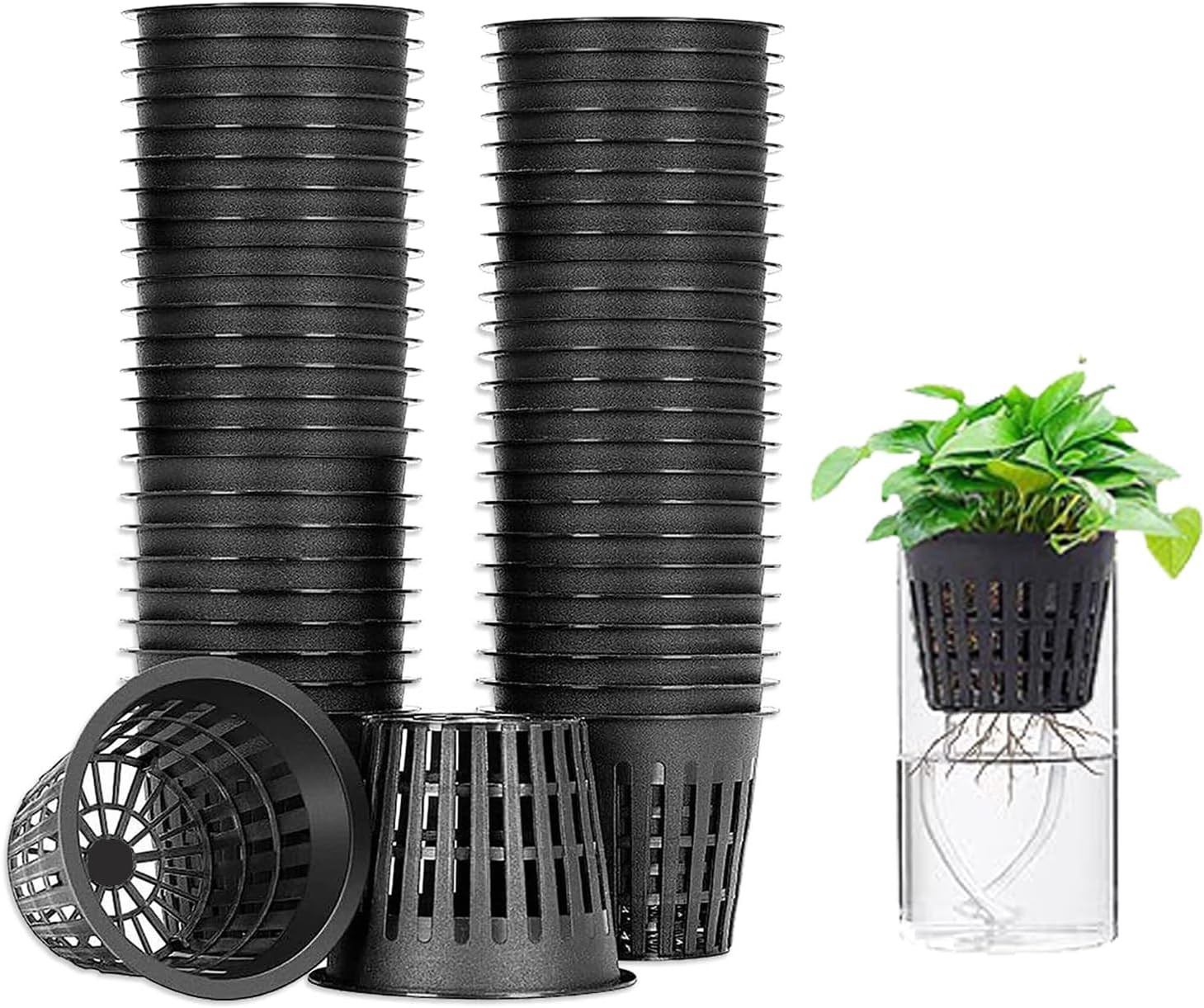

Photos from current listings. Actual item, color, and included accessories may vary.
Net Pot Buying Guide
Net pots are the mesh baskets that hold plant roots in hydroponic and aeroponic systems, and the core trade-off is rim stiffness and mesh geometry versus cost per unit. Cheap economy cups flex and crack under root pressure, while heavy-duty cups hold their shape through repeated cleaning and reuse. The decision rule: buy heavy-duty UV-stabilized polypropylene or HDPE with a reinforced rim for multi-season cloning and fruiting crops, and reserve thin economy cups for short-cycle seedling propagation where the pot is discarded after one run.
Key takeaways
- Rim design is the durability pivot: rolled or double-thick rims resist collapsing when roots and media expand, while flat single-wall rims split at the lip first.
- Mesh aperture drives performance: slots and holes around 4-8 mm retain coco coir and rockwool while draining freely; finer mesh clogs with perlite dust, wider gaps drop media.
- Material grade separates tiers: virgin polypropylene and HDPE with UV stabilizers survive sun and sanitizing dips; regrind-filled economy plastic turns brittle within one to two seasons.
At a glance
- Category
- Greenhouse & Hydroponics
- Last updated
- Nov 28, 2026
Current offers
Highlights
- Rim design is the durability pivot: rolled or double-thick rims resist collapsing when roots and media expand, while flat single-wall rims split at the lip first.
- Mesh aperture drives performance: slots and holes around 4-8 mm retain coco coir and rockwool while draining freely; finer mesh clogs with perlite dust, wider gaps drop media.
- Material grade separates tiers: virgin polypropylene and HDPE with UV stabilizers survive sun and sanitizing dips; regrind-filled economy plastic turns brittle within one to two seasons.
- Standard sizing follows net-pot conventions — 2-inch, 3-inch, 4-inch, 5-inch, and 6-inch rim diameters match common hole saws and raft/pipe cutouts, with 3-inch as the cloning-to-veg workhorse.
Best use cases
- Best fit: heavy-duty 3-inch cups for NFT, DWC, and aeroponic cloning where roots are handled and pots are reused — skip thin economy cups that crack at the rim during transplant.
- Best fit: economy 2-inch and 3-inch cups for single-cycle seed starting and lettuce rafts that go to compost after harvest — do not pay heavy-duty premiums for one-run propagation.
- Wrong fit: oversized 5-6 inch pots in shallow raft channels or small net-pot holes — match pot diameter to the cutout and water depth before choosing wall thickness.
- Best fit: UV-stabilized pots for outdoor Dutch buckets and Kratky setups exposed to sunlight; indoor-only systems can accept standard unstabilized resin at lower cost.
Buying tips
- Match pot rim to your cutout: 3-inch pots need a 3-inch hole saw or raft cutout — buy the pot first, then size the lid or channel hole to the rim, not the base.
- Compute media volume per pot: a 3-inch net pot holds roughly 100-150 mL of media, so a 50-pack covers a 50-site raft or cloning tray without overbuying.
- Choose UV-stabilized PP or HDPE for outdoor and greenhouse use; unstabilized economy resin degrades and chalks after sustained UV exposure.
- Prefer slotted or multi-hole mesh over fine screen for perlite and clay pebble media; fine mesh traps dust and restricts drainage in flood-and-drain systems.
Specs
| Rim Type | Reinforced rolled vs flat single-wall |
|---|---|
| Material Grade | UV-stabilized PP/HDPE vs economy regrind |
| Standard Sizes | 2, 3, 4, 5, 6 in rim diameter |
| Mesh Aperture | 4-8 mm slots/holes for media retention |
Related searches
What to check before buying
- Measure your system's cutout diameter and water depth — pot rim must seat flush without falling through the lid or channel.
- Confirm the pot base clears your reservoir or channel floor so roots have room to exit the mesh before hitting standing water.
- Check media particle size against mesh aperture: coco and rockwool need tighter slots; clay pebbles and perlite need wider openings.
- Verify outdoor UV exposure: full-sun greenhouse and Dutch-bucket sites require UV-stabilized plastic to avoid brittleness.
FAQ
Data sources: eBay / Amazon listings and product attribute feeds. Updated Nov 28, 2026.
Some links on this page are affiliate links. If you buy after clicking one, we may earn a commission at no extra cost to you. This does not change which products appear here or their order. Affiliate disclosure.