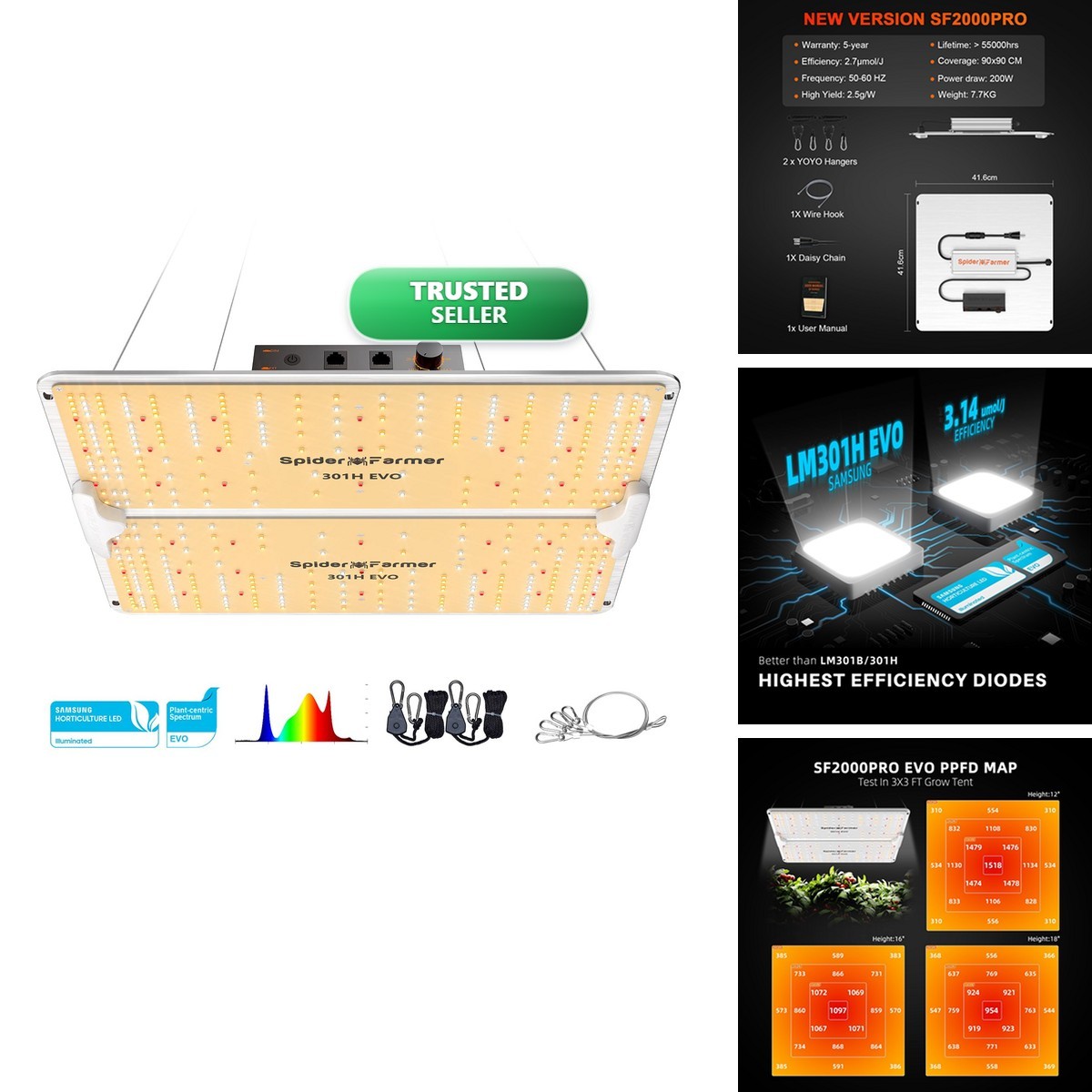

Photos from current listings. Actual item, color, and included accessories may vary.
LED Grow Tent Kit Buying Guide
An LED grow tent kit bundles a reflective enclosure, full-spectrum LED fixture, ventilation, and often a timer or fabric pot set into a single indoor cultivation system. The core trade-off is fixture efficiency and driver quality versus tent thickness and airflow capacity: high-efficacy LEDs with quality drivers and thick, light-tight fabric deliver reliable yields, while thin tents and unbranded drivers cause heat buildup and light leaks. The decision rule is simple: buy kits that specify LED chip brand and efficacy (µmol/J), tent fabric denier and zipper grade, and inline fan CFM sized to tent volume, and skip any kit that omits these three data points.
Key takeaways
- LED fixtures are rated by efficacy (µmol/J) and true wall draw; diode brand and driver quality determine yield per watt, not the marketing 'equivalent wattage'.
- Grow tent fabric is graded by denier (1680D > 600D > 210D) and zipper quality; thicker Oxford cloth with double-stitched seams blocks light leaks and supports filter and fan weight.
- Ventilation must match tent volume: an inline fan rated near the tent's cubic feet per minute requirement, paired with a carbon filter, controls heat and odor; passive vents alone are insufficient for high-power LEDs.
At a glance
- Category
- Greenhouse & Hydroponics
- Last updated
- Nov 28, 2026
Current offers
Highlights
- LED fixtures are rated by efficacy (µmol/J) and true wall draw; diode brand and driver quality determine yield per watt, not the marketing 'equivalent wattage'.
- Grow tent fabric is graded by denier (1680D > 600D > 210D) and zipper quality; thicker Oxford cloth with double-stitched seams blocks light leaks and supports filter and fan weight.
- Ventilation must match tent volume: an inline fan rated near the tent's cubic feet per minute requirement, paired with a carbon filter, controls heat and odor; passive vents alone are insufficient for high-power LEDs.
- Kit tiers differ by completeness: entry kits include tent, light, and basic exhaust; full kits add timers, ducting, fabric pots, and sometimes hydroponic reservoirs, so compare included components rather than fixture wattage alone.
Best use cases
- Best fit: a 2x4 or 3x3 ft footprint for a 200W full-spectrum LED with Samsung 281B+PRO chips—this pairing delivers adequate PPFD for flowering without excess heat in a small bedroom or closet.
- Best fit: 4x4 ft or larger tents should step up to 400–480W true-draw LED bars and a 6-inch inline fan; kits bundling a 200W light with a 4x4 tent under-light the canopy and stretch plants.
- Wrong fit: unheated garages, sheds, or basements below 60°F need insulated tents or supplemental heating; standard grow tent kits assume a climate-controlled room.
- Wrong fit: buyers wanting a silent bedroom setup should skip kits with unbranded inline fans and choose EC-motor fans with speed controllers, which run quieter and modulate airflow.
Buying tips
- Match LED true draw to footprint: roughly 30–40W per square foot for flowering means a 2x4 ft (8 sq ft) tent needs 240–320W, so a 200W fixture is best for vegetative growth or a 3x3 ft footprint.
- Choose 1680D Oxford fabric tents with metal corner connectors and double-stitched seams over 210D or 600D tents; thicker fabric resists pinhole light leaks and supports carbon filter weight.
- Size the inline fan to tent volume: a 2x4x5 ft tent is 40 cubic feet; with a carbon filter and ducting, select a fan rated at least 100–200 CFM and use a speed controller to manage noise and negative pressure.
- Confirm the LED driver is dimmable and daisy-chain capable, and that the kit includes a mechanical or digital timer rated for the fixture's load; cheap timers fail under high-wattage LED drivers.
Specs
| LED Efficacy | 2.3–3.0 µmol/J |
|---|---|
| Tent Fabric | 1680D > 600D > 210D Oxford |
| Ventilation | Inline fan 100–400 CFM |
| Kit Tier | Entry / Full / Hydroponic |
Related searches
What to check before buying
- Measure your room and tent footprint: a 2x4 ft tent needs at least 2.5x4.5 ft of floor space plus clearance for ducting and access doors; verify ceiling height for light hangers and filter placement.
- Check electrical capacity: a 200W LED plus fan and accessories draws roughly 2–3 amps at 120V; confirm the circuit supports the total load and use a surge protector.
- Verify climate compatibility: tents in cold rooms need insulation or heating, and high-humidity rooms require a dehumidifier; standard kits do not include climate control.
- Confirm included companion parts: ducting, clamps, carbon filter, timer, and fabric pots are often sold separately; kits that omit them add hidden cost and compatibility risk.
FAQ
Data sources: eBay / Amazon listings and product attribute feeds. Updated Nov 28, 2026.
Some links on this page are affiliate links. If you buy after clicking one, we may earn a commission at no extra cost to you. This does not change which products appear here or their order. Affiliate disclosure.