
Photos from current listings. Actual item, color, and included accessories may vary.
Grow Light Bulb Buying Guide
Grow light bulbs are screw-in or clip-in lamps that deliver photosynthetically active radiation (PAR) to indoor plants, and the core trade-off is between outdated low-efficiency blurple/incandescent globes and modern full-spectrum LED or ceramic-metal-halide emitters with real PPF and lifespan ratings. The decision rule: buy only lamps that publish PAR/PPFD, Kelvin, wattage draw, and diode or arc-tube lifespan—skip any bulb that lists 'equivalent watts' without true draw or omits PPF entirely.
Median $490.09 · New listings
Key takeaways
- LED grow bulbs run 2.0–2.8 µmol/J efficacy versus 1.0–1.4 µmol/J for CMH and under 0.5 µmol/J for incandescent/halogen; efficacy, not wattage, sets yield per kWh.
- Full-spectrum white LEDs (3000K–5000K plus 660 nm red) outperform blurple (blue/red only) for visual inspection and generally match or beat it in PPF per watt.
- Screw-in LED bulbs are passively cooled and typically rated 25,000–50,000 hours L70; CMH and HPS arc tubes lose 20–30% output by 10,000–15,000 hours and need replacement.
At a glance
- Category
- Greenhouse & Hydroponics
- Last updated
- Nov 27, 2026
Current offers
 LED Grow Light Bulb For Indoor Plants Red And Blue Spectrum LED Plant Light XIRK$245.36New · Last checked Nov 20, 2026View on eBay
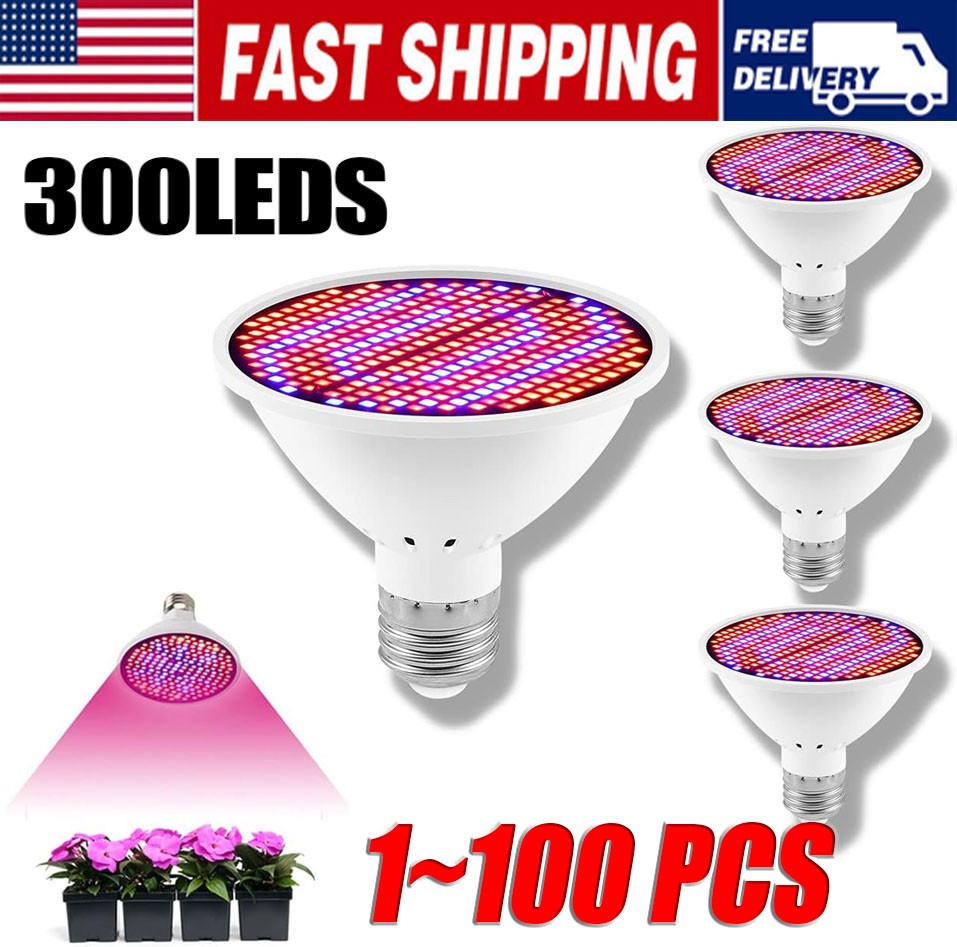 300LED Grow Light Bulb Full Spectrum Light for Indoor Plants Flowers Veg Growing$490.09New · Last checked Nov 20, 2026View on eBay
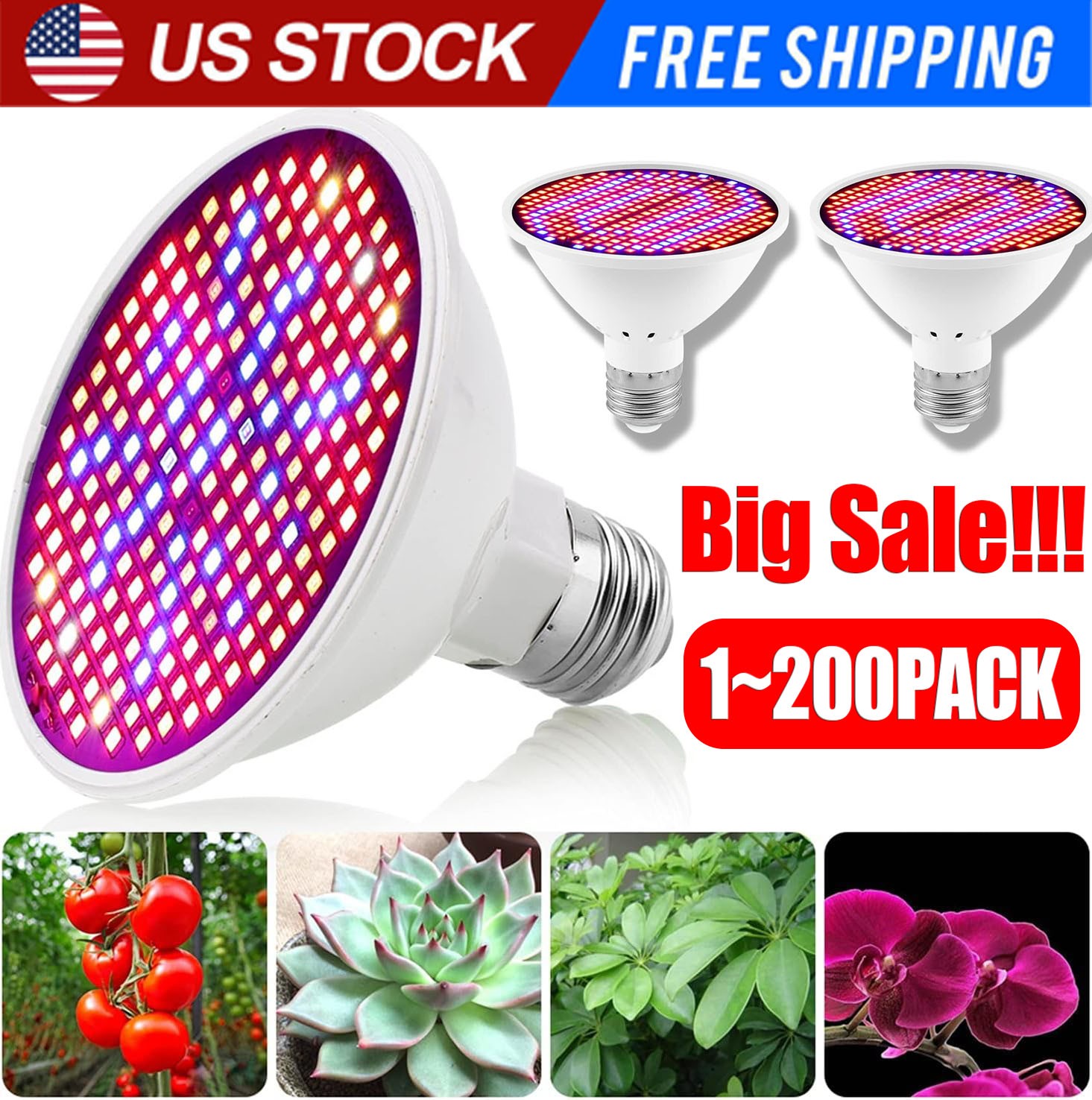 300LED Grow Light Bulb Full Spectrum Light for Indoor Plants Flowers Veg Growing$652.39New · Last checked Nov 20, 2026View on eBay
Highlights
- LED grow bulbs run 2.0–2.8 µmol/J efficacy versus 1.0–1.4 µmol/J for CMH and under 0.5 µmol/J for incandescent/halogen; efficacy, not wattage, sets yield per kWh.
- Full-spectrum white LEDs (3000K–5000K plus 660 nm red) outperform blurple (blue/red only) for visual inspection and generally match or beat it in PPF per watt.
- Screw-in LED bulbs are passively cooled and typically rated 25,000–50,000 hours L70; CMH and HPS arc tubes lose 20–30% output by 10,000–15,000 hours and need replacement.
- Standard E26/E27 base bulbs draw 9–36 W and cover 1–4 sq ft; higher-output mogul or integrated-array fixtures deliver 100–1000+ W and are not interchangeable with household sockets.
Best use cases
- Seedlings and leafy greens in a 1–2 sq ft tray: pick a 9–15 W full-spectrum E26 LED at 24–30 in above canopy; skip blurple and any 'equivalent to 100 W' claim.
- Single houseplant or herbs in a dark corner: choose a 15–36 W dimmable full-spectrum LED or a clip-on gooseneck array; skip high-output CMH/HPS, which overheat small spaces.
- Fruiting crops (tomatoes, peppers) in a 3×3 ft tent: use a 100–300 W bar or quantum-board LED fixture with published PPFD maps; skip screw-in bulbs, which physically cannot cover the canopy.
- Supplemental greenhouse lighting over 4+ sq ft: select commercial bar LEDs or CMH fixtures with 120–240 V drivers and daisy-chain ports; skip household-base bulbs rated only for dry indoor use.
Buying tips
- Match wattage to canopy: 30–50 W true LED draw per sq ft for fruiting crops, 15–25 W per sq ft for leafy greens and seedlings.
- Verify spectrum: demand 3000K–5000K white plus 660 nm red; reject bulbs listing only 'blue+red' ratios without Kelvin or nanometer bands.
- Check the driver and thermal design: mean-well-class drivers and aluminum heat sinks rated IP20 or higher for humid rooms; plastic-bodied bulbs run hotter and dim faster.
- For CMH/HPS, match ballast wattage exactly (e.g., 315 W CMH, 400/600/1000 W HPS) and confirm the bulb is pulse-start or square-wave compatible; mismatched ballasts shorten arc-tube life.
Specs
| Emitter Type | Full-spectrum LED / CMH / HPS |
|---|---|
| Efficacy | 2.0–2.8 µmol/J LED; 1.0–1.4 CMH |
| Base / Socket | E26/E27 household; E39 mogul HID |
| Lifespan | 25k–50k hr LED; 10k–15k hr HID |
Related searches
What to check before buying
- Measure canopy footprint and height clearance: screw-in LEDs need 18–36 in above plants, so confirm the socket or clip arm reaches without blocking windows.
- Confirm socket type and voltage: E26/E27 for household bulbs, mogul E39 for high-wattage HID, and 120 V vs 240 V drivers for hardwired fixtures.
- Verify room humidity and ventilation: passive LED bulbs in sealed terrariums overheat; use IP-rated fixtures or add airflow above 60% RH.
- Plan a timer and dimmer: most quality LED bulbs accept 0–10 V or TRIAC dimming and 12–16 h photoperiod control; check the bulb lists dimmable compatibility.
FAQ
Data sources: eBay / Amazon listings and product attribute feeds. Updated Nov 27, 2026.
Some links on this page are affiliate links. If you buy after clicking one, we may earn a commission at no extra cost to you. This does not change which products appear here or their order. Affiliate disclosure.