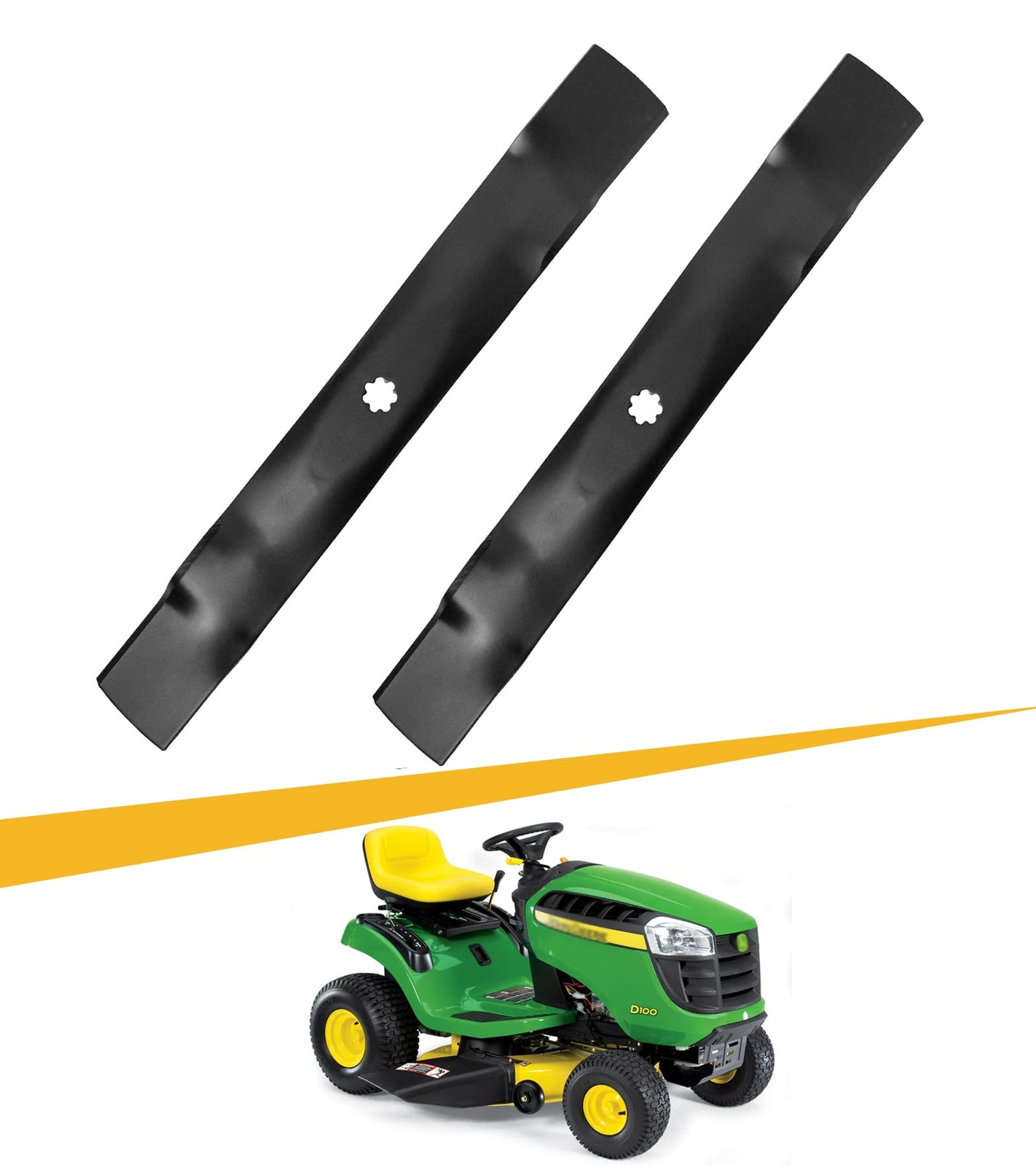

Photos from current listings. Actual item, color, and included accessories may vary.
42 In John Deere Blade Buying Guide
John Deere 42-inch decks are the most common residential size, but replacement blades must match the deck series (e.g., 100-series, D100, E100, or older LT) and the spindle style—not just the width. Buyers frequently order 42-inch blades that are the wrong length, offset, or center-hole diameter and then blame the deck. Use deck model and serial number, not the tractor's badge, to select the correct blade set.
Key takeaways
- 42-inch decks use blades roughly 21 inches long each, with center-hole diameters typically 5/8 inch or 7/8 inch depending on spindle series; measure the old blade or the spindle shaft before ordering.
- Deck series determines blade style: 100-series and D100 decks often use a star or round center hole with specific offset, while E100 and older LT decks can differ in blade length and lift wing shape.
- Mulching blades have extra cutting surfaces and curved wings that recirculate clippings; standard high-lift blades discharge better in tall or wet grass and are the safer default for side-discharge decks.
At a glance
- Category
- Residential Outdoor Power Equipment
- Last updated
- Nov 28, 2026
Current offers
Highlights
- 42-inch decks use blades roughly 21 inches long each, with center-hole diameters typically 5/8 inch or 7/8 inch depending on spindle series; measure the old blade or the spindle shaft before ordering.
- Deck series determines blade style: 100-series and D100 decks often use a star or round center hole with specific offset, while E100 and older LT decks can differ in blade length and lift wing shape.
- Mulching blades have extra cutting surfaces and curved wings that recirculate clippings; standard high-lift blades discharge better in tall or wet grass and are the safer default for side-discharge decks.
- Blade steel thickness and hardening matter: 0.135-inch to 0.160-inch hardened steel resists bending, while thin aftermarket blades dull faster and can vibrate on 42-inch decks.
Best use cases
- Best fit: residential lawns under one acre with a 42-inch John Deere 100-series or D100 deck—choose a 2-blade set with the correct center hole and standard high-lift profile for clean discharge.
- Choose mulching blades only if you already mulch regularly and your deck has a mulch plug or kit; standard decks without a mulch kit will clump and bog down in thick spring grass.
- Wrong fit: anyone ordering by tractor model alone without checking deck series—blades for a 42-inch D100 deck will not fit a 42-inch E100 or older LT deck because spindle and blade geometry changed.
Buying tips
- Check the deck model and serial number on the sticker under the deck, then cross-reference the blade part number—do not rely on the tractor's model year alone.
- Measure the old blade center hole and overall length; a 42-inch deck blade is about 21 inches tip-to-tip, and small differences in offset cause vibration or deck contact.
- Prioritize hardened steel with a thickness of at least 0.135 inch; thinner blades flex, dull quickly, and are more prone to bending on rocky or uneven lawns.
- Avoid mixing blade types on one deck—run two standard high-lift blades or a matched mulching pair, because mismatched lift profiles cause uneven cut and spindle wear.
Specs
| Deck Series Fit | 100, D100, E100, LT (verify serial) |
|---|---|
| Blade Length | ~21 in per blade (2-blade set) |
| Center Hole | 5/8 in or 7/8 in by spindle |
| Blade Type | High-lift standard or mulching |
Related searches
What to check before buying
- Locate the deck serial tag (often on the left side or rear of the deck) and confirm it matches the blade listing's fitment before ordering.
- Measure the spindle center-hole diameter and blade length from your existing blades; 42-inch decks commonly use 5/8-inch or 7/8-inch holes depending on series.
- Confirm your deck has the matching mulch plug or kit if you plan to use mulching blades; without it, clippings will clump and discharge poorly.
- Inspect the spindle shafts and blade bolts for wear or rounding—new blades will not fix vibration caused by worn spindles or a bent deck shell.
FAQ
Data sources: eBay / Amazon listings and product attribute feeds. Updated Nov 28, 2026.
Some links on this page are affiliate links. If you buy after clicking one, we may earn a commission at no extra cost to you. This does not change which products appear here or their order. Affiliate disclosure.