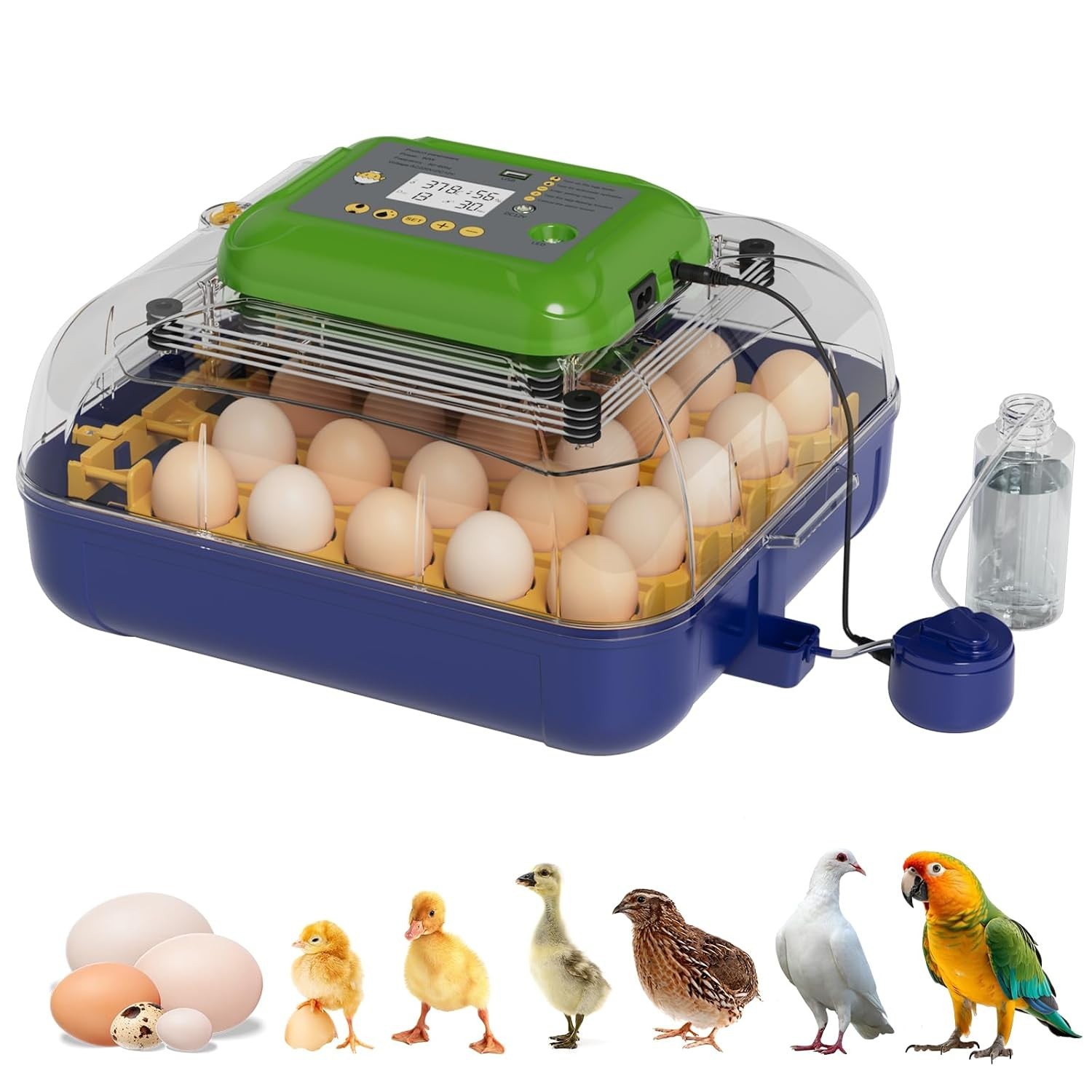

Photos from current listings. Actual item, color, and included accessories may vary.
Hatching Chicken Egg Buying Guide
Hatching chicken eggs requires a calibrated incubator that holds 99.5-100°F and 45-55% humidity during incubation, then 65-75% for lockdown, with automatic turning or manual 4-6x daily rotation. The core trade-off is forced-air thermal stability and true humidity control versus cheap still-air units that swing in temperature. Buy a forced-air cabinet with a separate humidity tray and independent thermometer/hygrometer; skip any incubator without a fan or with only a single preset thermostat.
Key takeaways
- Forced-air (fan-assisted) incubators hold ±0.5°F uniformity; still-air units stratify up to 5°F top-to-bottom and need a fan retrofit.
- Automatic turners rotate eggs every 1-2 hours; manual turning requires 4-6 rotations daily at roughly 90° angles and stops at lockdown day 18.
- Separate humidity control via water channels and vent adjustment is essential; preset single-tray units cannot hit the 65-75% lockdown target.
At a glance
- Category
- Chicken Fencing & Egg Handling
- Last updated
- Nov 28, 2026
Current offers
Highlights
- Forced-air (fan-assisted) incubators hold ±0.5°F uniformity; still-air units stratify up to 5°F top-to-bottom and need a fan retrofit.
- Automatic turners rotate eggs every 1-2 hours; manual turning requires 4-6 rotations daily at roughly 90° angles and stops at lockdown day 18.
- Separate humidity control via water channels and vent adjustment is essential; preset single-tray units cannot hit the 65-75% lockdown target.
- Capacity tiers (12, 25, 48+ eggs) are sized to egg size: a 12-egg bantam tray fits small eggs, while 25-egg chicken trays need roughly 1 inch between eggs for airflow.
Best use cases
- Best fit: 12-egg forced-air starter unit with auto turn and external humidity port for a first hatch of 6-12 chicken eggs or mixed quail/bantam — skip if you plan to hatch more than 20 eggs per cycle.
- Best fit: 25-egg forced-air cabinet with independent thermostat and humidity display for regular backyard flock replenishment — skip still-air foam boxes, which drift and need constant manual venting.
- Wrong fit: any incubator without a fan or with only a fixed 100°F preset and no humidity control for anyone hatching shipped eggs or expensive breeds — the hatch rate loss outweighs the savings.
- Best fit: a dedicated hatcher or a second unit set to 65-75% humidity for lockdown if you hatch more than 30 eggs at once — running one unit through both phases risks temperature spikes when you open it.
Buying tips
- Match egg count to usable tray space: a 12-egg unit fits 12 chicken eggs but only about 8-10 duck or 24+ quail eggs because of egg diameter differences.
- Choose a forced-air unit with an external humidity reservoir and adjustable vent; still-air foam incubators need a fan and separate hygrometer added, eroding the cost advantage.
- Confirm the thermostat is adjustable in 0.1°F increments and holds 99.5-100°F; fixed 100°F presets cannot compensate for cool rooms or shipped-egg stress.
- For lockdown, plan a separate hatcher or a unit with a lockdown mode that stops turning and raises humidity to 65-75%; turning during hatch can kill pipped chicks.
Specs
| Airflow | Forced-air fan vs still-air |
|---|---|
| Turning | Automatic vs manual 4-6x daily |
| Capacity | 12 / 25 / 48+ egg trays |
| Humidity Control | Adjustable 45-55% / 65-75% |
Related searches
What to check before buying
- Measure your counter or shelf: a 25-egg forced-air cabinet runs roughly 18-20 inches wide and needs 6 inches of clearance above for venting.
- Confirm room ambient stays between 65-80°F; incubators in cold garages or drafty sheds need a forced-air unit with a higher-wattage heater and insulation.
- Check plug and voltage: most units are 110-120V US standard; 220-240V regions need a step-down transformer or a native 220V model.
- Have a calibrated separate thermometer/hygrometer on hand — onboard displays are frequently off by 1-3°F and 5-10% RH, which is enough to ruin a hatch.
FAQ
Data sources: eBay / Amazon listings and product attribute feeds. Updated Nov 28, 2026.
Some links on this page are affiliate links. If you buy after clicking one, we may earn a commission at no extra cost to you. This does not change which products appear here or their order. Affiliate disclosure.