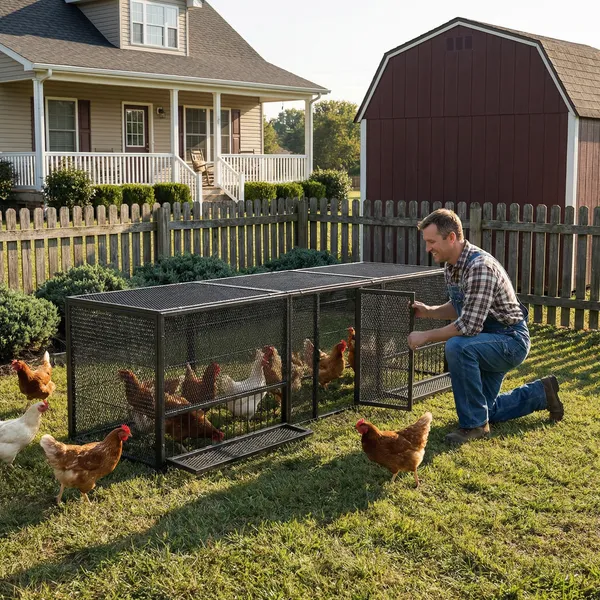

Photos from current listings. Actual item, color, and included accessories may vary.
Home Chicken Coop Buying Guide
A home chicken coop is a predator-resistant, ventilated animal enclosure whose durability hinges on wire gauge versus mesh size, framing material and joinery, and roof/floor weather sealing. The core trade-off is upfront build quality against constant patch-and-repair labor. The decision rule: buy a coop whose wire is at least 14-gauge welded mesh with 1/2-inch openings, a solid rot-resistant frame, and a raised, sealed floor; skip anything with chicken-wire (hexagonal netting), stapled seams, or untreated softwood.
Key takeaways
- Wire specification is the primary security metric: 14-gauge or thicker welded galvanized mesh with 1/2-inch openings resists raccoon and hawk predation; standard 1-inch hexagonal chicken wire stops chickens only and fails against predators.
- Frame and cladding durability divides tiers: hot-dipped galvanized steel or rot-resistant cedar/thermally treated wood outlast untreated pine or fir, which warps and rots within a few seasons in wet climates.
- Ventilation and draft control are structural, not optional: high-placed vents or ridge gaps with adjustable covers prevent ammonia buildup and frostbite while keeping roost-level air still.
At a glance
- Category
- Chicken Coops & Runs
- Last updated
- Nov 28, 2026
Current offers
Highlights
- Wire specification is the primary security metric: 14-gauge or thicker welded galvanized mesh with 1/2-inch openings resists raccoon and hawk predation; standard 1-inch hexagonal chicken wire stops chickens only and fails against predators.
- Frame and cladding durability divides tiers: hot-dipped galvanized steel or rot-resistant cedar/thermally treated wood outlast untreated pine or fir, which warps and rots within a few seasons in wet climates.
- Ventilation and draft control are structural, not optional: high-placed vents or ridge gaps with adjustable covers prevent ammonia buildup and frostbite while keeping roost-level air still.
- Space standards set the minimum viable footprint: 4 sq ft of interior floor per standard-size hen and 8-10 sq ft of run space per bird, with nest boxes at roughly one per 4-5 hens.
Best use cases
- Best fit: a stationary backyard flock of 4-8 hens in a mixed climate — pick a raised coop with a sealed floor, 1/2-inch mesh, and a hinged human-access door for cleaning; skip thin imported 'easy-install' cages with stapled panels for permanent home use.
- Best fit: a predator-heavy rural yard — choose a coop with a welded mesh skirt or buried apron and two-step latches; skip any model relying on chicken wire, spring hooks, or twist ties as the only closure.
- Best fit: a small urban or suburban yard — select a compact raised coop on lockable casters or a tractor-style portable run moved weekly; skip large stationary coops that exceed setback and floor-area rules.
- Wrong fit: open-bottom cages marketed for pigeons or 'home breeding' — those lack roosts, nest boxes, and wind protection and are not a year-round home flock coop.
Buying tips
- Size from bird count with margin: calculate 4 sq ft interior per standard hen plus 8-10 sq ft run per bird; bantam breeds need about 25% less, heavy breeds about 25% more.
- Specify mesh, not marketing: demand 14-gauge or heavier welded galvanized wire at 1/2-inch openings for the lower 3 ft and apron; 16-gauge or 1-inch hex netting is a predator compromise.
- Match framing to climate: hot-dipped galvanized steel or cedar in wet/humid regions; powder-coated steel in coastal salt air; untreated softwood only under a full roof with regular sealing.
- Choose roof and floor deliberately: an overhanging metal or asphalt-shingle roof with a plywood or composite floor raised 12-18 inches beats an open mesh floor for dryness and parasite control.
Specs
| Predator Mesh | 14-ga+ welded / 1/2-in openings |
|---|---|
| Frame Material | Galvanized steel / cedar / treated wood |
| Space Per Hen | 4 sq ft coop + 8-10 sq ft run |
| Nest Box Ratio | 1 box per 4-5 hens |
Related searches
What to check before buying
- Measure the intended footprint with clearance: confirm the coop plus run fits the yard with 2-3 ft of access space on the door and cleaning sides, and check local setback and flock-size limits.
- Verify predator and climate exposure: note local raccoon, fox, hawk, and snake pressure plus snow load and wind; the coop needs 1/2-inch mesh, lockable latches, and a roof rated for expected snow.
- Confirm level ground and anchoring: a coop on sloped or soft ground needs a level pad or buried apron; portable tractors require flat, movable pasture and predator skirts.
- Plan companion parts before assembly: roost bars, one nest box per 4-5 hens, a hanging feeder and nipple or cup waterer, and bedding; confirm the coop's door and vent dimensions accommodate them.
FAQ
Data sources: eBay / Amazon listings and product attribute feeds. Updated Nov 28, 2026.
Some links on this page are affiliate links. If you buy after clicking one, we may earn a commission at no extra cost to you. This does not change which products appear here or their order. Affiliate disclosure.