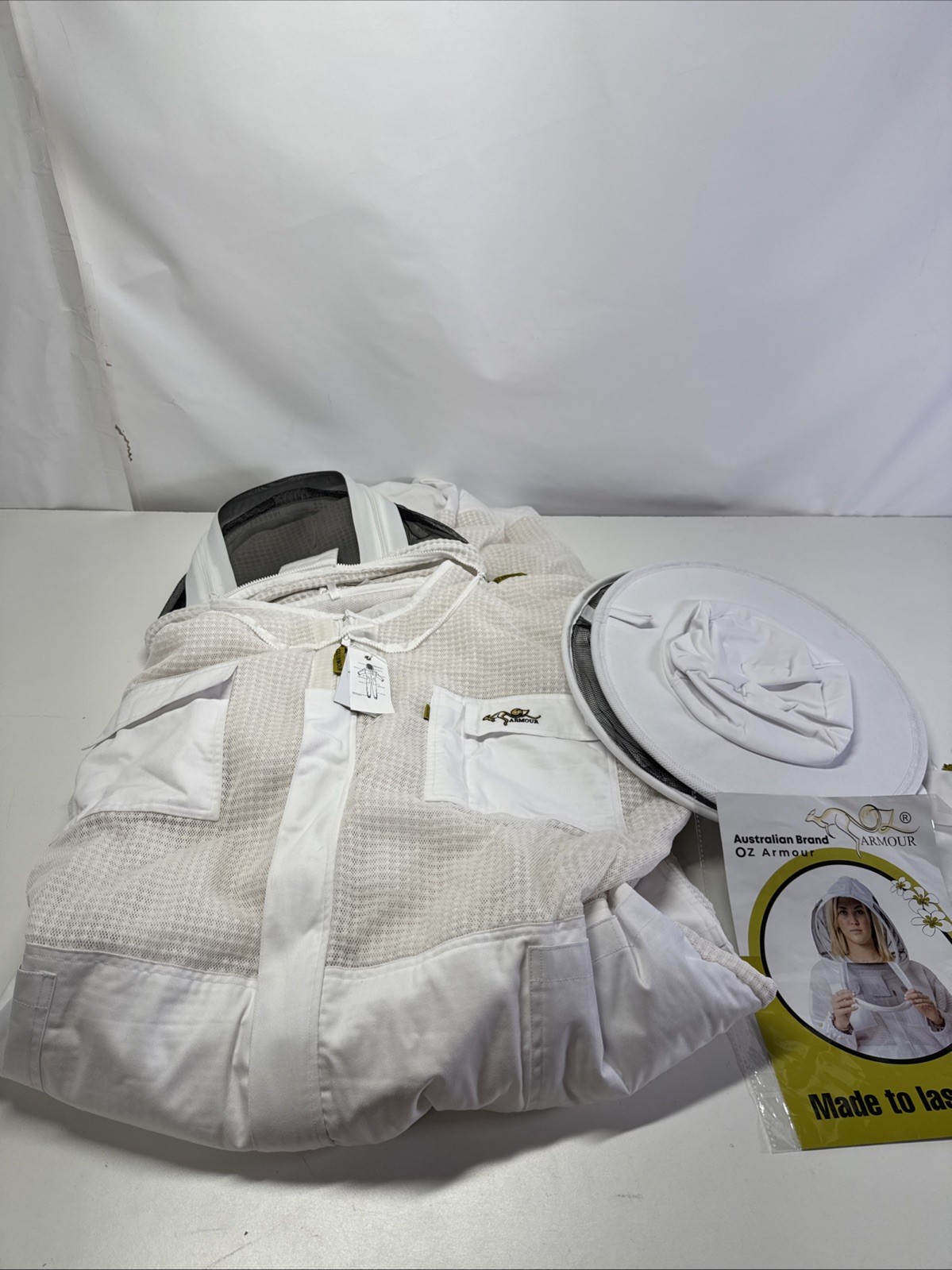

Photos from current listings. Actual item, color, and included accessories may vary.
Oz Armour Bee Suit Buying Guide
The Oz Armour Bee Suit is a heavyweight ventilated beekeeping suit built around a three-layer mesh architecture that stops stingers while allowing airflow, positioned as a premium alternative to standard cotton or poly-cotton suits. The primary trade-off is between ventilation and sting protection: ultra-breathable meshes can let fine stingers through under pressure, while heavy cotton blocks stings but traps heat. The clear decision rule is to pick a suit whose mesh density and seam construction are rated for your climate and bee temperament—ventilated triple-layer for hot apiaries with docile bees, and tightly woven or reinforced suits for aggressive colonies or high-heat physical work.
Key takeaways
- Three-layer ventilated mesh: outer and inner mesh layers sandwich a fine stinger-blocking membrane, delivering airflow without direct skin contact.
- Heavy-duty construction typically uses 220–280 GSM equivalent mesh with reinforced double-stitched seams at wrists, ankles, and zippers—critical failure points.
- Full-suit tiers differ by attached vs detachable hood, fencing veil vs round veil, and whether ankle/wrist closures are elastic cuffs or zippered vents.
At a glance
- Category
- Beekeeping Suits & Protection
- Last updated
- Nov 25, 2026
Current offers
Highlights
- Three-layer ventilated mesh: outer and inner mesh layers sandwich a fine stinger-blocking membrane, delivering airflow without direct skin contact.
- Heavy-duty construction typically uses 220–280 GSM equivalent mesh with reinforced double-stitched seams at wrists, ankles, and zippers—critical failure points.
- Full-suit tiers differ by attached vs detachable hood, fencing veil vs round veil, and whether ankle/wrist closures are elastic cuffs or zippered vents.
- Ykk-style heavy zippers and self-supporting collars distinguish premium tiers; budget suits often use lighter coil zippers that snag and gap.
Best use cases
- Best fit: Hot-climate beekeepers (sustained 85°F+) working docile Italian or Carniolan colonies—choose the triple-layer ventilated full suit with fencing veil for airflow and face clearance.
- Best fit: Commercial or sideliner workloads with frequent inspections—pick the tier with reinforced knee panels, thumb loops, and heavy zippers; skip lightweight hobby suits that wear through at seams.
- Wrong fit: Aggressive Africanized or defensive colonies in high-pressure inspections—a ventilated mesh suit alone is insufficient; layer a heavy cotton or leather jacket over key sting zones.
- Wrong fit: Cool-climate spring/fall work—ventilated suits run cold and offer no insulation; a standard poly-cotton suit with an insulating base layer is the better pick.
Buying tips
- Size by chest and height, not street size: ventilated suits run roomy to preserve airflow—order your normal chest measurement but size up if between sizes for layering.
- Check mesh rating: stinger-blocking requires mesh openings under 2 mm; triple-layer bonded mesh outperforms single-layer screening, which bees can sting through.
- Verify closure system: heavy-duty zippers with storm flaps at the veil, wrists, and ankles are the difference between a sting-proof suit and a gap-prone one.
- Confirm hood type: fencing veil (square, rigid, better visibility and face clearance) suits most; round veil is lighter but collapses against the face under wind.
Specs
| Mesh Architecture | Triple-layer ventilated vs single-layer |
|---|---|
| Stinger Blocking | Mesh openings under 2 mm |
| Veil Type | Fencing (rigid) vs round (collapsible) |
| Closure System | Heavy-duty zippers + storm flaps |
Related searches
What to check before buying
- Measure chest circumference and height against the suit size chart—ventilated suits need 2–4 inches of chest ease for airflow and layering.
- Confirm boot compatibility: ankle cuffs must overlap tall boots or be tuckable; elastic cuffs without straps let bees crawl up.
- Check glove interface: wrist closures must seal over or under your beekeeping gloves—measure glove cuff circumference before selecting suit size.
- Verify climate fit: ventilated triple-layer mesh suits are for warm/hot apiaries; below 60°F you need an insulating layer or a non-ventilated suit.
FAQ
Data sources: eBay / Amazon listings and product attribute feeds. Updated Nov 25, 2026.
Some links on this page are affiliate links. If you buy after clicking one, we may earn a commission at no extra cost to you. This does not change which products appear here or their order. Affiliate disclosure.