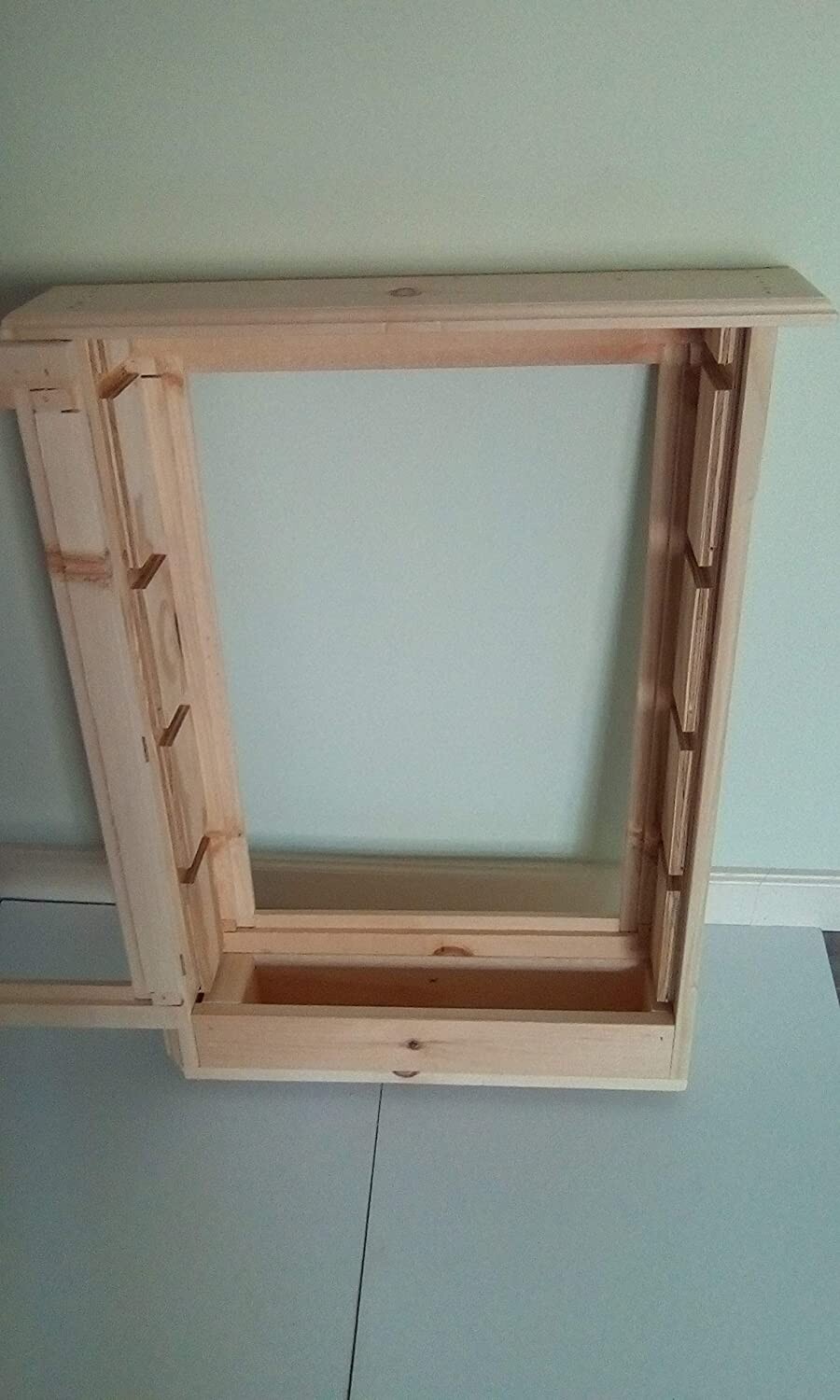

Photos from current listings. Actual item, color, and included accessories may vary.
Indoor Beehive Buying Guide
An indoor beehive is an observation hive designed to bring a functioning colony inside a home, classroom, or exhibition space, typically through a glass-walled box that holds standard Langstroth medium frames. The core trade-off is between full-size colony capacity (more frames, deeper boxes, heavier loaded weight) and observation-friendly compactness (fewer frames, thinner walls, easier viewing). The clear rule: buy a hive built to hold standard interchangeable medium frames with a sealed, escape-proof entry system and plan for a dedicated vent-to-outside duct — anything without a direct external entrance/exit port is a display box, not a working indoor hive.
Key takeaways
- Frame compatibility is the defining spec: true indoor observation hives accept standard 6-5/8 in medium Langstroth frames so brood and honey frames remain interchangeable with outdoor apiary equipment.
- Colony capacity drives everything: an 8-medium-frame indoor hive gives roughly 60-70 lb of loaded comb and bees, needing reinforced shelving or a stand rated well above that.
- Observation walls must be glass or high-clarity acrylic with sealed edges; unsealed seams and single-pane acrylic warp and fog with hive humidity, obscuring the view within a season.
At a glance
- Category
- Beehives & Frames
- Last updated
- Nov 28, 2026
Current offers
Highlights
- Frame compatibility is the defining spec: true indoor observation hives accept standard 6-5/8 in medium Langstroth frames so brood and honey frames remain interchangeable with outdoor apiary equipment.
- Colony capacity drives everything: an 8-medium-frame indoor hive gives roughly 60-70 lb of loaded comb and bees, needing reinforced shelving or a stand rated well above that.
- Observation walls must be glass or high-clarity acrylic with sealed edges; unsealed seams and single-pane acrylic warp and fog with hive humidity, obscuring the view within a season.
- The entrance must be a dedicated tunnel or port through a wall or window to the outdoors — a screened vent into the room recirculates humid air and bee pheromones instead of exhausting them.
Best use cases
- Best fit: classrooms, nature centers, and hobbyists who want year-round observation — choose a full-size 8-medium-frame glass hive with an external entrance tunnel and rear vent port.
- Best fit: a single-season educational display or pollinator exhibit — a compact 2-4 frame observation hive with a closable entrance is easier to move and re-queen.
- Wrong fit: keeping a permanent indoor colony in a spare bedroom with only a window screen — without a sealed tunnel to the outside, bees orient to the room light and humidity spikes.
- Skip: thin single-pane acrylic boxes marketed as 'indoor hives' with no frame-standard dimensions — they are display cases that cannot accept real Langstroth frames or support a laying queen.
Buying tips
- Match frames to the medium Langstroth standard (6-5/8 in depth, 19 in top bar): anything else means custom frames and no interchange with outdoor hives.
- Size the stand and floor for loaded weight: 8 medium frames of honey and brood run 60-70 lb, so use a stand rated at least 100 lb with a drip tray.
- Require a 1-1.5 in inside-diameter entrance tunnel long enough to pass through your wall or window frame, plus a sliding closure for transport and queen introduction.
- Choose tempered glass or 1/4 in cast acrylic viewing panels; thinner 1/8 in acrylic bows under humidity and distorts the view within months.
Specs
| Frame Standard | Medium Langstroth, 6-5/8 in deep |
|---|---|
| Colony Capacity | 2-4 frames compact / 8 frames full-size |
| Viewing Panel | Tempered glass or 1/4 in cast acrylic |
| Entrance Type | External 1-1.5 in tunnel with closure |
Related searches
What to check before buying
- Measure the wall or window path for the entrance tunnel: you need a continuous 1-1.5 in bore from hive face to outdoors, with no gaps into the room.
- Confirm the shelf or stand footprint and load rating for an 8-frame hive at 60-70 lb loaded, plus clearance for the lid and frame removal.
- Check room climate: indoor hives need ambient temperatures above roughly 50°F and a vent path to outside to exhaust humidity, not recirculate it.
- Verify the hive includes a feeder port, queen excluder slot, and bottom debris tray — these are the parts that make indoor management practical.
FAQ
Data sources: eBay / Amazon listings and product attribute feeds. Updated Nov 28, 2026.
Some links on this page are affiliate links. If you buy after clicking one, we may earn a commission at no extra cost to you. This does not change which products appear here or their order. Affiliate disclosure.