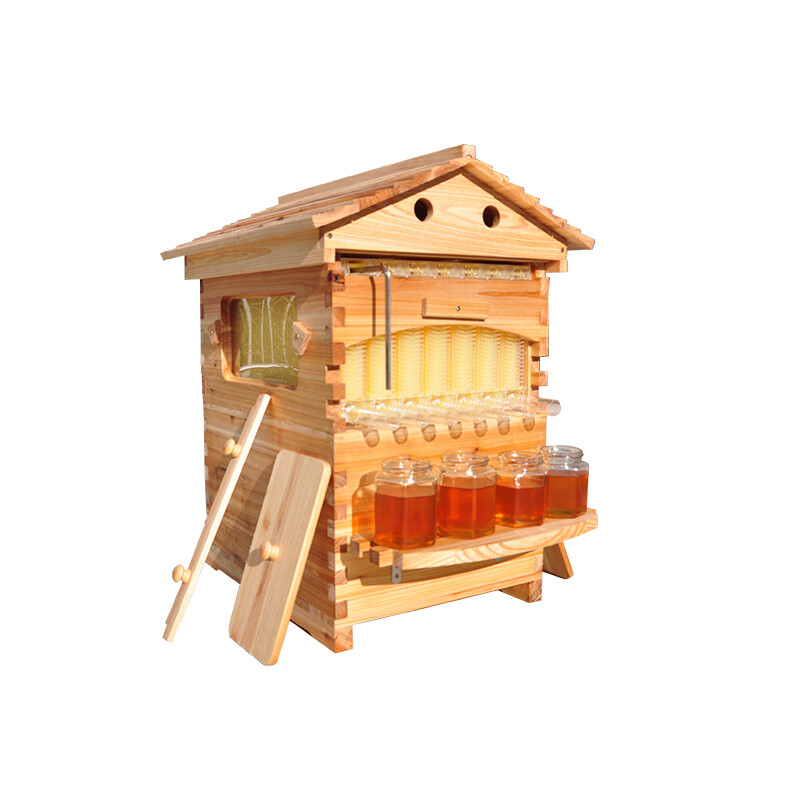

Photos from current listings. Actual item, color, and included accessories may vary.
Honey Bee Box Buying Guide
A honey bee box is the physical hive cavity—most commonly a Langstroth modular stack of brood and honey supers—that determines colony management, honey harvest ease, and long-term weather resistance. The primary trade-off is frame compatibility and box material: standard 10-frame Langstroth pine with proper joints supports interchangeable parts and expands, while odd frame counts, thin walls, or non-standard spacing lock you into proprietary replacements. The decision rule: buy only hive bodies that state Langstroth frame capacity, use a known box depth (deep, medium, or shallow), and specify lumber thickness or food-grade plastic—skip unlabeled boxes with mixed frame counts.
Key takeaways
- Langstroth boxes are defined by frame capacity and depth: 10-frame vs 8-frame width, and deep (9-5/8"), medium (6-5/8"), or shallow (5-11/16") height, each holding a matching frame size.
- Standard Langstroth frame spacing is 1-3/8" center-to-center; boxes built to this spec accept standard foundation, feeders, and extractors without modification.
- Box wall thickness drives insulation and durability: 3/4" kiln-dried pine is the common standard, while 1" or food-grade HDPE/PVC resists rot and moisture better in humid climates.
At a glance
- Category
- Beehives & Frames
- Last updated
- Nov 28, 2026
Current offers
Highlights
- Langstroth boxes are defined by frame capacity and depth: 10-frame vs 8-frame width, and deep (9-5/8"), medium (6-5/8"), or shallow (5-11/16") height, each holding a matching frame size.
- Standard Langstroth frame spacing is 1-3/8" center-to-center; boxes built to this spec accept standard foundation, feeders, and extractors without modification.
- Box wall thickness drives insulation and durability: 3/4" kiln-dried pine is the common standard, while 1" or food-grade HDPE/PVC resists rot and moisture better in humid climates.
- Box joints (finger joints) and rabbet cuts determine structural life; dovetailed or box-jointed corners with exterior-grade glue and nails outperform stapled butt joints under loaded honey weight.
Best use cases
- Best fit: a backyard beekeeper starting with one colony should buy a 10-frame deep brood box plus a medium super, because standard Langstroth dimensions keep frames, feeders, and extractors interchangeable.
- Best fit: a hobbyist harvesting comb honey or running a smaller apiary should choose 8-frame boxes to reduce lifted weight per box, accepting slightly lower honey volume per super.
- Wrong fit: buyers in high-humidity or rainy climates should skip thin 1/2" pine boxes and choose 3/4" pine with exterior paint or food-grade plastic to prevent warping and rot.
- Wrong fit: anyone buying a box advertised only as "bee house" or with a non-standard frame count should skip it—replacement frames and accessories will not fit standard Langstroth gear.
Buying tips
- Match frame count and depth before buying: a 10-frame deep box needs ten deep frames (9-5/8"), while an 8-frame medium box needs eight medium frames (6-5/8"); mismatched frames leave gaps or won't fit.
- Choose 3/4" kiln-dried pine for most climates; step up to 1" thick walls or food-grade plastic if winters are severe or humidity is consistently high, since thin walls condense moisture.
- Verify joint construction: box-jointed or dovetailed corners with exterior glue and ring-shank nails hold up under 60-80 lb loaded supers; stapled butt joints are a durability compromise.
- Buy boxes that include or explicitly fit standard Langstroth frames and a matching bottom board and inner cover; a box sold without frame-size specs is a closed system with no replacement path.
Specs
| Frame Standard | Langstroth (standard spacing) |
|---|---|
| Frame Count | 8-frame or 10-frame |
| Box Depth | Deep 9-5/8" / Medium 6-5/8" |
| Wall Material | 3/4" pine / food-grade plastic |
Related searches
What to check before buying
- Confirm your intended frame count (8 or 10) and depth (deep, medium, shallow) so the box matches the frames, foundation, and extractor you already own or plan to buy.
- Measure your hive stand or existing hive footprint: a 10-frame box is roughly 19-7/8" long, while an 8-frame box is about 16-1/4" long, so mixing widths breaks stack alignment.
- Check climate and exposure: painted 3/4" pine works in most zones, but full-sun humid sites benefit from plastic or thicker walls; ensure the lid overhangs and sheds rain.
- Plan companion parts before purchase: a complete stack needs a bottom board, inner cover, outer cover, entrance reducer, and frames with foundation—boxes sold alone require these separately.
FAQ
Data sources: eBay / Amazon listings and product attribute feeds. Updated Nov 28, 2026.
Some links on this page are affiliate links. If you buy after clicking one, we may earn a commission at no extra cost to you. This does not change which products appear here or their order. Affiliate disclosure.