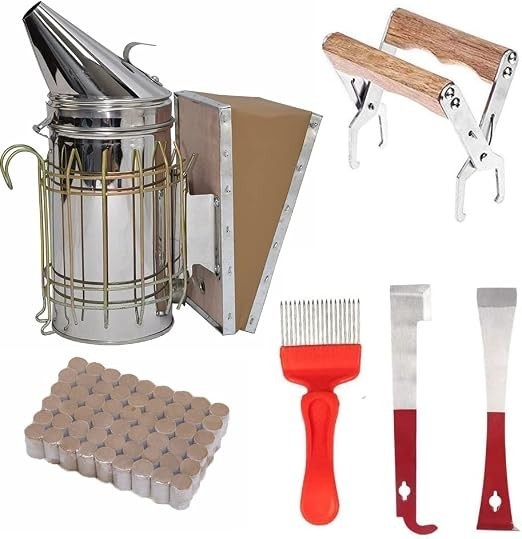

Photos from current listings. Actual item, color, and included accessories may vary.
Hive Tool Buying Guide
A hive tool is the beekeeper's primary prying and scraping instrument—used to break propolis seals, separate hive boxes, and lever frames—and the core trade-off is steel grade versus handle ergonomics: cheap carbon steel bends and rusts, while properly hardened stainless or spring steel holds an edge and resists corrosion. Buy a hardened stainless or spring-steel tool with a full-tang or forged shank; skip thin stamped mystery-metal imports that flex under frame weight.
Key takeaways
- J-hook vs L-hook: the J-hook pulls frames up and scrapes parallel to comb; the L-hook levers boxes apart and scrapes perpendicular—most beekeepers carry both.
- Hardened stainless (e.g., 420/440-grade) resists propolis corrosion and holds a scraping edge; plain carbon steel is cheaper but rusts and dulls faster.
- Full-tang or forged one-piece construction transmits prying force without bending; stamped two-piece riveted handles loosen over seasons.
At a glance
- Category
- Bee Smokers & Hive Tools
- Last updated
- Nov 24, 2026
Current offers
Highlights
- J-hook vs L-hook: the J-hook pulls frames up and scrapes parallel to comb; the L-hook levers boxes apart and scrapes perpendicular—most beekeepers carry both.
- Hardened stainless (e.g., 420/440-grade) resists propolis corrosion and holds a scraping edge; plain carbon steel is cheaper but rusts and dulls faster.
- Full-tang or forged one-piece construction transmits prying force without bending; stamped two-piece riveted handles loosen over seasons.
- Standard hive tool length runs roughly 9-10 in with a 1-1.5 in-wide scraper blade; the paint-scraper end and nail-puller notch are the two most-used features.
Best use cases
- Best fit: backyard beekeeper with 1-5 hives—buy a J-hook plus L-hook pair in hardened stainless; skip single cheap carbon-steel tools that bend at the hook.
- Best fit: frequent inspections and honey harvests—pick a full-tang forged tool with a bright finish so it is visible when dropped in grass; skip painted tools that chip into the hive.
- Wrong fit: buying a multi-piece kit solely for the hive tool—kit tools are often thinner stamped steel; buy the tool separately and pair with a smoker only if needed.
- Wrong fit: using a standard hive tool as a frame grip or uncapping knife—dedicated frame holders and uncapping tools outperform it for those jobs.
Buying tips
- Choose hardened stainless or spring steel for corrosion resistance and edge retention; plain carbon steel needs oiling after every session.
- Check for a full-tang or forged shank and a securely riveted or molded handle—flex at the hook means bent frames and lost leverage.
- Match hook style to task: J-hook for lifting frames and scraping, L-hook for prying boxes and scraping propolis off top bars.
- Buy two tools—one J-hook and one L-hook—so you are not swapping ends mid-inspection; keep a spare in the bee bag.
Specs
| Hook Style | J-hook / L-hook / combo |
|---|---|
| Steel Grade | Hardened stainless vs carbon steel |
| Construction | Full-tang forged vs stamped |
| Tool Length | 9-10 in standard |
Related searches
What to check before buying
- Measure your hive box seams and frame rests: a 1-1.5 in scraper blade fits standard Langstroth dimensions; oversized blades mar wood.
- Confirm handle grip diameter fits your hand and gloves—thick gloved hands need a larger, textured grip.
- Check steel finish: bright polished or electropolished stainless wipes clean and resists propolis buildup better than rough cast surfaces.
- Verify the tool length clears your hive stand height and fits your tool bag or holster without snagging.
FAQ
Data sources: eBay / Amazon listings and product attribute feeds. Updated Nov 24, 2026.
Some links on this page are affiliate links. If you buy after clicking one, we may earn a commission at no extra cost to you. This does not change which products appear here or their order. Affiliate disclosure.