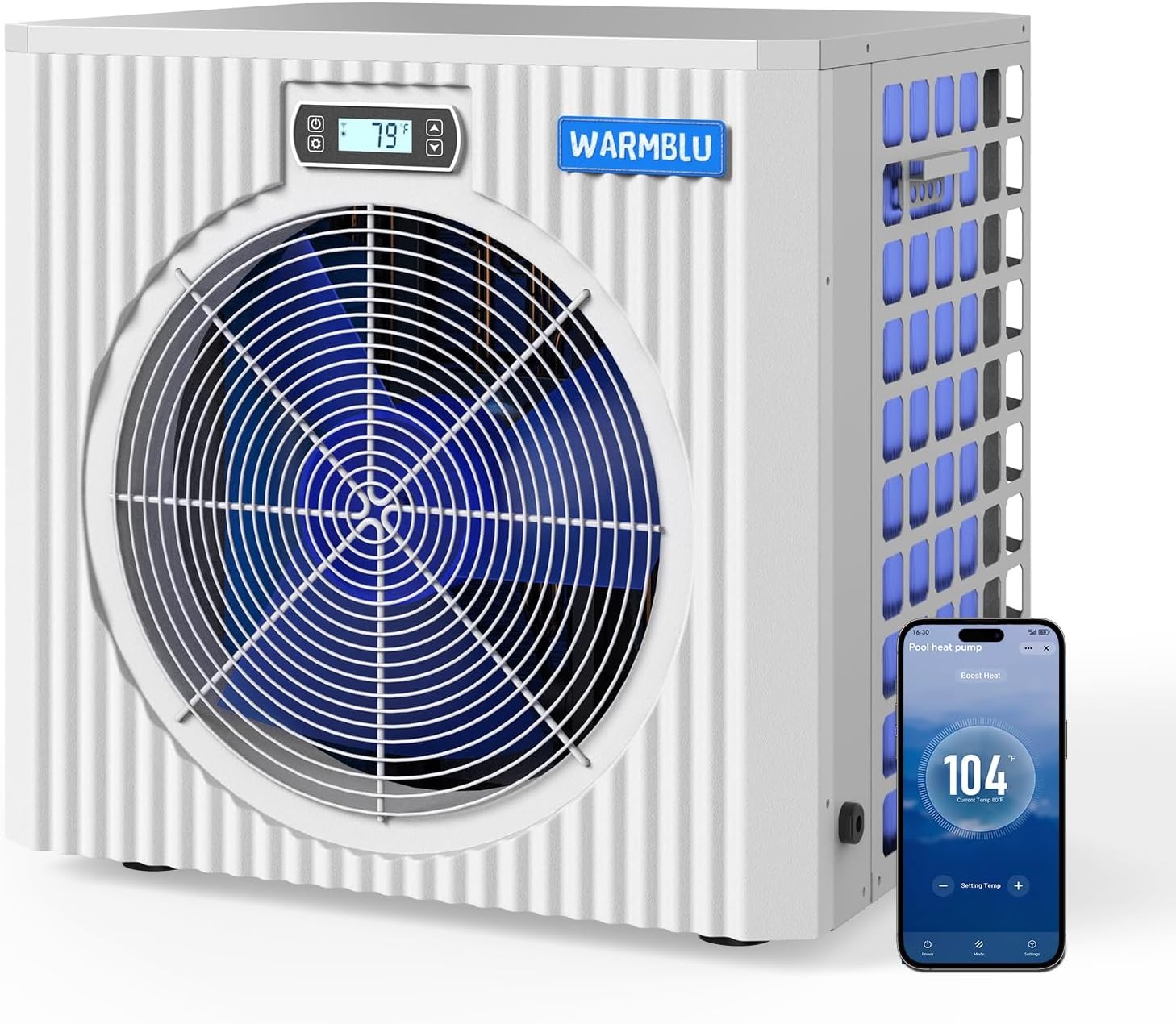

Photos from current listings. Actual item, color, and included accessories may vary.
Heat Pump Pool Heater Buying Guide
A heat pump pool heater moves existing heat from the air into your pool water, delivering 4–6x the heat per watt of a resistive electric heater and maintaining temperature rather than only extending the season. The core trade-off is compressor architecture and BTU sizing: fixed-speed on/off units cost less upfront but cycle hard and lose efficiency below 50°F, while inverter (variable-speed) models modulate output, hold temperature in cooler air, and pair with 220–240V service. Buy an inverter unit sized to your pool volume and local air temperature if you heat year-round or want the lowest operating cost; choose a fixed-speed unit only for seasonal heating in warm climates with a tight budget.
Key takeaways
- Inverter (variable-speed) compressors modulate RPM to match heat loss, maintaining COP above 4 down to roughly 50°F air; fixed-speed units drop toward COP 3–3.5 and cycle on/off at lower temps.
- BTU sizing rule: 1 BTU per gallon raises water ~1°F per hour; a 20,000-gallon pool needs ~100,000 BTU for meaningful heat gain, while 27,000–55,000 BTU units suit above-ground pools under 10,000 gallons.
- Voltage tiers are rigid: 110–120V units cap near 27,000 BTU and need a dedicated 15–20A circuit; 220–240V inverter units deliver 80,000–140,000 BTU and require a 30–60A breaker with correct wire gauge.
At a glance
- Category
- Pools & Spas
- Last updated
- Nov 28, 2026
Current offers
Highlights
- Inverter (variable-speed) compressors modulate RPM to match heat loss, maintaining COP above 4 down to roughly 50°F air; fixed-speed units drop toward COP 3–3.5 and cycle on/off at lower temps.
- BTU sizing rule: 1 BTU per gallon raises water ~1°F per hour; a 20,000-gallon pool needs ~100,000 BTU for meaningful heat gain, while 27,000–55,000 BTU units suit above-ground pools under 10,000 gallons.
- Voltage tiers are rigid: 110–120V units cap near 27,000 BTU and need a dedicated 15–20A circuit; 220–240V inverter units deliver 80,000–140,000 BTU and require a 30–60A breaker with correct wire gauge.
- Titanium tube-in-shell heat exchangers resist chlorine and salt up to ~5,000 ppm; cupronickel is a cheaper alternative but degrades faster in high-chlorine or saltwater pools.
Best use cases
- Above-ground pool under 10,000 gallons in a warm climate: pick a 110V 27,000–40,000 BTU fixed or inverter unit that plugs into a dedicated circuit; skip 220V commercial-sized units.
- In-ground pool 15,000–30,000 gallons with year-round use: choose a 220–240V all-DC inverter unit at 100,000–140,000 BTU with titanium exchanger and WiFi/app control; skip 110V plug-in heaters.
- Seasonal extend-only heating in a mild climate (air above 60°F): a fixed-speed 220V unit at 1 BTU/gallon is adequate and cheaper upfront; skip inverter premiums if you never heat below 60°F air.
- Saltwater or high-chlorine pool: require titanium heat exchanger rated to 5,000+ ppm salt; skip cupronickel or aluminum exchangers that corrode and void warranty.
Buying tips
- Size by pool volume, not by unit BTU alone: target 1 BTU per gallon for 1°F/hour gain, and add 20–30% if the pool is shaded, windy, or uncovered.
- Match voltage to your panel: 110–120V units max out near 27,000 BTU; anything above 55,000 BTU requires 220–240V and a dedicated breaker (typically 30–60A).
- Demand a titanium tube-in-shell exchanger for chlorine or salt pools; cupronickel is acceptable only for low-chlorine, non-salt water and short seasons.
- Inverter units cost more but hold COP 4–6 at 50°F air versus 3–3.5 for fixed-speed; payback comes in 2–4 seasons if you heat more than 3 months per year.
Specs
| Compressor Type | Inverter variable-speed vs fixed-speed |
|---|---|
| BTU Capacity | 27,000–140,000 BTU |
| Voltage / Breaker | 110–120V 15–20A or 220–240V 30–60A |
| Heat Exchanger | Titanium tube-in-shell (salt-rated) |
Related searches
What to check before buying
- Measure pool volume (length × width × average depth × 7.5 for rectangular; × 5.9 for round) to confirm gallon capacity before selecting BTU.
- Confirm electrical service: 110V units need a dedicated 15–20A outdoor GFCI circuit; 220V units need a 30–60A breaker and correct wire gauge run.
- Check air temperature range: inverter units maintain heat to ~50°F air; fixed-speed units lose efficiency below 60°F and should be bypassed in winter.
- Verify plumbing compatibility: most units use 1.5–2 inch PVC unions and require a bypass valve kit for flow rates above the heater's max GPM.
FAQ
Data sources: eBay / Amazon listings and product attribute feeds. Updated Nov 28, 2026.
Some links on this page are affiliate links. If you buy after clicking one, we may earn a commission at no extra cost to you. This does not change which products appear here or their order. Affiliate disclosure.