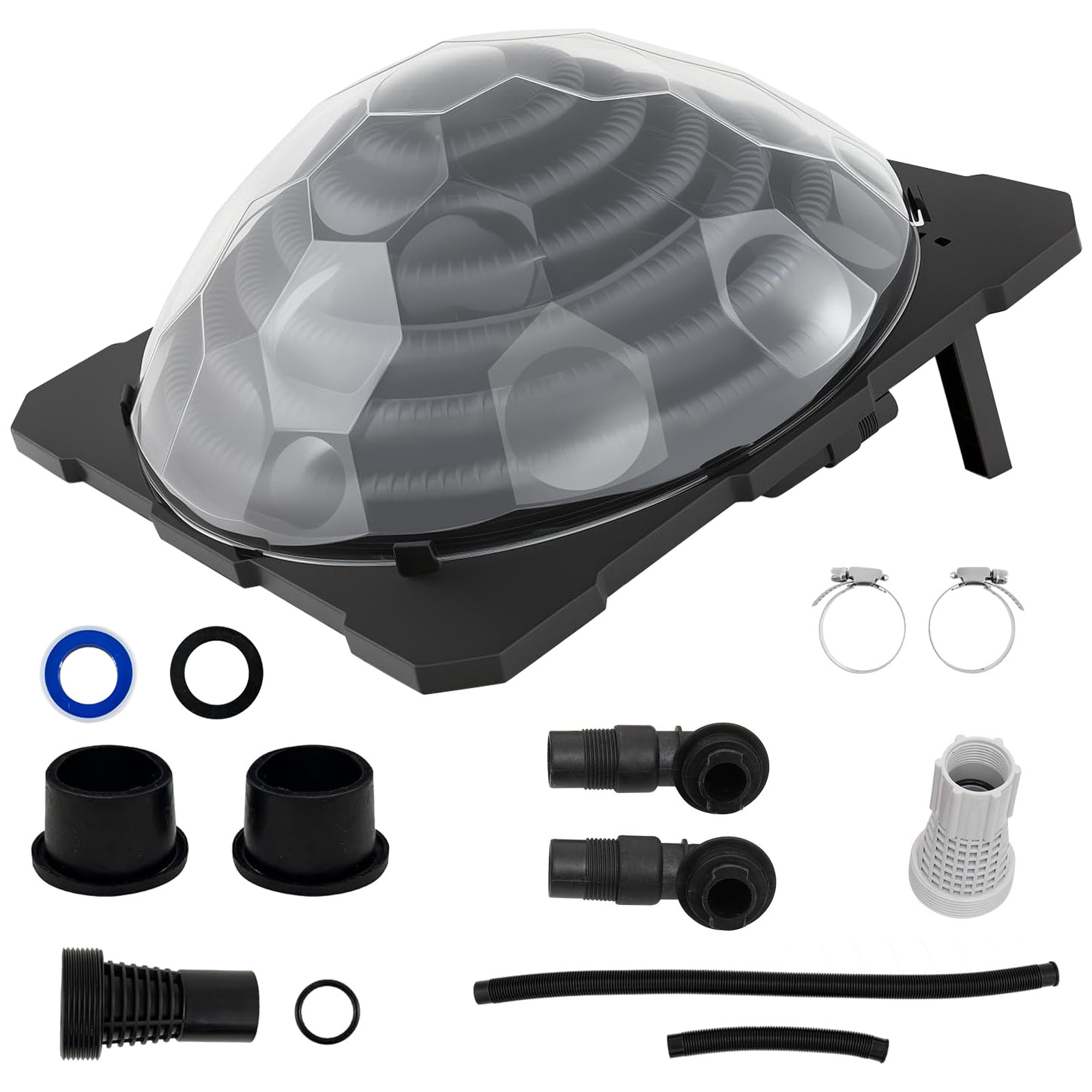

Photos from current listings. Actual item, color, and included accessories may vary.
Above Ground Pool Warmer Buying Guide
Above-ground pool warmers are solar heating systems that circulate pool water through collector panels to raise temperature without grid energy. The core trade-off is collector surface area versus available sunlight and pump compatibility: undersized panels cannot overcome overnight heat loss. Choose by matching collector area to pool volume and ensuring the circulator pump meets the panel's minimum flow.
Key takeaways
- Solar collector area is the limiting factor: a common rule is 50-100% of pool surface area; below 50% yields marginal warming in cool climates.
- Panel material grades: ethylene-propylene-diene monomer (EPDM) rubber or polypropylene; EPDM tolerates higher stagnation temperatures and UV better than thin PVC.
- Systems are either unglazed (open-flow mat) or glazed (insulated box); glazed panels produce higher water temperatures in low-sun conditions but cost more.
At a glance
- Category
- Pools & Spas
- Last updated
- Nov 28, 2026
Current offers
Highlights
- Solar collector area is the limiting factor: a common rule is 50-100% of pool surface area; below 50% yields marginal warming in cool climates.
- Panel material grades: ethylene-propylene-diene monomer (EPDM) rubber or polypropylene; EPDM tolerates higher stagnation temperatures and UV better than thin PVC.
- Systems are either unglazed (open-flow mat) or glazed (insulated box); glazed panels produce higher water temperatures in low-sun conditions but cost more.
- Pump compatibility: most solar mats require a minimum flow of 10-20 gallons per minute per panel; undersized cartridge pumps often fail to provide enough flow.
Best use cases
- Best fit: daytime-only warming in sunny climates for pools 15-24 feet round with a dedicated 0.5-1 HP pump; choose unglazed EPDM mats sized at 50% of pool surface area.
- Wrong fit: year-round heating in cold climates or heavily shaded yards; solar alone cannot maintain temperature and should be skipped in favor of a heat pump.
- Best fit: above-ground pools with a sand filter system that already runs 6-8 hours daily; integrate panels on a south-facing rack between filter and return.
- Wrong fit: inflatable or soft-sided pools with low-flow cartridge pumps under 1000 GPH; the solar loop will starve flow and provide negligible heat.
Buying tips
- Size collector area at 50-100% of pool water surface: a 24-foot round pool (452 sq ft) needs 226-452 sq ft of solar mat, typically 4-8 panels.
- Select EPDM or UV-stabilized polypropylene panels over thin PVC; PVC mats degrade faster under stagnation and freeze cycles.
- Match panel flow rating to pump output: a 1 HP pump typically delivers 40-60 GPM, enough for 2-3 panels in parallel; use a diverter valve to balance flow.
- For glazed panels, confirm the system includes a freeze-protection drain-back or automatic bypass; unglazed mats can be manually drained.
Specs
| Collector Type | Unglazed mat vs glazed panel |
|---|---|
| Panel Material | EPDM rubber / polypropylene / PVC |
| Sizing Rule | 50-100% of pool surface area |
| Min Pump Flow | 10-20 GPM per panel |
Related searches
What to check before buying
- Measure pool surface area and daily sun exposure hours; panels need at least 4-6 hours of direct sun for effective heating.
- Confirm pump flow rate in GPH and filter system type; solar mats require a minimum flow that most cartridge pumps do not meet.
- Check mounting location: south-facing rack or roof within hose-run distance; longer runs lose heat and require a booster pump.
- Verify plumbing compatibility: most systems use 1.5-inch or 1.25-inch hoses with adapters for above-ground pools; confirm your pool's return fitting size.
FAQ
Data sources: eBay / Amazon listings and product attribute feeds. Updated Nov 28, 2026.
Some links on this page are affiliate links. If you buy after clicking one, we may earn a commission at no extra cost to you. This does not change which products appear here or their order. Affiliate disclosure.