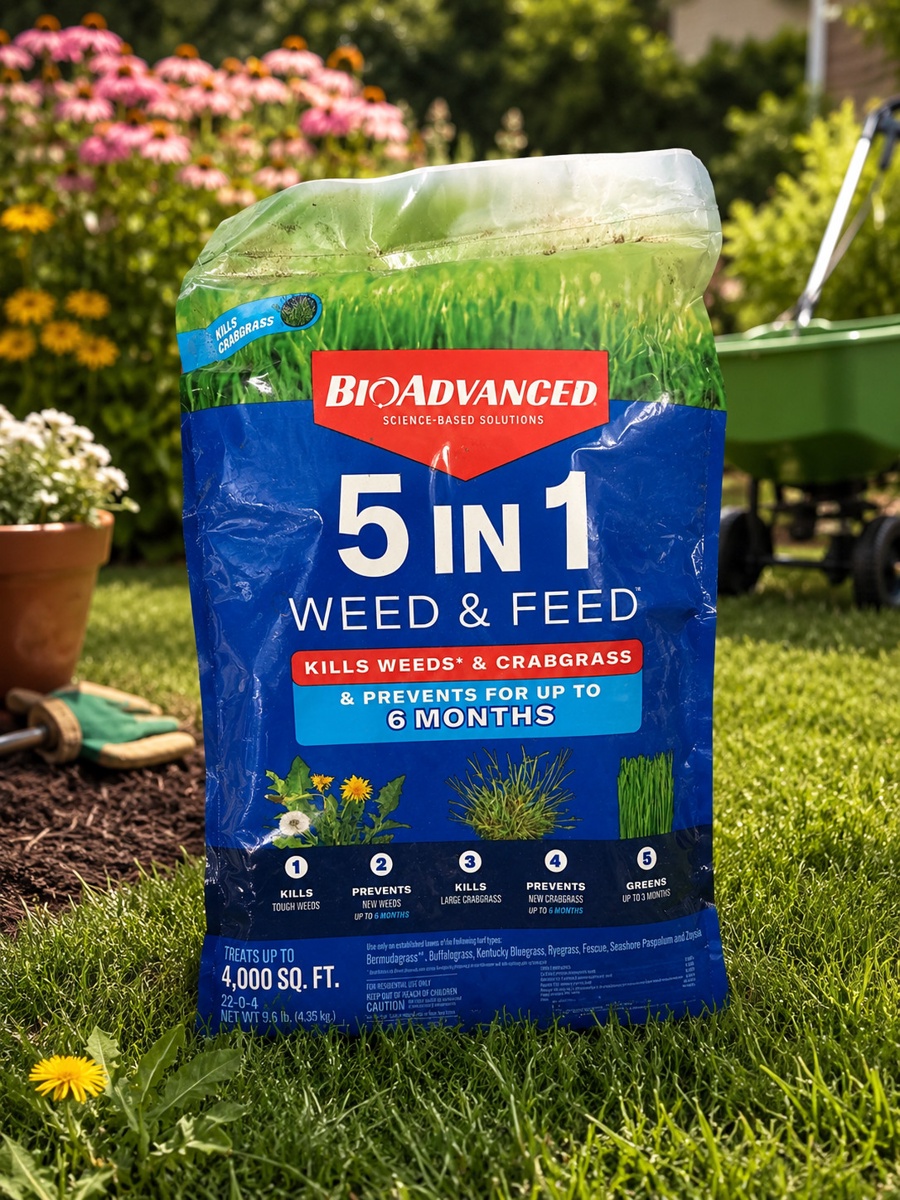

Photos from current listings. Actual item, color, and included accessories may vary.
Weed Killer Lawn Without Killing Grass Buying Guide
Selective post-emergent herbicides kill broadleaf and grassy weeds in established turf without harming the lawn grass when dosed correctly. The key trade-off is selectivity: 2,4-D and dicamba formulations control broadleaf weeds but can injure desirable grasses at high rates, while non-selective glyphosate kills everything. Choose a lawn-safe herbicide matched to your grass type and weed class; skip soil sterilants and total-vegetation killers for turf use.
Key takeaways
- Granular weed-and-feed products combine a slow-release nitrogen carrier with 2,4-D or dicamba for post-emergent broadleaf control plus fertilization in one pass.
- Liquid concentrate 2,4-D amine ester formulations are rain-fast within 6-24 hours and are labeled for established cool- and warm-season turf at labeled rates.
- Granular products require uniform spreader calibration (typically 3-4 lb per 1,000 sq ft) to avoid streaking and turf burn from overlapping passes.
At a glance
- Category
- Lawn Care
- Last updated
- Nov 28, 2026
Current offers
Highlights
- Granular weed-and-feed products combine a slow-release nitrogen carrier with 2,4-D or dicamba for post-emergent broadleaf control plus fertilization in one pass.
- Liquid concentrate 2,4-D amine ester formulations are rain-fast within 6-24 hours and are labeled for established cool- and warm-season turf at labeled rates.
- Granular products require uniform spreader calibration (typically 3-4 lb per 1,000 sq ft) to avoid streaking and turf burn from overlapping passes.
- Non-selective glyphosate and soil sterilants (prometon, diuron) kill all vegetation and are unsuitable for spot-treating weeds within a lawn.
Best use cases
- Best fit: established lawn with dandelion, clover, or plantain — pick a granular weed-and-feed with 2,4-D plus slow-release nitrogen and apply in spring or fall when weeds are actively growing.
- Best fit: spot-treating individual broadleaf weeds in a healthy lawn — use a liquid 2,4-D concentrate in a pump sprayer at labeled dilution, avoiding drift onto ornamentals.
- Wrong fit: seeding or overseeding within 4 weeks — most broadleaf herbicides are pre-emergent or root-active and will prevent grass seed germination; skip weed-and-feed until new grass is mature.
- Wrong fit: St. Augustine or centipede lawns — many 2,4-D and dicamba products cause severe injury; choose a formulation labeled for southern turfgrasses or use a granular product with lower dicamba rates.
Buying tips
- Match the herbicide to your grass: 2,4-D is safe on tall fescue and Kentucky bluegrass but injures St. Augustine; use dicamba-free or low-dicamba blends for southern lawns.
- Calculate coverage from the label rate (typically 1-1.5 oz concentrate per 1,000 sq ft) and mix only what you can apply in one session — do not store diluted spray.
- Choose granular weed-and-feed only when you also need fertilization; the nitrogen carrier can burn drought-stressed turf, so apply to moist soil and water in.
- Avoid products containing atrazine for home lawns unless labeled for your specific grass — atrazine is restricted in many states and persists in soil.
Specs
| Active Ingredient Class | 2,4-D / dicamba / atrazine-free |
|---|---|
| Application Form | Granular weed-and-feed vs liquid concentrate |
| Grass Compatibility | Cool-season vs warm-season labeled |
| Coverage Rate | 1-1.5 oz concentrate / 1,000 sq ft |
Related searches
What to check before buying
- Identify your grass species and weed type before selecting a product — broadleaf vs grassy weed determines the active ingredient class.
- Measure lawn square footage (length × width) to calculate product quantity; a typical suburban lawn is 3,000-8,000 sq ft.
- Check local restrictions: some states and municipalities restrict 2,4-D or atrazine sales and require licensed applicators.
- Confirm your spreader or sprayer calibration matches the label rate; a rotary spreader setting chart is product-specific and must be followed.
FAQ
Data sources: eBay / Amazon listings and product attribute feeds. Updated Nov 28, 2026.
Some links on this page are affiliate links. If you buy after clicking one, we may earn a commission at no extra cost to you. This does not change which products appear here or their order. Affiliate disclosure.