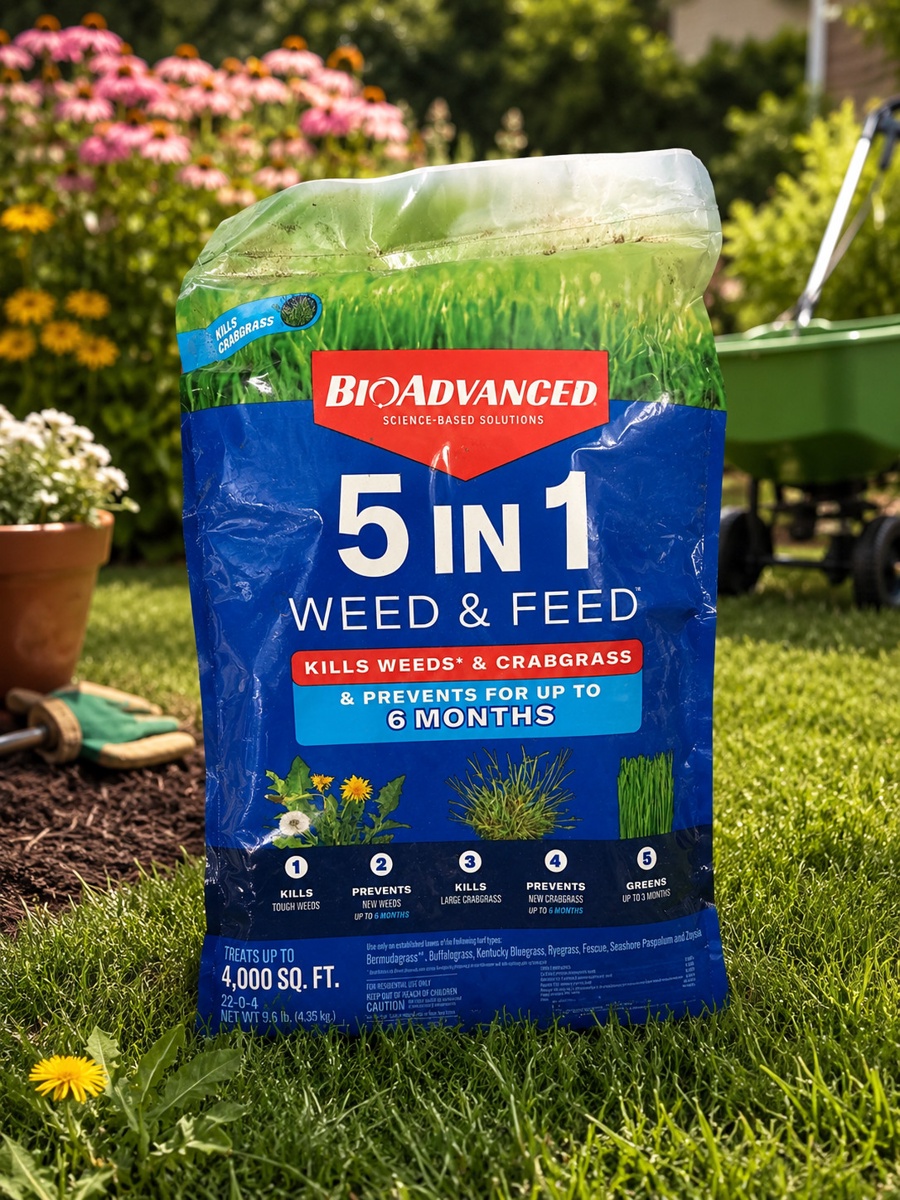

Photos from current listings. Actual item, color, and included accessories may vary.
Weed And Feed Buying Guide
Weed and feed products combine a selective post-emergent herbicide with a granular nitrogen fertilizer, and the critical trade-off is turfgrass safety: the herbicide must match your grass type (cool-season vs. warm-season) while the nitrogen release rate must match your climate and season. The decision rule is simple—buy a formulation whose label explicitly lists your grass species and whose nitrogen is at least 30% slow-release; anything else risks yellowing, burning, or ineffective weed kill.
Key takeaways
- Granular weed and feed uses 2,4-D plus dicamba or MCPP as the standard broadleaf trio; these kill dandelion and clover but injure St. Augustine, centipede, and carpetgrass at summer temperatures.
- Atrazine is the only selective broadleaf herbicide safe on St. Augustine and centipede, but it is restricted in many states and must be applied when temperatures stay below 85°F.
- Nitrogen analysis typically ranges 20-0-0 to 30-0-0 with 30-60% polymer-coated slow-release nitrogen; urea-heavy formulas green fast but burn roots in heat.
At a glance
- Category
- Lawn Care
- Last updated
- Nov 28, 2026
Current offers
Highlights
- Granular weed and feed uses 2,4-D plus dicamba or MCPP as the standard broadleaf trio; these kill dandelion and clover but injure St. Augustine, centipede, and carpetgrass at summer temperatures.
- Atrazine is the only selective broadleaf herbicide safe on St. Augustine and centipede, but it is restricted in many states and must be applied when temperatures stay below 85°F.
- Nitrogen analysis typically ranges 20-0-0 to 30-0-0 with 30-60% polymer-coated slow-release nitrogen; urea-heavy formulas green fast but burn roots in heat.
- Granule size and density determine spreader calibration: premium products use uniform prills that drop within 5% of the label rate, while dusty blends segregate and overdose strips.
Best use cases
- Best for cool-season lawns (tall fescue, Kentucky bluegrass, perennial ryegrass): apply a 2,4-D/quinclorac blend in early fall when soil is moist and weeds are actively growing; skip spring applications that push top growth before roots establish.
- Best for St. Augustine and centipede lawns: choose an atrazine-based weed and feed applied in late spring after full green-up, never in summer heat; skip any 2,4-D product entirely.
- Wrong fit for bahiagrass and Bermuda in peak summer: high-nitrogen weed and feed burns these grasses above 90°F; instead use a stand-alone quinclorac spot spray and separate slow-release fertilizer.
- Wrong fit for newly seeded or sodded lawns: weed and feed herbicides kill seedling roots; wait until the lawn has been mowed at least four times before applying any combination product.
Buying tips
- Match the herbicide to your grass: 2,4-D blends for cool-season grasses; atrazine for St. Augustine and centipede; quinclorac for crabgrass in most turf except fine fescue.
- Demand at least 30% slow-release nitrogen (look for polymer-coated or sulfur-coated urea on the label) to avoid the flush-and-burn cycle of straight urea.
- Calculate coverage by spreader calibration: a 30-lb bag labeled for 5,000 sq ft delivers 6 lb per 1,000 sq ft; set your rotary spreader to the label's dial setting and overlap passes by 30%.
- Apply only when grass is dry and temperatures are 60-85°F with no rain forecast for 24 hours; watering in immediately activates the herbicide and reduces leaf burn.
Specs
| Herbicide Active | 2,4-D / Atrazine / Quinclorac |
|---|---|
| Nitrogen Analysis | 20-0-0 to 30-0-0 |
| Slow-Release N | 30-60% polymer-coated |
| Grass Compatibility | Cool-season vs. warm-season |
Related searches
What to check before buying
- Measure your lawn's square footage (length × width for rectangles, or split into geometric zones) so you buy the correct bag size and avoid over-application.
- Identify your grass species from a local extension guide or sod invoice; the herbicide label must list it as tolerant before purchase.
- Confirm your spreader type (rotary broadcast vs. drop) and cross-reference the product's label dial settings for your model.
- Check state and local restrictions on atrazine and 2,4-D; some municipalities ban these active ingredients for home lawn use.
FAQ
Data sources: eBay / Amazon listings and product attribute feeds. Updated Nov 28, 2026.
Some links on this page are affiliate links. If you buy after clicking one, we may earn a commission at no extra cost to you. This does not change which products appear here or their order. Affiliate disclosure.