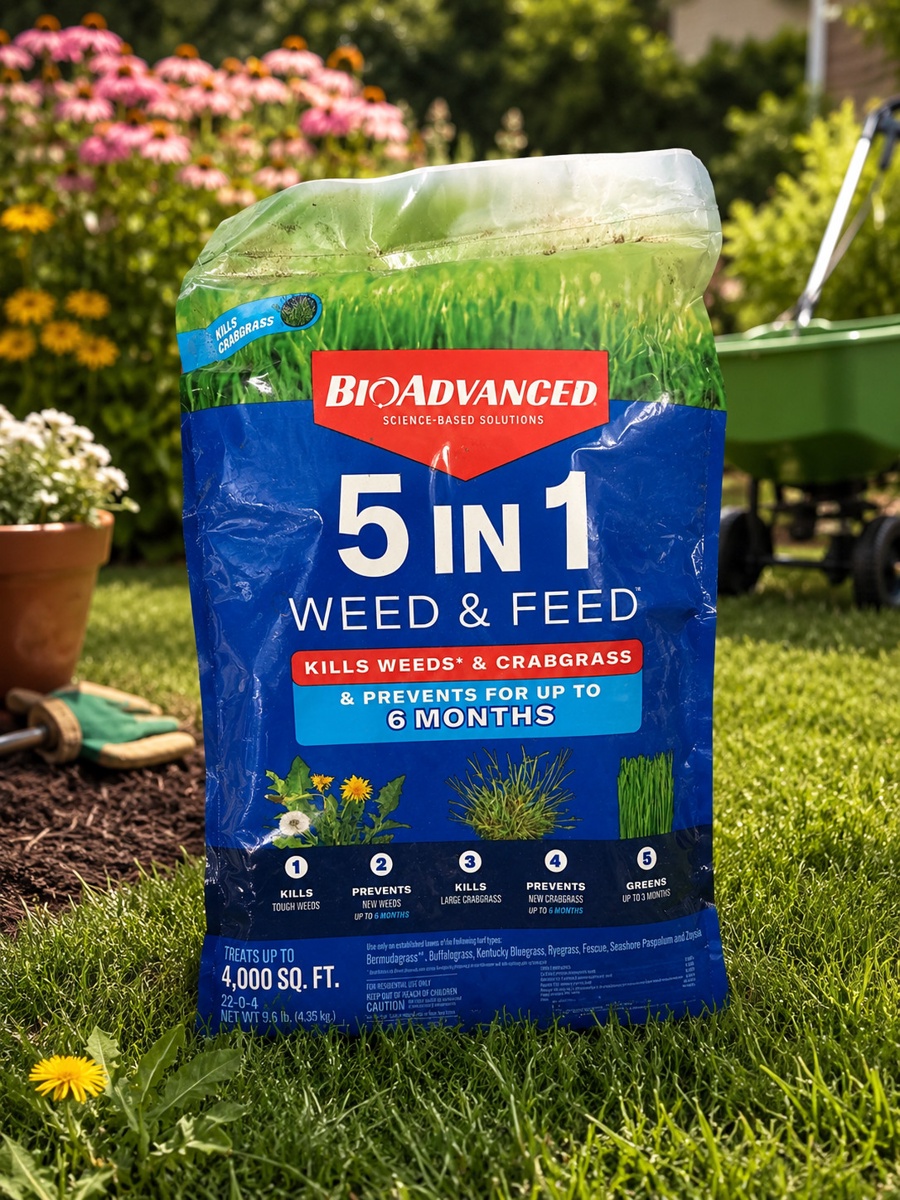

Photos from current listings. Actual item, color, and included accessories may vary.
Weed And Crabgrass Killer Buying Guide
Weed and crabgrass killers for lawns split into two chemical strategies: selective post-emergent herbicides that kill existing weeds without harming grass, and pre-emergent barriers that stop crabgrass before it sprouts. The critical trade-off is speed versus prevention—post-emergents act in days but miss seeds, while pre-emergents last weeks but require precise timing. Choose a post-emergent with the right active ingredient for your weed type (2,4-D for broadleaf, quinclorac for crabgrass) or a pre-emergent (prodiamine, dithiopyr) applied before soil hits 55°F.
Key takeaways
- Granular 'weed & feed' products combine fertilizer with 2,4-D or dicamba—effective on broadleaf weeds but weak on mature crabgrass; standalone quinclorac or fenoxaprop is required for crabgrass post-emergence.
- Pre-emergent herbicides (prodiamine, pendimethalin) form a soil barrier that kills germinating seeds for 8–16 weeks; they must be applied 2–4 weeks before crabgrass germination and watered in to activate.
- Application rate is calibrated per 1,000 sq ft—a 5,000 sq ft bag at 3.2 lb/1,000 sq ft delivers 16 lb of granules; under-application leaves gaps in the barrier, over-application risks turf injury.
At a glance
- Category
- Lawn Care
- Last updated
- Nov 28, 2026
Current offers
Highlights
- Granular 'weed & feed' products combine fertilizer with 2,4-D or dicamba—effective on broadleaf weeds but weak on mature crabgrass; standalone quinclorac or fenoxaprop is required for crabgrass post-emergence.
- Pre-emergent herbicides (prodiamine, pendimethalin) form a soil barrier that kills germinating seeds for 8–16 weeks; they must be applied 2–4 weeks before crabgrass germination and watered in to activate.
- Application rate is calibrated per 1,000 sq ft—a 5,000 sq ft bag at 3.2 lb/1,000 sq ft delivers 16 lb of granules; under-application leaves gaps in the barrier, over-application risks turf injury.
- Liquid concentrates (2,4-D amine, quinclorac 75 DF) allow spot treatment at 1–2 oz per gallon over 1,000 sq ft; granular broadcast covers larger areas faster but needs uniform spreader calibration.
Best use cases
- Best fit: established lawn with visible crabgrass clumps in summer—choose a post-emergent containing quinclorac or fenoxaprop plus a surfactant; skip weed & feed, which won't kill mature crabgrass.
- Best fit: spring preventive program in a lawn with a history of crabgrass—apply a pre-emergent like prodiamine at 0.38–0.75 lb active per acre before soil reaches 55°F; skip if you plan to overseed within 8 weeks.
- Best fit: mixed broadleaf weeds (dandelion, clover) in cool-season grass—use a 2,4-D + dicamba + mecoprop granular weed & feed at labeled rate; skip on St. Augustine or centipede, which are sensitive to 2,4-D.
- Wrong fit: newly seeded lawn under 4 mowings—any pre-emergent will kill new grass seed; use post-emergent spot treatment only after seedlings mature.
Buying tips
- Match active ingredient to weed: quinclorac 75 DF at 0.5–0.75 lb/acre for crabgrass post-emergence; prodiamine 65 WDG at 0.4–0.8 lb/acre for pre-emergence; 2,4-D at 1–2 lb acid equivalent/acre for broadleaf.
- Calculate coverage from bag rate: a 5,000 sq ft bag at 3.2 lb/1,000 sq ft weighs 16 lb—if the bag is lighter, the rate is lower and you'll need two passes for full barrier.
- Check grass tolerance: 2,4-D injures St. Augustine and centipede; use atrazine or simazine alternatives in warm-season southern grasses; quinclorac is safe on most cool-season and bermudagrass.
- Pre-emergent timing: apply when soil temperature at 2-inch depth reaches 55°F for three consecutive days—typically when forsythia blooms; split applications 8 weeks apart extend control to 16 weeks.
Specs
| Herbicide Type | Pre-emergent vs post-emergent selective |
|---|---|
| Active Ingredient | 2,4-D / quinclorac / prodiamine / pendimethalin |
| Coverage Rate | 1,000–5,000 sq ft per bag |
| Application Form | Granular broadcast vs liquid concentrate |
Related searches
What to check before buying
- Measure lawn square footage (length × width for rectangles, or break into sections) to buy the correct bag size—granular products are dosed per 1,000 sq ft.
- Identify grass type and weed species before selecting active ingredient—quinclorac for crabgrass, 2,4-D for broadleaf, prodiamine for prevention.
- Confirm soil temperature (55°F for pre-emergent) and whether you will overseed within 8 weeks—pre-emergents block seed germination.
- Check spreader calibration: drop spreaders need a setting from the bag (e.g., 3.2 lb/1,000 sq ft); rotary spreaders apply half-rate per pass and require two perpendicular passes.
FAQ
Data sources: eBay / Amazon listings and product attribute feeds. Updated Nov 28, 2026.
Some links on this page are affiliate links. If you buy after clicking one, we may earn a commission at no extra cost to you. This does not change which products appear here or their order. Affiliate disclosure.