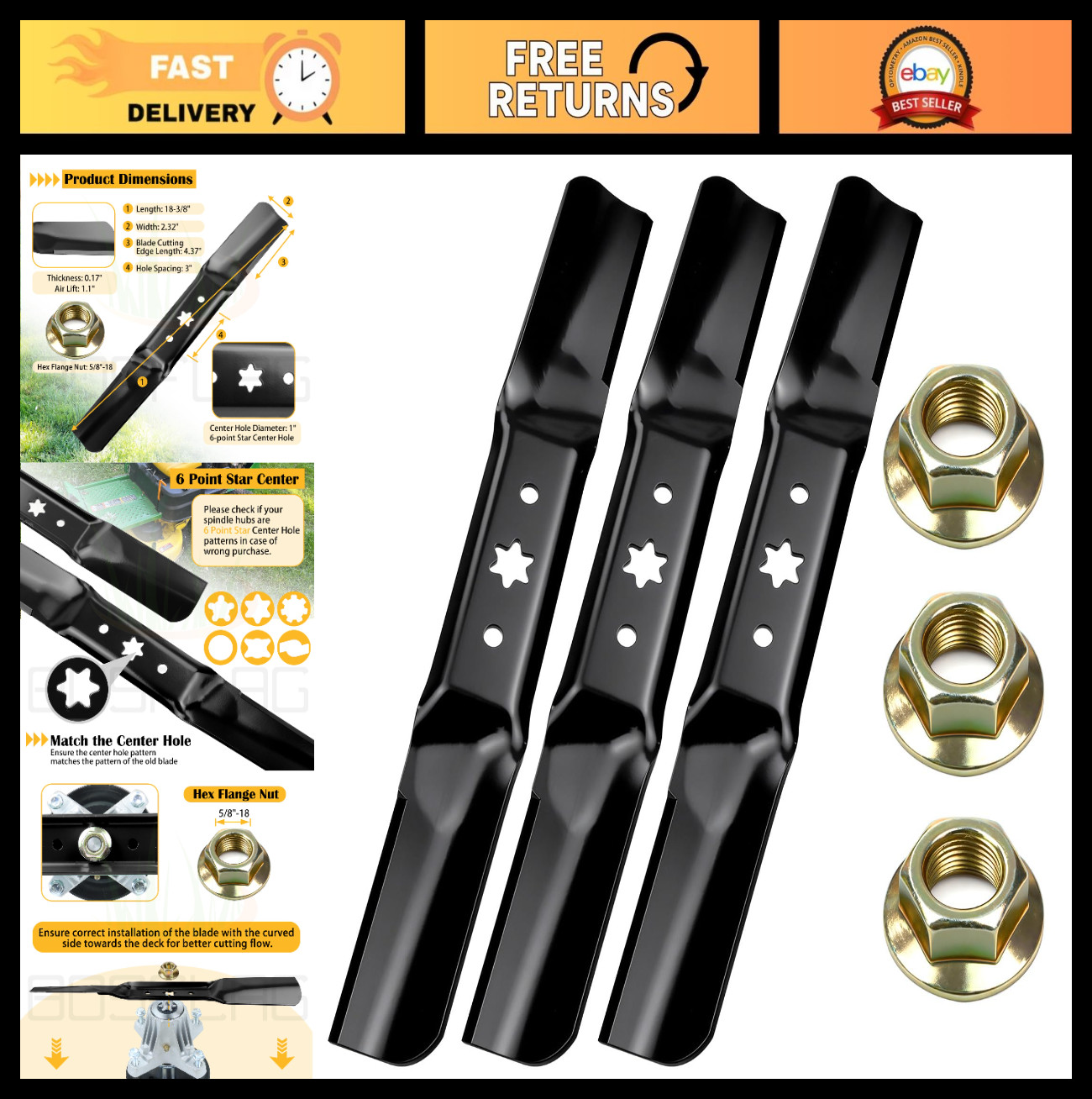

Photos from current listings. Actual item, color, and included accessories may vary.
Replacement Mower Blade Buying Guide
Replacement mower blades are the wear item that directly determines cut quality, engine load, and deck life. The core trade-off is between generic stamped-steel blades and heat-treated, balanced, OEM-spec or premium aftermarket blades that hold an edge without warping. The decision rule: match blade length, center-hole diameter, and offset or star pattern exactly to your deck spindle, then choose a hardened, balanced blade rated for your mower type rather than the cheapest stamping that fits.
Key takeaways
- Blade steel grade separates durable edges from fast-dulling ones: heat-treated boron or high-carbon steel holds an edge far longer than basic stamped mild steel.
- Center mounting is model-specific: round 5/8 in, 3/4 in, or 1 in holes, star or spline patterns, and offset (saddle) vs straight center holes are not interchangeable.
- Blade length must match deck cutting width minus overlap; a 21 in deck typically uses a 20-21 in blade, while 42 in decks use two 21 in blades or one 42 in bar.
At a glance
- Category
- Lawn Care
- Last updated
- Nov 28, 2026
Current offers
Highlights
- Blade steel grade separates durable edges from fast-dulling ones: heat-treated boron or high-carbon steel holds an edge far longer than basic stamped mild steel.
- Center mounting is model-specific: round 5/8 in, 3/4 in, or 1 in holes, star or spline patterns, and offset (saddle) vs straight center holes are not interchangeable.
- Blade length must match deck cutting width minus overlap; a 21 in deck typically uses a 20-21 in blade, while 42 in decks use two 21 in blades or one 42 in bar.
- Balance and straightness matter more than coating: an out-of-balance blade causes spindle vibration; mulching and high-lift profiles change airflow and discharge, not fit.
Best use cases
- Best fit: replace like-for-like when the old blade matches deck width, center hole, and offset — pick a hardened OEM-spec or premium aftermarket blade in the same profile (standard, mulching, or high-lift).
- Best fit: sandy or rocky lawns — choose a hardened, thicker-gauge blade and inspect frequently; standard stamped blades dull or bend faster in abrasive soil.
- Wrong fit: buying a longer blade to 'cover more' or a universal star blade for a round-hole spindle — it will not seat, will vibrate, and can strike the deck.
- Wrong fit: using a mulching blade on a side-discharge deck without the matching baffle or plug — airflow and discharge pattern will be wrong even if the blade bolts on.
Buying tips
- Measure the old blade tip-to-tip and center hole with calipers; match length within 1/8 in and hole diameter exactly, and confirm offset or star pattern to the spindle.
- Choose blade steel by duty: heat-treated/hardened steel for weekly mowing and abrasive soil; basic stamped steel only for light, clean lawns.
- For multi-blade decks, replace all blades on the deck at once and torque spindle bolts to the mower manufacturer's spec — mismatched worn/new blades cause uneven cut.
- Match blade profile to discharge: standard for side discharge, mulching for bagging/mulching decks, high-lift for bagging; gator or 3-in-1 styles trade suction against power draw.
Specs
| Blade Steel | Heat-treated/hardened vs stamped |
|---|---|
| Center Hole | 5/8, 3/4, or 1 in; round/star/spline |
| Blade Length | Deck width minus overlap (20-21 in common) |
| Blade Profile | Standard / mulching / high-lift |
Related searches
What to check before buying
- Deck cutting width and blade count: confirm whether your deck takes one bar blade or two/three separate blades before ordering.
- Center-hole geometry: measure hole diameter (5/8, 3/4, 1 in), and note round vs star/spline plus offset (saddle) vs straight.
- Spindle and bolt condition: check spindle bearings for play and replace worn blade bolts/washers — a new blade on a bad spindle still vibrates.
- Mower type and terrain: walk-behind, riding, or zero-turn decks have different blade thickness and length ranges; rocky or sandy ground calls for hardened steel.
FAQ
Data sources: eBay / Amazon listings and product attribute feeds. Updated Nov 28, 2026.
Some links on this page are affiliate links. If you buy after clicking one, we may earn a commission at no extra cost to you. This does not change which products appear here or their order. Affiliate disclosure.