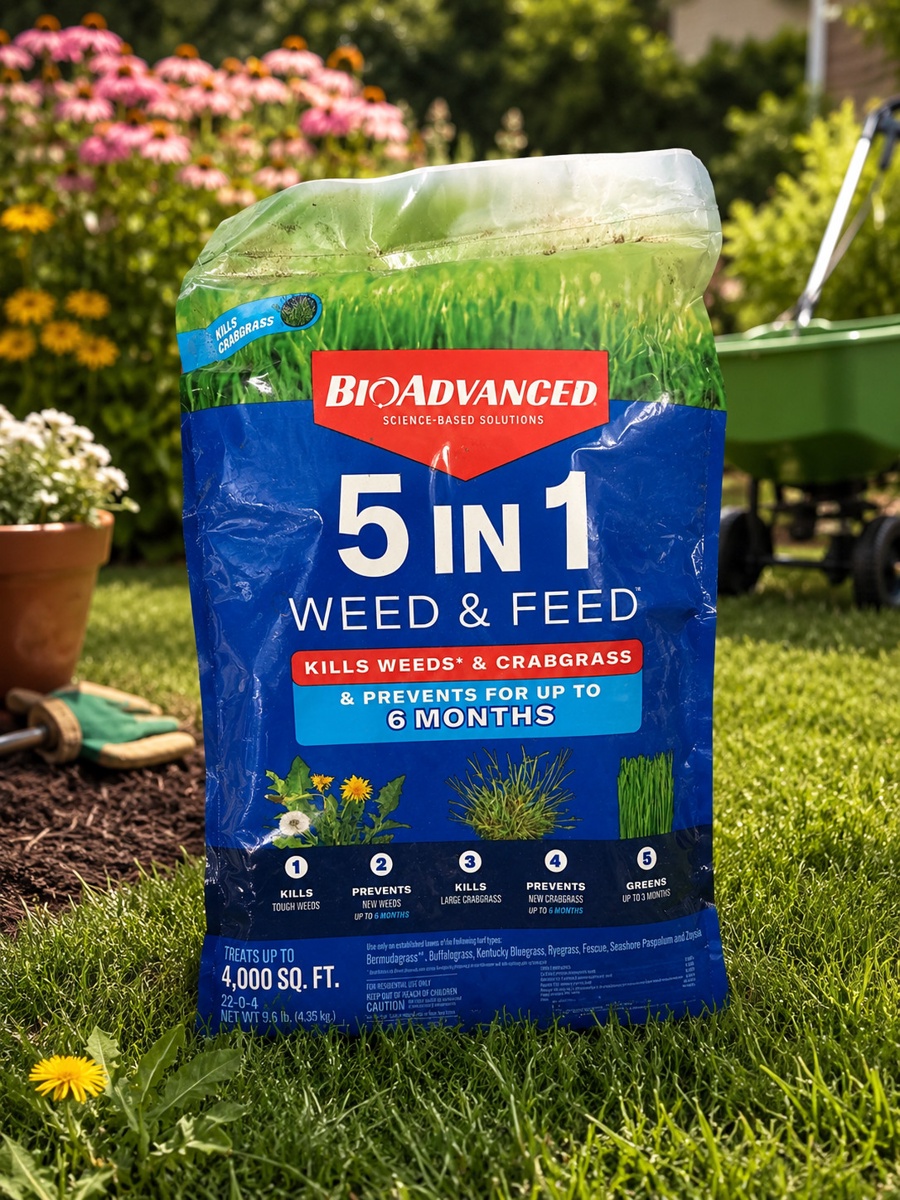

Photos from current listings. Actual item, color, and included accessories may vary.
Lawn Weed And Feed Buying Guide
Lawn weed and feed is a single-application granular or liquid product combining a broadleaf herbicide with nitrogen-heavy fertilizer, letting you fertilize and kill weeds in one pass. The core trade-off is selectivity and timing: effective formulas use 2,4-D or dicamba for broadleaf control while requiring precise soil-moisture and temperature windows to avoid turf injury. The decision rule is simple—choose a granular weed and feed with a stated coverage rate and active ingredient list if you can water it in immediately; choose separate weed killer and fertilizer if your lawn is newly seeded, stressed, or you need spot control.
Key takeaways
- Granular weed and feed typically pairs 2,4-D, MCPP, or dicamba with slow-release nitrogen (often 20-0-0 to 28-0-4 ratios), while liquid concentrates act faster but are easier to mis-dose.
- Coverage ratings scale directly with spreader calibration: a 4,000–5,000 sq ft bag requires a drop or broadcast spreader set to the label's pound-per-1,000-sq-ft rate, not a hand toss.
- Weed and feed works only when applied to wet grass so granules cling to weed leaves; applying to dry turf sends herbicide to soil and reduces broadleaf kill.
At a glance
- Category
- Lawn Care
- Last updated
- Nov 28, 2026
Current offers
Highlights
- Granular weed and feed typically pairs 2,4-D, MCPP, or dicamba with slow-release nitrogen (often 20-0-0 to 28-0-4 ratios), while liquid concentrates act faster but are easier to mis-dose.
- Coverage ratings scale directly with spreader calibration: a 4,000–5,000 sq ft bag requires a drop or broadcast spreader set to the label's pound-per-1,000-sq-ft rate, not a hand toss.
- Weed and feed works only when applied to wet grass so granules cling to weed leaves; applying to dry turf sends herbicide to soil and reduces broadleaf kill.
- Products labeled '5-in-1' or 'crabgrass control' add pre-emergent or post-emergent grass-weed chemistry, meaning they must be timed to crabgrass germination (soil temps 55–60°F) rather than general feeding.
Best use cases
- Best fit: established cool-season or warm-season lawns with visible broadleaf weeds (dandelion, clover, plantain) and no seeding within 4 weeks—use a granular 2,4-D weed and feed at the label's 1 lb per 1,000 sq ft rate.
- Wrong fit: newly seeded or overseeded lawns—herbicide in weed and feed kills tender grass seedlings, so use a starter fertilizer (no herbicide) until the new turf has been mowed 3–4 times.
- Best fit: crabgrass-prone lawns in spring—pick a product with pre-emergent plus fertilizer and apply when soil temperature hits 55°F, not after crabgrass is already visible.
- Wrong fit: St. Augustine or centipede lawns in summer heat—many 2,4-D formulas injure these grasses above 85°F; use a formula labeled safe for southern turf or spot-treat instead.
Buying tips
- Match the bag's coverage number to your actual lawn square footage (length × width minus house and beds); a 4,000 sq ft bag at the label rate covers exactly that, so buying two small bags beats over-applying one.
- Check the nitrogen analysis: a 20-0-0 or 22-0-4 slow-release blend feeds for 6–8 weeks, while high-soluble nitrogen (urea-heavy) greens fast but leaches and burns in heat.
- Confirm the active ingredient list includes 2,4-D or dicamba for broadleaf weeds and quinclorac or prodiamine if you need crabgrass control—'weed and feed' without a listed herbicide is just fertilizer.
- Calibrate your spreader with the label's setting before the first pass; applying at half rate twice in crossing directions prevents streaks and overdose that yellow the lawn.
Specs
| Herbicide Actives | 2,4-D / dicamba / MCPP vs quinclorac |
|---|---|
| Nitrogen Analysis | 20-0-0 to 28-0-4 slow-release |
| Coverage Per Bag | 4,000-5,000 sq ft at 1 lb/1,000 |
| Application Form | Granular spreader vs liquid concentrate |
Related searches
What to check before buying
- Measure lawn square footage accurately so the bag's stated coverage (e.g., 4,000–5,000 sq ft) matches your turf without leftovers or shortfalls.
- Verify your spreader type (drop or broadcast) and its calibration settings against the product label—handheld or wrong-setting spreaders cause striping and burn.
- Check soil temperature and 48-hour forecast: apply when grass is wet, air is 60–80°F, and no rain over 0.5 inch is expected for 24–48 hours.
- Confirm your grass species tolerance—fine fescue, St. Augustine, and centipede have restricted herbicide windows; read the label's turf-type table before buying.
FAQ
Data sources: eBay / Amazon listings and product attribute feeds. Updated Nov 28, 2026.
Some links on this page are affiliate links. If you buy after clicking one, we may earn a commission at no extra cost to you. This does not change which products appear here or their order. Affiliate disclosure.