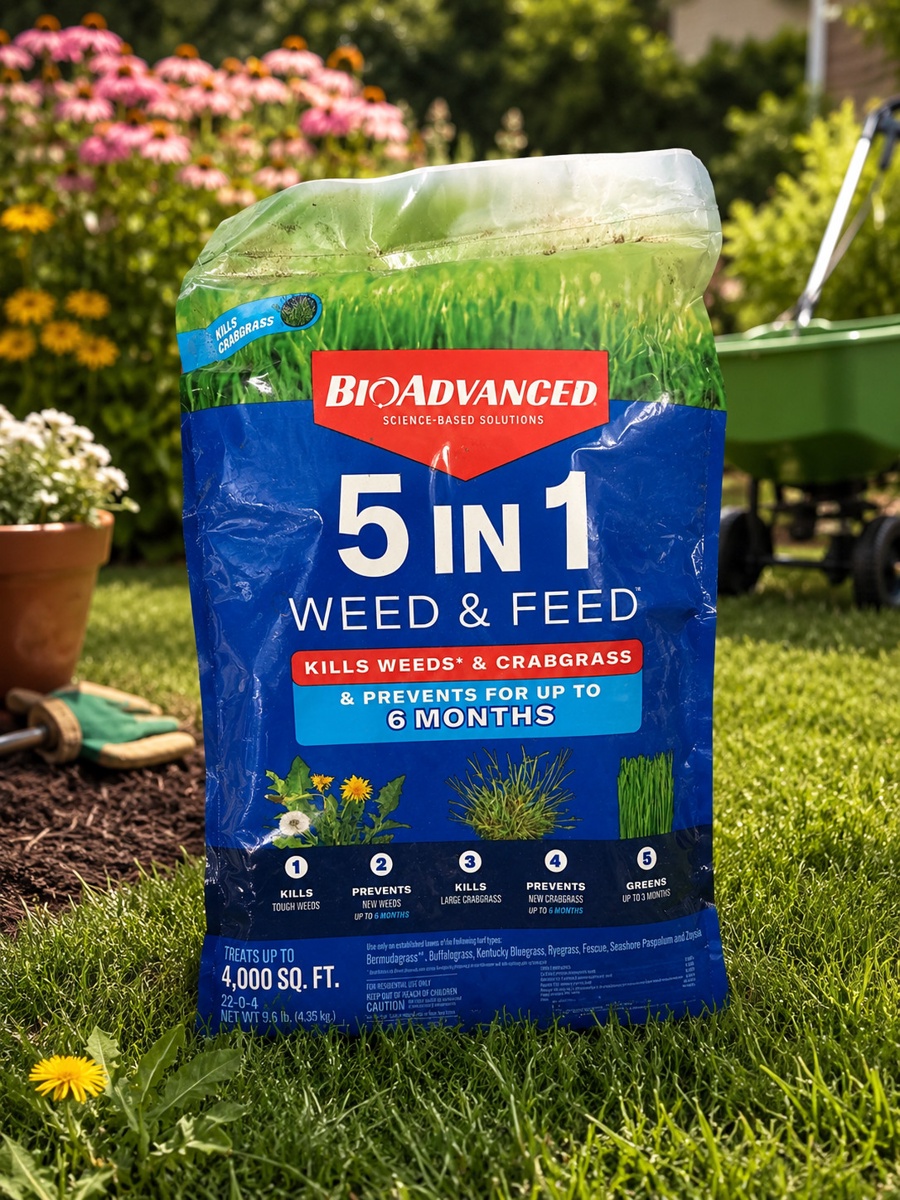

Photos from current listings. Actual item, color, and included accessories may vary.
Bioadvanced Weed Killer Buying Guide
BioAdvanced weed killers are selective post-emergent and weed-and-feed formulations built around 2,4-D, dicamba, and MCPP or quinclorac for broadleaf and crabgrass control in established turf. The core trade-off is between fast foliar burn-down (amine salts) and lower-volatility ester or acid formulations that reduce drift damage to ornamentals. Choose a concentrate matched to your grass type and sprayer calibration over ready-to-use triggers for large lawns; skip soil-acting products when reseeding within four weeks.
Key takeaways
- Weed-and-feed granules combine 2,4-D plus dicamba with slow-release nitrogen; apply only when foliage is dry and temperatures stay below 85°F to avoid turf burn.
- Concentrate formulas use amine salts (low volatility, rain-fast in 6-8 hours) versus ester formulations (stronger woody brush control but higher drift risk above 80°F).
- Quinclorac-based tiers target crabgrass and foxtail post-emergence, while standard 2,4-D blends only control broadleaf weeds and will not suppress grassy weeds.
At a glance
- Category
- Lawn Care
- Last updated
- Nov 28, 2026
Current offers
Highlights
- Weed-and-feed granules combine 2,4-D plus dicamba with slow-release nitrogen; apply only when foliage is dry and temperatures stay below 85°F to avoid turf burn.
- Concentrate formulas use amine salts (low volatility, rain-fast in 6-8 hours) versus ester formulations (stronger woody brush control but higher drift risk above 80°F).
- Quinclorac-based tiers target crabgrass and foxtail post-emergence, while standard 2,4-D blends only control broadleaf weeds and will not suppress grassy weeds.
- Hose-end ready-to-spray bottles cover roughly 5,000-15,000 sq ft depending on dilution; concentrate pints typically treat 10,000-20,000 sq ft for lower cost per application.
Best use cases
- Best fit: established Kentucky bluegrass or fescue lawn with dandelion and clover pressure — pick a 2,4-D plus dicamba concentrate mixed per label rate and spot-treat.
- Best fit: large lawn over 10,000 sq ft with both broadleaf and crabgrass — choose a quinclorac or 5-in-1 weed-and-feed granule tier rather than a ready-to-use trigger bottle.
- Wrong fit: newly seeded or overseeded lawn within four weeks — 2,4-D and quinclorac will injure immature grass; wait until three mowings before applying.
- Wrong fit: St. Augustine or centipede lawn — most 2,4-D and quinclorac blends cause stunting; select a product labeled explicitly for southern turf or use a different active.
Buying tips
- Match the active to the weed: quinclorac for crabgrass and foxtail, 2,4-D plus dicamba plus MCPP for broadleaf weeds like dandelion and plantain.
- Calibrate your sprayer: concentrate labels assume 1 gallon of water per 1,000 sq ft; over-diluting reduces efficacy and under-diluting burns turf.
- Granular weed-and-feed covers about 4,000-5,000 sq ft per bag at label rate — measure lawn square footage (length x width) before choosing bag count.
- Check grass-type tolerance: Kentucky bluegrass, tall fescue, and perennial ryegrass tolerate standard 2,4-D blends; centipede and St. Augustine require lower rates or different actives.
Specs
| Active Ingredient | 2,4-D + dicamba + MCPP / quinclorac |
|---|---|
| Formulation | Concentrate / RTS / Granules |
| Weed Spectrum | Broadleaf / Crabgrass / 5-in-1 |
| Coverage | 4,000-20,000 sq ft per container |
Related searches
What to check before buying
- Measure lawn length x width to get square footage and confirm the product treats at least that area at label rate.
- Confirm your grass species: cool-season grasses tolerate 2,4-D broadly; southern warm-season grasses need a labeled-for-turf formulation.
- Verify air temperature will stay between 60°F and 85°F for 48 hours — high heat increases volatility and turf injury.
- Check that you own a calibrated pump sprayer or hose-end sprayer; concentrates require dilution and cannot be applied with a watering can accurately.
FAQ
Data sources: eBay / Amazon listings and product attribute feeds. Updated Nov 28, 2026.
Some links on this page are affiliate links. If you buy after clicking one, we may earn a commission at no extra cost to you. This does not change which products appear here or their order. Affiliate disclosure.